Rational (Reciprocal) Functions and Power Functions
Your group hires a bus for a trip. It costs 120 euros and you split the price equally. If 4 of you go, each pays 30 euros. If 8 go, each pays only 15 euros. The more people, the less each one pays, but the price never drops to zero. This is inverse proportion y = 120/x, and its graph is a hyperbola.
The function y = k/x (k ≠ 0) is not defined for x = 0 — you cannot divide by zero. Its graph has two branches.
For x close to zero, k/x is a huge number: the graph "shoots off" up or down along the y-axis.
For large x, k/x is almost zero: the graph "snuggles up" to the x-axis.
Lines that the graph keeps getting closer to but never reaches are called asymptotes. For y = k/x they are the x-axis and the y-axis.
k > 0: the branches are in the first and third quadrants, and the function decreases on each branch.
k < 0: the branches are in the second and fourth quadrants, and the function increases on each branch.
A shifted hyperbola
The function
y = x−mk+n
has the same hyperbola as y = k/x, just shifted: m to the right and n up. The asymptotes are:
vertical x = m — where the denominator is zero,
horizontal y = n — the number that y gets close to for large x.
Worked example 1
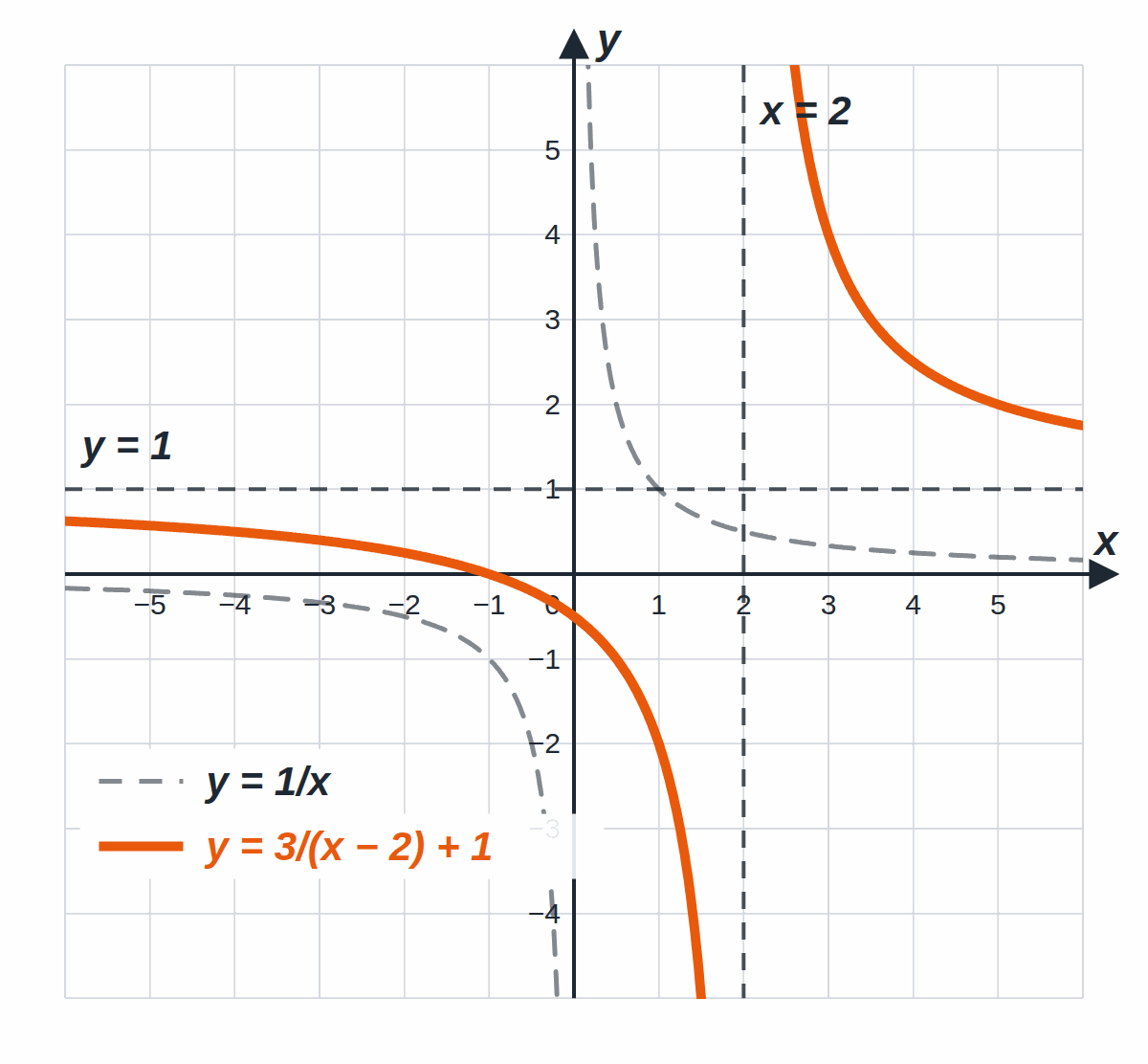
y = x−23+1.
The denominator x − 2 = 0 for x = 2. Vertical asymptote x = 2.
For large x the fraction 3/(x − 2) is almost zero, so y ≈ 1. Horizontal asymptote y = 1.
The domain is ℝ ∖ {2}, the range is ℝ ∖ {1}.
⚠️ Watch the sign: y = 5/(x + 3) − 2 has the asymptotes x = −3 and y = −2.
The general form of a rational function
The rational function we study here is a quotient of two linear expressions:
y = cx+dax+b, where c ≠ 0 and the numerator is not a multiple of the denominator.
We find the asymptotes by dividing the fraction — rewriting it in the form k/(x − m) + n.
Worked example 2
y = x−12x+1.
Write the numerator using the denominator: 2x + 1 = 2(x − 1) + 3.
y = x−12(x−1)+3=2+x−13.
Asymptotes: x = 1 and y = 2.
💡 Shortcut: the vertical asymptote is where the denominator is zero. The horizontal one is the quotient of the numbers in front of x: y = a/c. Here 2/1 = 2.
Power functions
A power function has the formula y = xⁿ. Its properties depend on whether the exponent n is even or odd and whether it is positive or negative.
Even positive exponent (x², x⁴, …): the graph looks like a parabola, the function is even, the domain is ℝ, the range is [0, ∞), it has a minimum of 0, and it increases on [0, ∞).
Even negative exponent (x⁻² = 1/x², x⁻⁴, …): the function is even, the domain is ℝ ∖ {0}, the range is (0, ∞), it decreases on (0, ∞), and it has no minimum.
Odd positive exponent (x³, x⁵, …): the function is odd and increasing on the whole of ℝ; the domain and the range are both ℝ.
Odd negative exponent (x⁻¹ = 1/x, x⁻³, …): a hyperbola, the function is odd, the domain and the range are both ℝ ∖ {0}, and it decreases on (0, ∞).
We read x⁻² as "x to the power of minus two", and it means 1/x².
💡 All graphs y = xⁿ pass through the point (1, 1). For positive n they also pass through (0, 0).
Common mistakes
Wrong sign of the asymptote. For 1/(x + 4) the vertical asymptote is x = −4.
Forgetting the horizontal asymptote. For y = k/(x − m) + n it is y = n, not the x-axis.
x⁻² = −x². No! x⁻² = 1/x², and it is always positive.
"The hyperbola is decreasing." For k > 0 it decreases on each branch separately, but it is not decreasing on its whole domain: −1 < 1, and yet 1/(−1) < 1/1.
Summary
y = k/(x − m) + n: a hyperbola with asymptotes x = m and y = n.
(ax + b)/(cx + d): divide, or use x = −d/c and y = a/c.
y = xⁿ: even n gives an even function, odd n gives an odd function.
Negative n: the graph never touches the axes, and the domain does not contain zero.
Try it yourself
Find the asymptotes of y = 4/(x + 1) − 3.
Find the asymptotes of y = (x + 5)/(x − 2).
Is the function y = x⁻³ even or odd? What is its domain?
Answers:
x = −1, y = −3.
x + 5 = (x − 2) + 7, so y = 1 + 7/(x − 2): x = 2, y = 1.
Odd (the exponent −3 is odd), and the domain is ℝ ∖ {0}.
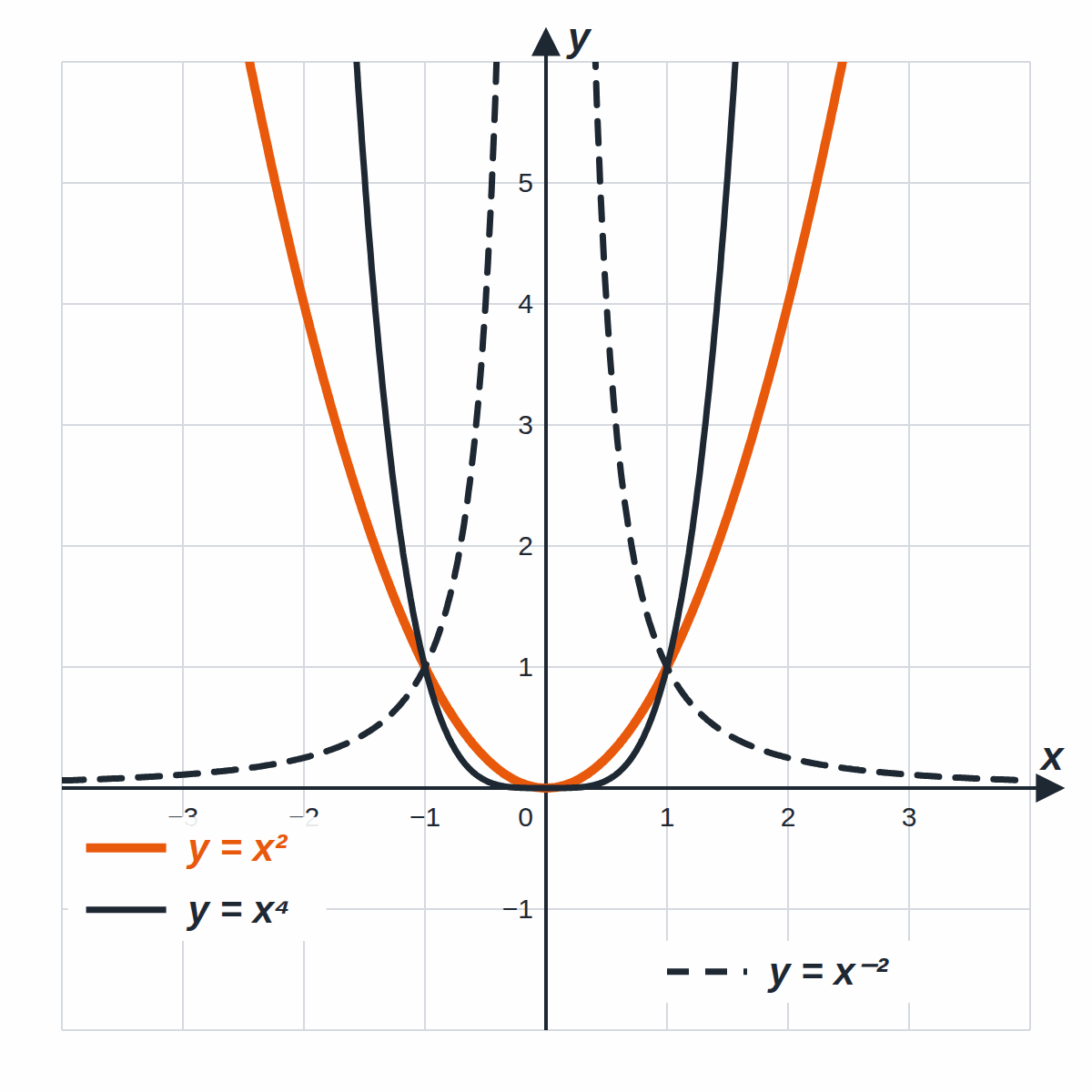 Even positive exponent (x², x⁴, …): the graph looks like a parabola, the function is even, the domain is ℝ, the range is [0, ∞), it has a minimum of 0, and it increases on [0, ∞).
Even negative exponent (x⁻² = 1/x², x⁻⁴, …): the function is even, the domain is ℝ ∖ {0}, the range is (0, ∞), it decreases on (0, ∞), and it has no minimum.
Even positive exponent (x², x⁴, …): the graph looks like a parabola, the function is even, the domain is ℝ, the range is [0, ∞), it has a minimum of 0, and it increases on [0, ∞).
Even negative exponent (x⁻² = 1/x², x⁻⁴, …): the function is even, the domain is ℝ ∖ {0}, the range is (0, ∞), it decreases on (0, ∞), and it has no minimum.
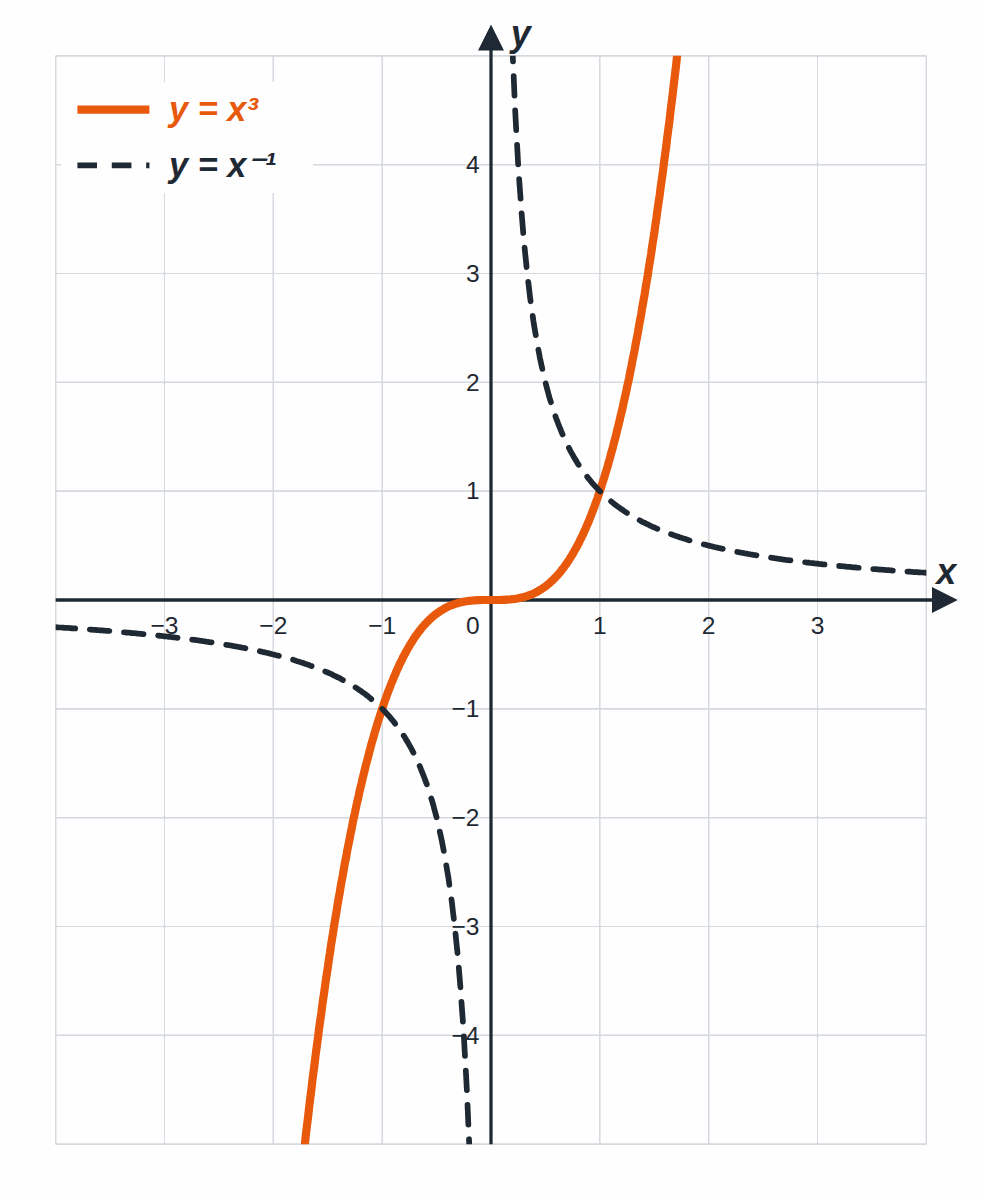 Odd positive exponent (x³, x⁵, …): the function is odd and increasing on the whole of ℝ; the domain and the range are both ℝ.
Odd negative exponent (x⁻¹ = 1/x, x⁻³, …): a hyperbola, the function is odd, the domain and the range are both ℝ ∖ {0}, and it decreases on (0, ∞).
Odd positive exponent (x³, x⁵, …): the function is odd and increasing on the whole of ℝ; the domain and the range are both ℝ.
Odd negative exponent (x⁻¹ = 1/x, x⁻³, …): a hyperbola, the function is odd, the domain and the range are both ℝ ∖ {0}, and it decreases on (0, ∞).