A friend throws a ball and you want to know when the ball was higher than 2 metres. You are not looking for one moment, but for a whole stretch of time. That is exactly what an inequality does: instead of one number it looks for all the numbers that satisfy a condition. For a quadratic inequality, a parabola helps us.
A quadratic inequality has the form ax² + bx + c > 0 (or <, ≥, ≤), where a ≠ 0.
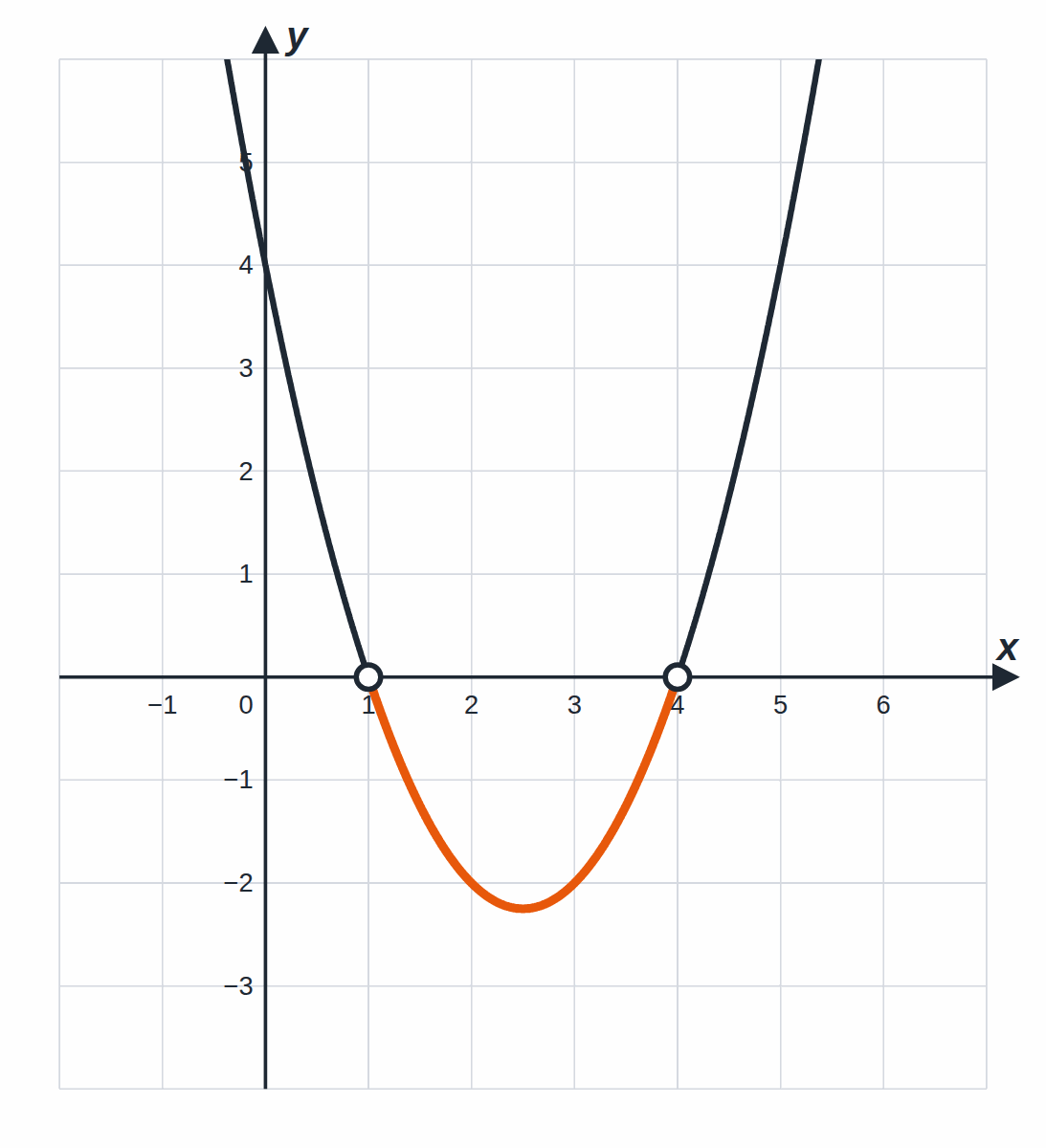
Let's solve (x − 1)(x − 4) < 0. We read it as: "for which x is the product negative?"
Roots. The expression is zero for x = 1 and x = 4. That is where the parabola crosses the x-axis.
Sketch. After expanding, the coefficient of x² is +1, so the parabola opens upward. Between the roots the parabola is below the x-axis, outside them it is above.
Choose. We want "< 0", that is the part below the x-axis. That is between the roots.
Solution: x ∈ (1, 4).
(1, 4) is an open interval — the numbers between 1 and 4, but without 1 and 4. Round brackets mean "the endpoint is not included", square brackets [ ] mean "the endpoint is included".
The roots are not included, because there the expression equals zero, and 0 < 0 is false.
Worked examples
Worked example 1
x² − x − 6 ≥ 0
Roots of the equation x² − x − 6 = 0: factorise to (x − 3)(x + 2) = 0, so x₁ = −2, x₂ = 3.
a = 1 > 0, so it opens upward: the parabola is above the x-axis to the left of −2 and to the right of 3.
We want "≥ 0" — above the axis or on it, so the roots are included.
Solution: x ∈ (−∞, −2] ∪ [3, ∞).
We read the symbol ∪ as "union" — the solutions are the numbers in one interval or in the other. Next to infinity (∞) the bracket is always round.
a = −1 < 0, so it opens downward: the parabola is above the x-axis between the roots.
We want "> 0", so above the axis, without the roots.
Solution: x ∈ (−2, 4).
💡 Another way: multiply the whole inequality by −1. The sign flips: x² − 2x − 8 < 0, and the answer is again (−2, 4).
When the parabola does not cross the x-axis
x² + 2x + 5 > 0
The discriminant is D = 4 − 20 = −16 < 0. The equation has no real roots, and the parabola does not cross the x-axis.
a = 1 > 0, so it opens upward. The whole parabola is above the x-axis — the expression is always positive.
We want "> 0": it holds for every x.
Solution: x ∈ ℝ (all real numbers).
If we were solving x² + 2x + 5 < 0, the solution would be the empty set ∅ — no such x exists.
A double root
x² − 6x + 9 > 0, that is (x − 3)² > 0.
A square is always ≥ 0. It is zero only for x = 3.
Solution: all numbers except 3, written x ∈ ℝ ∖ {3} ("all real numbers except three").
Other versions: (x − 3)² ≥ 0 has the solution ℝ, (x − 3)² < 0 has no solution (∅), and (x − 3)² ≤ 0 has the single solution x = 3, written {3}.
Overview
For a > 0 and two roots x₁ < x₂:
Inequality
Where the parabola is
Solution
ax² + bx + c > 0
above the x-axis, outside the roots
(−∞, x₁) ∪ (x₂, ∞)
ax² + bx + c ≥ 0
above the axis or on it
(−∞, x₁] ∪ [x₂, ∞)
ax² + bx + c < 0
below the x-axis, between the roots
(x₁, x₂)
ax² + bx + c ≤ 0
below the axis or on it
[x₁, x₂]
For a < 0 it is the other way round: the positive values are between the roots.
Common mistakes
Solving it like an equation. x² < 9 does not mean x < 3. The solution is x ∈ (−3, 3).
Forgetting to flip the sign when multiplying by a negative number.
Wrong brackets. With < and > the roots are not included (round bracket); with ≤ and ≥ they are (square bracket). Next to ∞ the bracket is always round.
"No roots = no solution." Not always! x² + 1 > 0 holds for every x.
Summary
Find the roots (factorising, the quadratic formula or vertex form).
Sketch the parabola: a > 0 opens upward, a < 0 opens downward.
"> 0" = above the x-axis, "< 0" = below the x-axis.
With ≤ and ≥ the roots belong to the solution.
Try it yourself
x² − 5x + 4 ≤ 0
x² − 9 > 0
−x² + 4x − 3 ≥ 0
x² + x + 1 < 0
Answers:
Roots 1 and 4, a > 0, between the roots including them: x ∈ [1, 4].
Roots −3 and 3, outside them: x ∈ (−∞, −3) ∪ (3, ∞).
Roots 1 and 3, a < 0, so the parabola is above the axis between the roots: x ∈ [1, 3].
D = 1 − 4 < 0, the whole parabola is above the axis: no solution, ∅.