You live near a bus stop and the bus is 300 metres away from you. It does not matter whether it is 300 metres to the left or to the right — the distance is the same. That is exactly what absolute value measures: how far a number is from zero, whatever the direction.
We read |x| as "the absolute value of x". |5| = 5, |−5| = 5, |0| = 0.
More precisely: |x| = x if x ≥ 0, and |x| = −x if x < 0. So absolute value "turns" a negative number into a positive one.
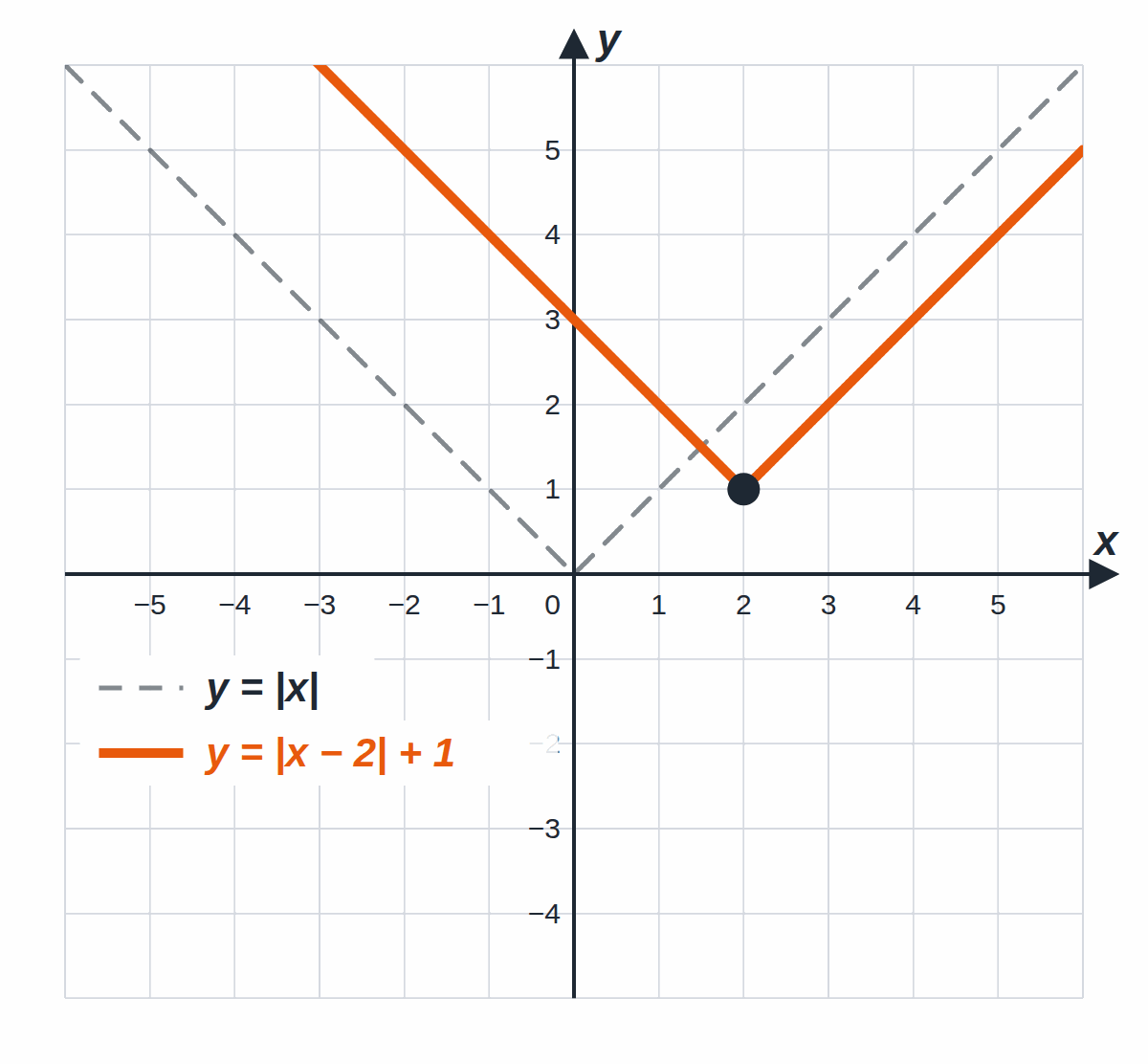
The points lie on two half-lines that meet at the point (0, 0). The graph looks like the letter V. The point (0, 0) is its vertex.
Properties: the function is even (the graph is symmetric about the y-axis), it decreases on (−∞, 0] and increases on [0, ∞), its minimum is 0, and it is not one-to-one.
A shifted graph
The graph of the function
y = |x − a| + b
is the same V, just shifted so that its vertex is at the point (a, b).
y = |x − 2| + 1: vertex (2, 1) — shifted 2 to the right and 1 up.
y = |x + 3|: vertex (−3, 0) — shifted 3 to the left.
y = |x| − 4: vertex (0, −4) — shifted 4 down.
⚠️ The same trap as with the parabola: a minus inside the absolute value shifts to the right, a plus shifts to the left.
Worked example 1
A V-shaped graph has vertex (−1, −2). What is its formula (if it is as "steep" as y = |x|)?
The vertex (a, b) = (−1, −2), so y = |x − (−1)| + (−2) = |x + 1| − 2.
Absolute value equations
The equation |x − 3| = 5 asks: "which numbers are 5 away from three?" On the number line there are two: 3 + 5 = 8 and 3 − 5 = −2.
Algebraically, we split the equation |expression| = c (for c > 0) into two equations:
expression = c or expression = −c.
Worked example 2
x + 4
x + 4 = 6 → x = 2.
x + 4 = −6 → x = −10.
Solution: x ∈ {−10, 2}.
Check: |2 + 4| = 6 ✓, |−10 + 4| = |−6| = 6 ✓.
Special cases
c = 0: |x − 5| = 0 has only one solution, x = 5. Only zero has absolute value zero.
c < 0: |x + 1| = −3 has no solution. Absolute value is never negative.
When x has a coefficient
Worked example 3
2x − 6
2x − 6 = 4 → 2x = 10 → x = 5.
2x − 6 = −4 → 2x = 2 → x = 1.
Solution: x ∈ {1, 5}.
💡 Notice: the solutions are symmetric around the number 3, where the expression 2x − 6 is zero.
Worked example 4
3x + 6
Common mistakes
Forgetting the second solution. |x| = 4 has the solutions 4 and −4.
"Absolute value just deletes the minus inside." |x − 3| is not x + 3! Absolute value applies to the whole expression.
Solving |expression| = a negative number. There is no solution, so there is nothing to calculate.
Wrong direction of the shift. |x − 2| has its vertex at x = 2, not −2.
Summary
|x| is the distance of x from zero; it is never negative.
The graph of y = |x − a| + b is a V with vertex (a, b).
|expression| = c, c > 0: expression = c or expression = −c (two solutions).
c = 0: one solution. c < 0: no solution.
Try it yourself
What is the vertex of the graph of y = |x + 2| − 3?