Quadratic Functions and Their Graphs: Vertex and Completing the Square
When you throw a ball up at an angle, it flies along a curve: first it rises, at the highest point it "stops" for a moment, and then it falls. That curve is a parabola — the graph of a quadratic function. A jet of water from a fountain and the cross-section of a satellite dish have the same shape.
A quadratic function has the formula
y = ax² + bx + c, where a ≠ 0.
The numbers a, b, c are coefficients. For example, y = 2x² − 4x + 1 has a = 2, b = −4, c = 1.
a > 0: the parabola opens upward, and the vertex is the lowest point.
a < 0: the parabola opens downward, and the vertex is the highest point.
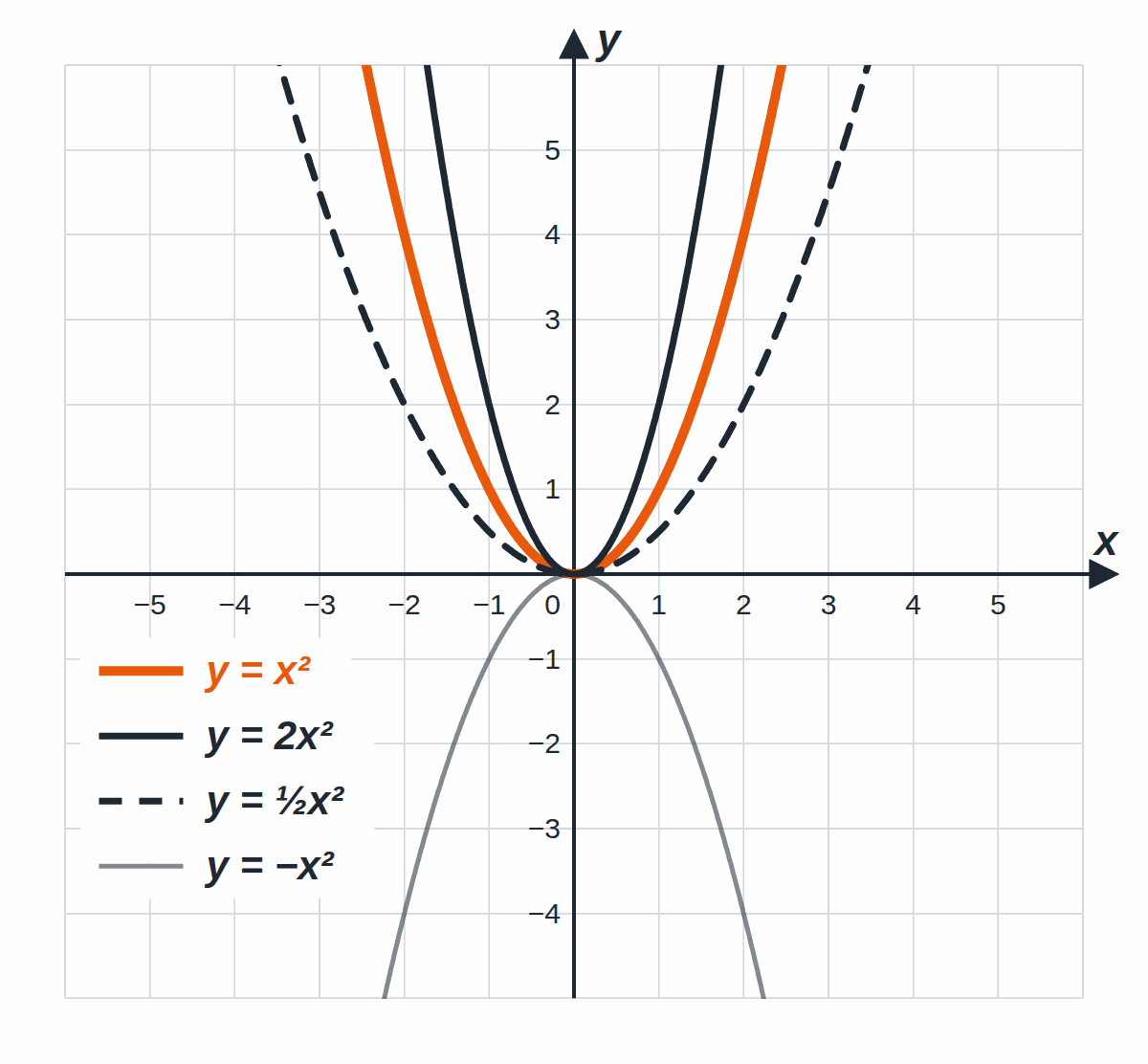
The bigger |a| is, the narrower the parabola. y = 2x² is narrower than y = x², and y = ½x² is wider.
💡 Tip: from the vertex, go 1 to the right. The graph goes up by exactly a (for y = 2x² by 2; for y = −x² it goes down by 1).
Vertex form
The most important point of a parabola is its vertex V. If the formula is in the form
y = a(x − m)² + n,
the vertex is V = (m, n). The whole parabola y = ax² is just shifted: m to the right and n up.
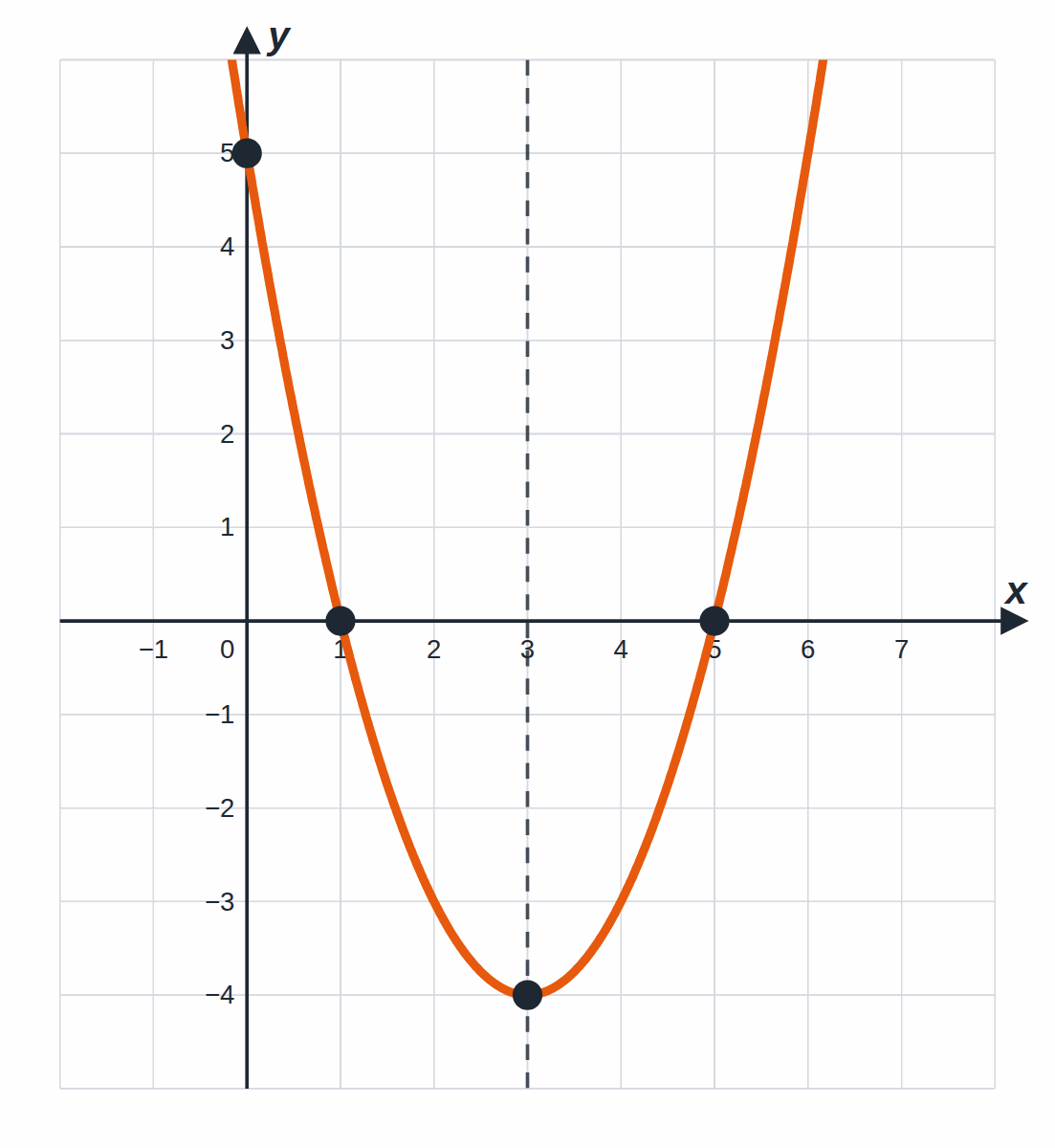
y = (x − 3)² − 4 has vertex V = (3, −4).
y = (x + 2)² + 1 = (x − (−2))² + 1 has vertex V = (−2, 1).
⚠️ Watch the sign: x − 3 shifts to the right, x + 2 shifts to the left.
The vertical line through the vertex, x = m, is the axis of symmetry of the parabola. The left and right halves are mirror images in it.
Completing the square
We usually get the formula in the form ax² + bx + c. We convert it to vertex form by completing the square. We use the identity (x + d)² = x² + 2dx + d².
Worked example 1
y = x² − 6x + 5. Find the vertex.
The coefficient of x is −6. Half of it is −3, so we use (x − 3)² = x² − 6x + 9.
The formula has +5, not +9. Rewrite: x² − 6x + 5 = (x² − 6x + 9) − 9 + 5.
y = (x − 3)² − 4.
The vertex is V = (3, −4), and the axis of the parabola is x = 3.
Worked example 2: when a is not 1
y = 2x² + 8x + 3.
Take the 2 outside a bracket from the first two terms: y = 2(x² + 4x) + 3.
Complete the square inside the bracket: x² + 4x = (x + 2)² − 4.
💡 Quick check: the x-coordinate of the vertex is always m=−2ab. For example 2: −8/4 = −2. ✓ You get the y-coordinate by substituting: 2 · 4 − 16 + 3 = −5. ✓
Intercepts with the axes
With the y-axis: substitute x = 0. You get y = c. The graph of y = x² − 6x + 5 crosses the y-axis at (0, 5).
With the x-axis: we look for the x-values where y = 0, so we solve the equation ax² + bx + c = 0. From vertex form this is quick:
Worked example 3
(x − 3)² − 4 = 0
(x − 3)² = 4.
x − 3 = 2 or x − 3 = −2.
x₁ = 5, x₂ = 1. The x-intercepts are (1, 0) and (5, 0).
The graph does not have to cross the x-axis. For example y = (x − 1)² + 3: the vertex (1, 3) is above the x-axis and the parabola opens upward, so it never reaches the x-axis. The equation (x − 1)² = −3 has no solution.
💡 The x-intercepts lie symmetrically around the axis of the parabola. In example 3: 1 and 5 are the same distance from 3.
How to match a formula to a graph
Vertex (m, n) → the formula has the form a(x − m)² + n.
Which way it opens → the sign of a.
One step right from the vertex → how far the graph goes up is a.
The y-intercept → the number c in the expanded form.
Worked example 4
A parabola has vertex (−1, 2), opens downward, and one step right from the vertex it goes down by 2. Formula: y = −2(x + 1)² + 2. After expanding, y = −2x² − 4x, so the y-intercept is (0, 0).
Common mistakes
Wrong sign of the vertex. y = (x + 4)² has its vertex at x = −4, not 4.
Forgetting a when completing the square. In example 2 the −4 must be multiplied by two: 2 · (−4) = −8.
Mixing up the y-intercept and the vertex. The y-intercept is (0, c), the vertex is (m, n).
"Every parabola crosses the x-axis." No — if the vertex is above the axis and the parabola opens upward (or below the axis and it opens downward), there are no x-intercepts.
Summary
y = ax² + bx + c, a ≠ 0, and the graph is a parabola.
a > 0 opens upward, a < 0 opens downward, a bigger |a| means a narrower parabola.
y = a(x − m)² + n has vertex V = (m, n) and axis x = m.