Word problems show you how the Pythagorean theorem is used in real life. The following examples are typical and often appear in tests and exams.
💡 Approach for every word problem:
1. Read the problem carefully.
2. Sketch a picture – a right triangle with the sides labeled.
3. Identify which side is the hypotenuse and which are the legs.
4. Plug into the formula and compute.
5. Don't forget to write the answer in words with units.
Table of contents
- A ladder leaning against a wall
- The diagonal of a rectangle
- The diagonal of a square
- Distance between two points
- Height of an isosceles triangle
- The shortest route
A ladder leaning against a wall
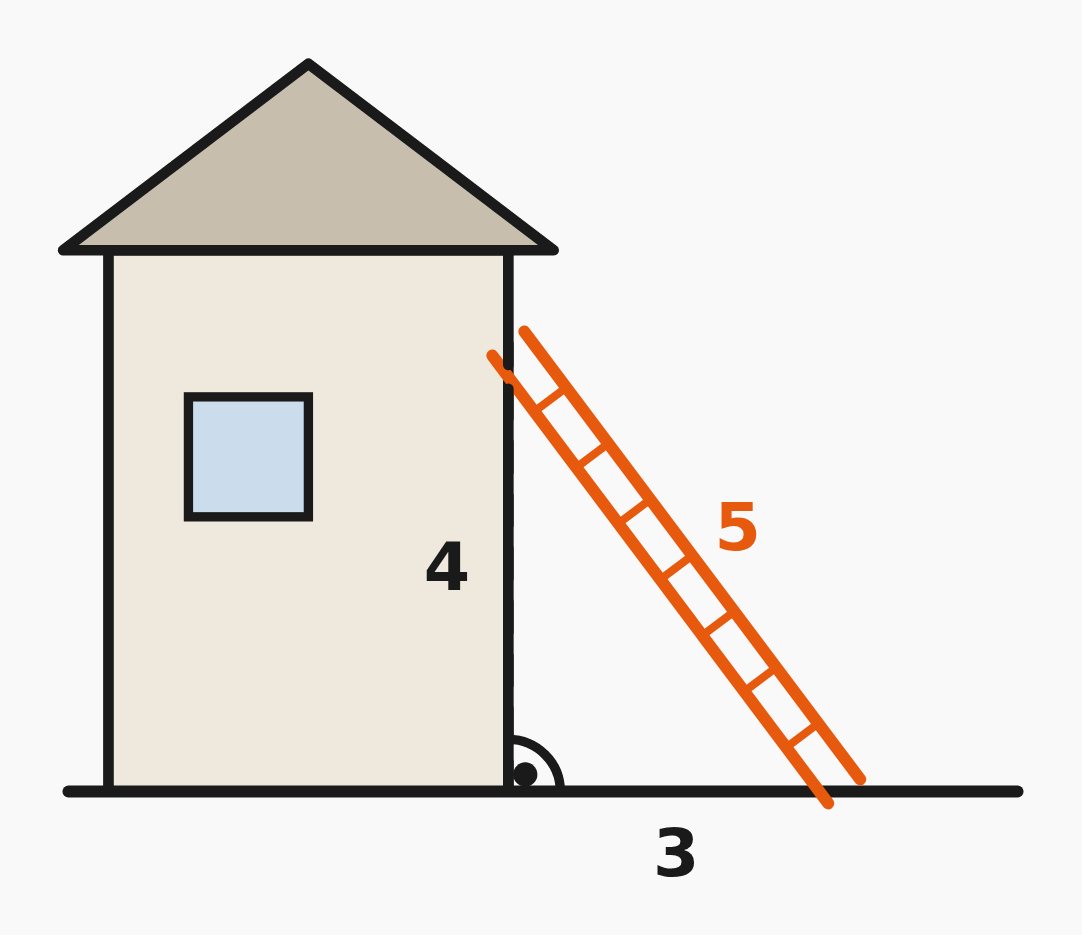
Problem: A ladder m long is leaning against a wall so that its foot is m from the wall. To what height does the ladder reach on the wall?The ladder forms the hypotenuse of a right triangle; the distance from the foot to the wall and the height on the wall form the legs.
The diagonal of a rectangle
Problem: A rectangle has dimensions cm and cm. Compute the length of its diagonal .The diagonal of a rectangle divides the rectangle into two right triangles. The sides of the rectangle are the legs, and the diagonal is the hypotenuse.
The diagonal of a square
Problem: A square has side cm. What is the length of its diagonal?In a square, both legs of the right triangle are equal:
💡 Formula for the diagonal of a square:
Distance between two points
Problem: City is km north and km east of city . What is the straight-line distance between the cities?Imagine a right triangle: one leg is km (north), the other is km (east), and the hypotenuse is the straight-line distance.
👉 More detailed explanation: Distance between two points in a plane
Height of an isosceles triangle
Problem: An isosceles triangle has base cm and legs cm. Compute its height .The height of an isosceles triangle bisects the base. This creates a right triangle where the leg of the isosceles triangle is the hypotenuse, half the base is one leg, and the height is the other leg.
The shortest route
Problem: A park has the shape of a rectangle with dimensions m and m. A path runs around the perimeter of the park, but you can also walk diagonally across the park. By how many meters is the diagonal path shorter than the path along two adjacent sides? Step 1: The diagonal of the park.Related articles
- The Pythagorean theorem – complete guide
- The Pythagorean theorem formula
- Pythagorean theorem examples
- Distance between two points
- The Pythagorean theorem in 3D