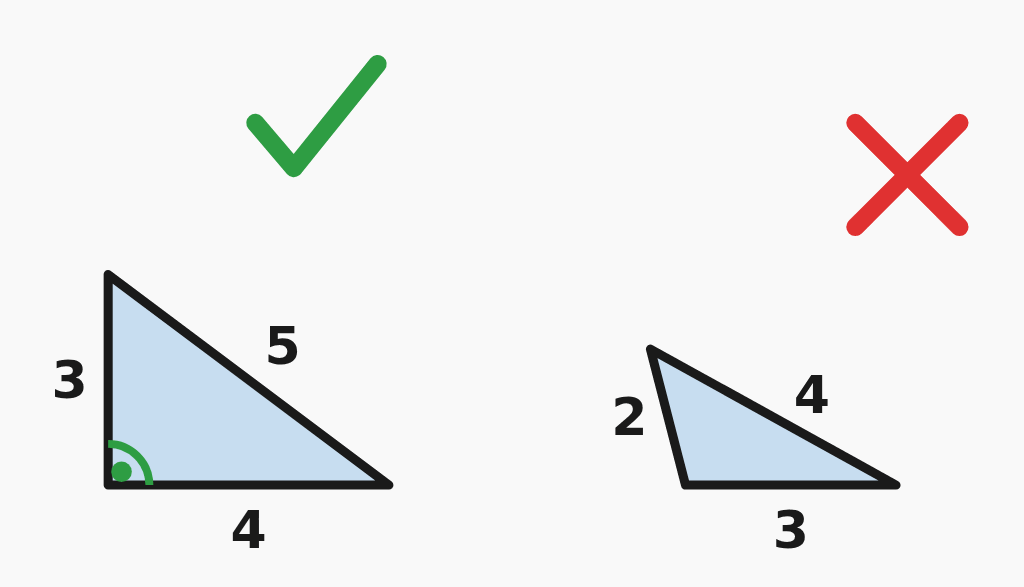
The Pythagorean theorem tells us how to compute the third side of a right triangle from the other two. The converse of the Pythagorean theorem goes the other direction: from three sides it helps us decide whether a triangle is a right triangle at all.
Table of contents
- Statement of the converse
- How to check
- Solved examples
- The most famous right triangle triples
- Common mistakes
Statement of the converse
Converse of the Pythagorean theorem: If in a triangle with sides , , (where is the longest side) the equation
%%MATH_BLOCK_0%%
holds, then the triangle is a right triangle and the right angle lies opposite side .
The important thing is that both implications hold:
- If the triangle is right → the relation holds.
- If the relation holds → the triangle is right.
How to check
- Find the longest side. Label it – if the triangle is right, this will be the hypotenuse.
- Compute from the other two sides.
- Compute from the longest side.
- Compare the results:
- If , the triangle is a right triangle.
- If , the triangle is not a right triangle.
Solved examples
Example 1: , , .The longest side is .
The triangle is a right triangle.
Example 2: , , .
The longest side is .
The triangle is not a right triangle.
Example 3: , , .
The most famous right triangle triples
Some triples of integers show up often in problems – it's worth learning them by heart:
- – a multiple of
👉 More information: Pythagorean triples
Common mistakes
⚠️ Don't forget to check which side is the longest. If you accidentally plug a different side in for , the result won't be correct.
⚠️ You compare the squares, not the sides. It often happens that a student just adds the sides instead of their squares.
⚠️ Watch out for rounding accuracy. If the sides aren't whole numbers, even a small measurement error can make the equality not exactly hold. In that case it's enough if the difference is negligible.
Related articles
- The Pythagorean theorem – complete guide
- The Pythagorean theorem formula
- Pythagorean theorem examples
- Pythagorean triples