A Pythagorean triple is a triple of natural numbers for which
In other words, they are the side lengths of a right triangle that are all whole numbers. Pythagorean triples are popular in textbooks because they give "nice" results without decimals.
Table of contents
- The most famous triple (3, 4, 5)
- Primitive Pythagorean triples
- Multiples of triples
- List of the most commonly used triples
- How to create a new triple
The most famous triple (3, 4, 5)
The triple is by far the most famous. Let's verify it:
A right triangle with legs and therefore has a hypotenuse of exactly . The ancient Egyptians already knew this triple – they used it to construct right angles when building the pyramids.
Primitive Pythagorean triples
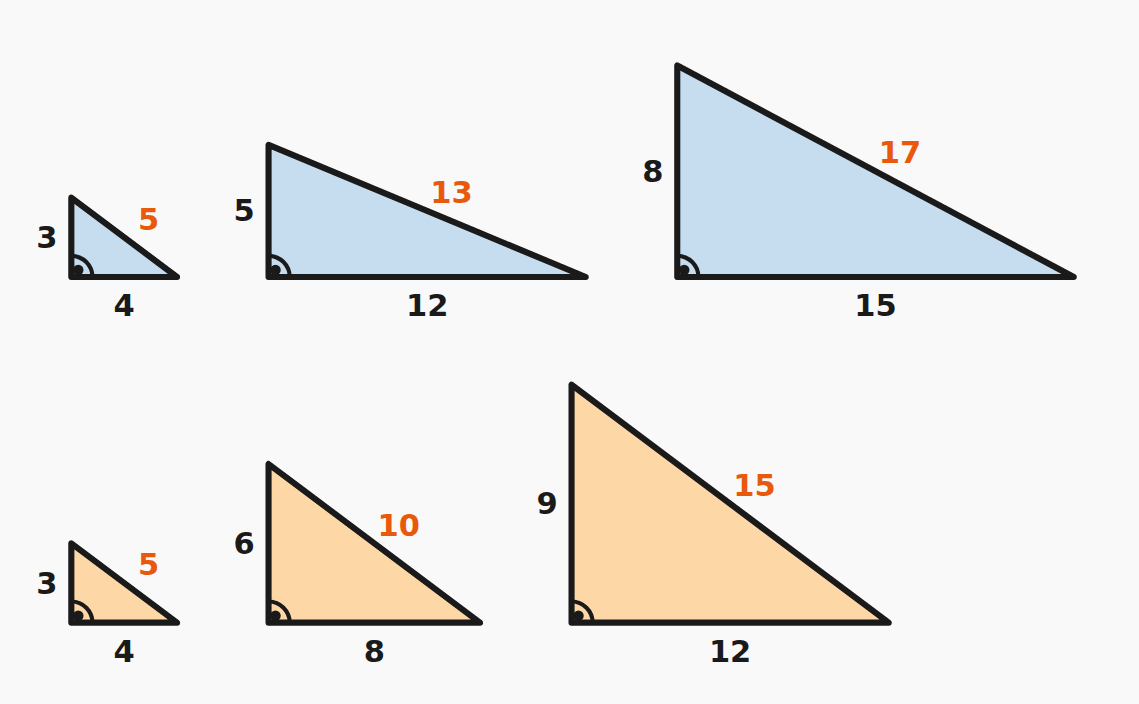
A primitive Pythagorean triple is one in which the numbers , , have no common divisor greater than – in other words, you can't divide all three by the same number.
Examples of primitive triples:
Multiples of triples
From every Pythagorean triple we can create more by multiplying all three numbers by the same natural number. The resulting triple will also be Pythagorean.
Example: Multiply the triple by :And by :
So from a single primitive triple we get infinitely many more: , , , , and so on.
List of the most commonly used triples
These triples are worth keeping "in your head" – they will speed up your problem solving:
| 3 | 4 | 5 |
| 5 | 12 | 13 |
| 6 | 8 | 10 |
| 7 | 24 | 25 |
| 8 | 15 | 17 |
| 9 | 12 | 15 |
| 9 | 40 | 41 |
| 11 | 60 | 61 |
| 12 | 16 | 20 |
| 20 | 21 | 29 |
How to create a new triple
There is a nice formula that generates primitive Pythagorean triples. For any natural numbers :
We got the triple .
For , :
We got the triple .
Related articles
- The Pythagorean theorem – complete guide
- The Pythagorean theorem formula
- The converse of the Pythagorean theorem
- Pythagorean theorem examples