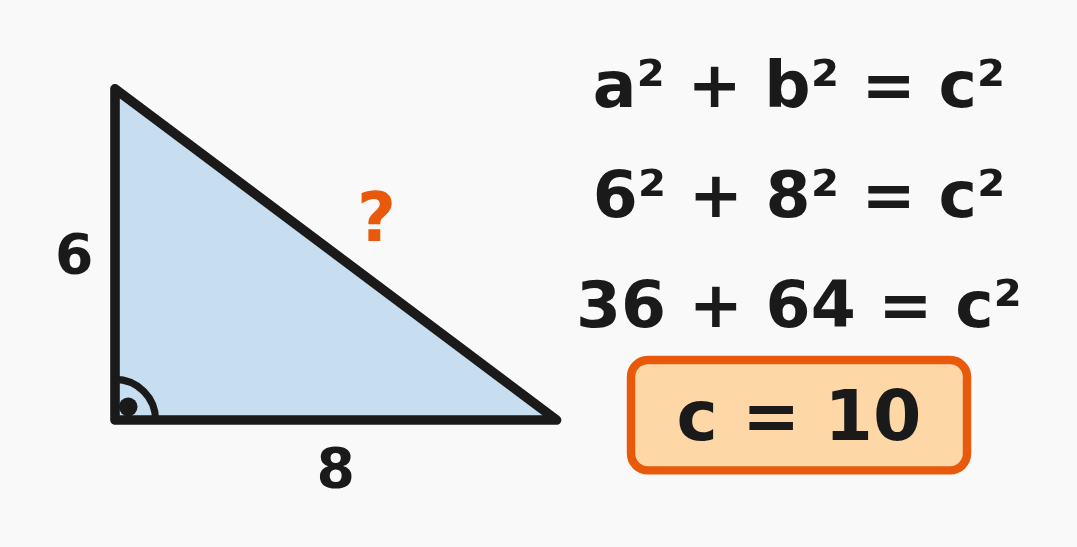
In this article you'll find a collection of solved examples, from the simplest to the more challenging. Each one is solved step by step.
Table of contents
- Calculating the hypotenuse
- Calculating a leg
- Examples with decimal results
- Checking for a right triangle
- Summary of formulas
Calculating the hypotenuse
Example 1: The legs of a right triangle have lengths cm and cm. Compute the length of the hypotenuse.Example 2: cm, cm. Compute .
Example 3: cm, cm. Compute .
Calculating a leg
Example 1: The hypotenuse of a right triangle has length cm and one leg is cm. Compute the other leg .Example 2: cm, cm. Compute .
Example 3: cm, cm. Compute .
Examples with decimal results
In practice, results often aren't whole numbers. In that case we round to a chosen number of decimal places.
Example 1: cm, cm. Compute (rounded to 2 decimal places).Example 2: cm, cm. Compute .
Example 3: cm, cm. Compute .
Checking for a right triangle
Example 1: Is a triangle with sides , , a right triangle?The longest side is , so it should be the hypotenuse.
Yes, it is a right triangle.
Example 2: Is a triangle with sides , , a right triangle?
The longest side is .
No, it is not a right triangle.
👉 More problems on checking: The converse of the Pythagorean theorem
Summary of formulas
- Hypotenuse:
- Leg: ,
- Checking for a right triangle:
Related articles
- The Pythagorean theorem – complete guide
- The Pythagorean theorem formula
- Word problems
- The converse of the Pythagorean theorem