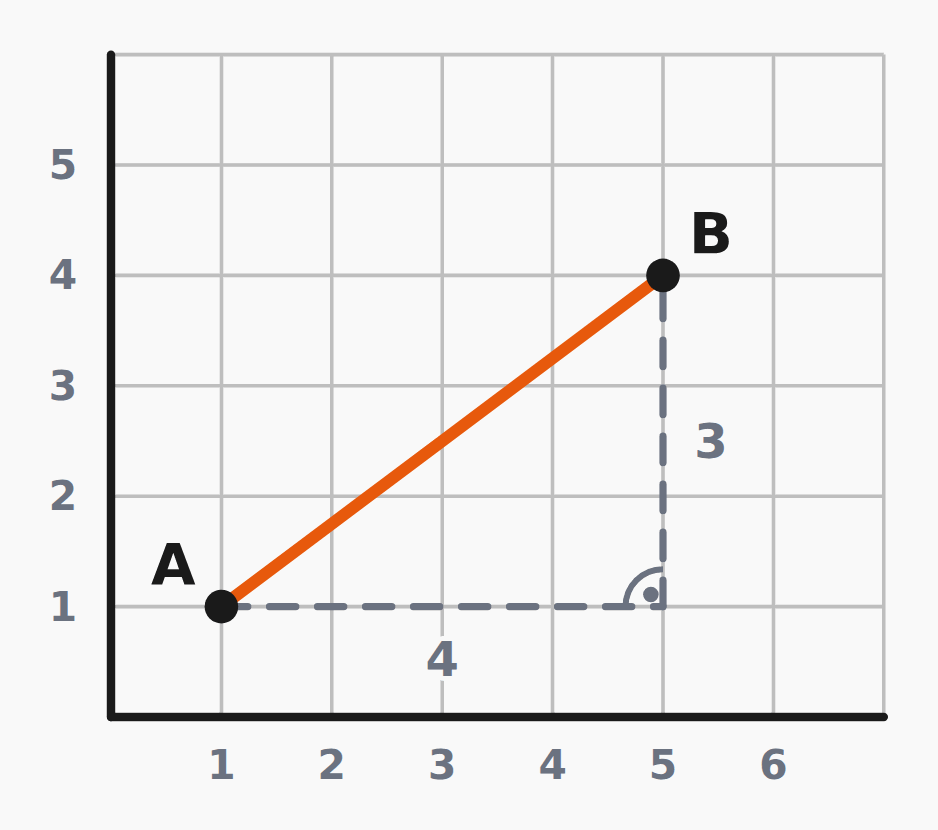
The Pythagorean theorem can also be used in the coordinate plane – it helps us compute the distance between two points when we know their coordinates.
Table of contents
Derivation of the formula
Let us have two points and in the coordinate plane. The segment forms the hypotenuse of a right triangle whose legs are parallel to the coordinate axes.
- The horizontal leg has length .
- The vertical leg has length .
By the Pythagorean theorem:
Formula for the distance
💡 When squaring a difference, the order doesn't matter – . Even negative differences give a positive number after squaring.
Solved examples
Example 1: Compute the distance between points and .
Answer: .
Example 2: Compute the distance between points and .
Answer: .
Example 3: Compute the distance between points and .
Answer: .
Practical uses
The distance formula is used wherever we work with coordinates:
- 🗺️ Maps and navigation – straight-line distance between two locations on a grid map.
- 🎮 Computer games – computing how far the player is from a target.
- 📐 Geometry – checking whether the sides of a shape are equal in length (for example, whether a triangle is isosceles).
- 📡 Physics – the distance traveled by an object in two-dimensional motion.
Related articles
- The Pythagorean theorem – complete guide
- The Pythagorean theorem formula
- Word problems
- The Pythagorean theorem in 3D