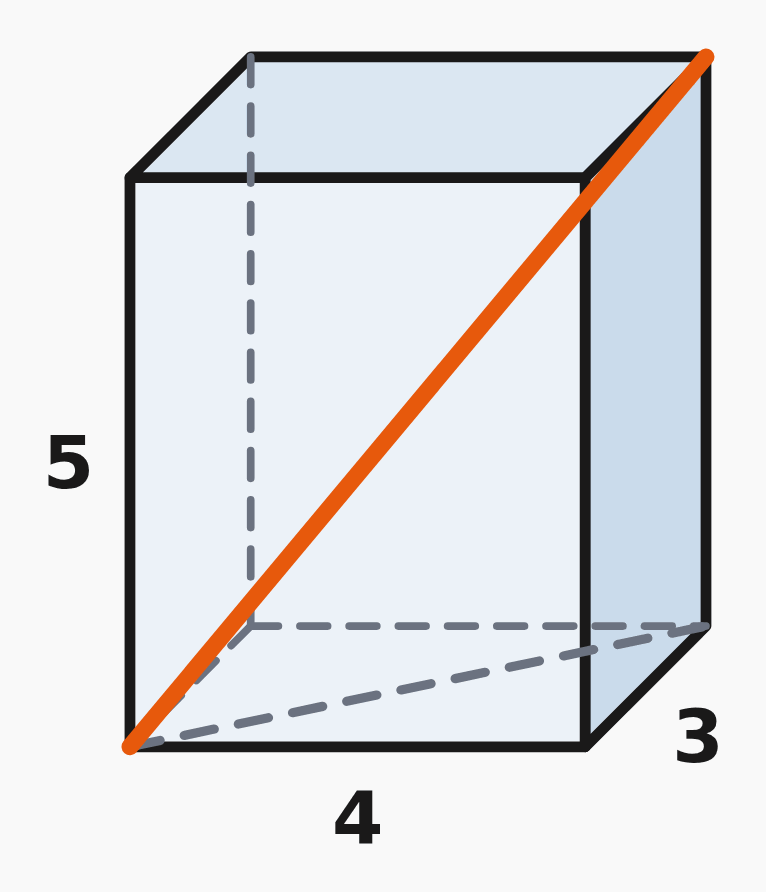
The Pythagorean theorem also works in three-dimensional space. Most often we use it to compute the space diagonal of a cuboid or a cube – that is, the segment that connects two opposite vertices of the solid.
Table of contents
The space diagonal of a cuboid
Imagine a cuboid with dimensions , , . The space diagonal is the segment connecting two opposite vertices – the longest segment that fits inside the cuboid.
The computation is done in two steps:
- First we compute the face diagonal on the base of the cuboid (a rectangle with sides , ):
- Then we apply the Pythagorean theorem a second time in the right triangle formed by the face diagonal, the space diagonal, and the height of the cuboid :
Formula for a cuboid
💡 Just square all three dimensions, add them, and take the square root. It's essentially an "extended" Pythagorean theorem.
Formula for a cube
A cube is a special case of a cuboid where . The formula therefore simplifies to:
Solved examples
Example 1: A cuboid has dimensions cm, cm, cm. Compute its space diagonal.Example 2: A cuboid has dimensions cm, cm, cm.
Example 3: A cube has edge cm. What is the length of its space diagonal?
Example 4 (from real life): Will a wooden rod m long fit inside a box with dimensions m?
It is enough to compare the length of the rod with the space diagonal of the box:
A rod m long will fit in the box, because its longest diagonal is approximately m.
Related articles
- The Pythagorean theorem – complete guide
- The Pythagorean theorem formula
- Distance between two points
- Word problems