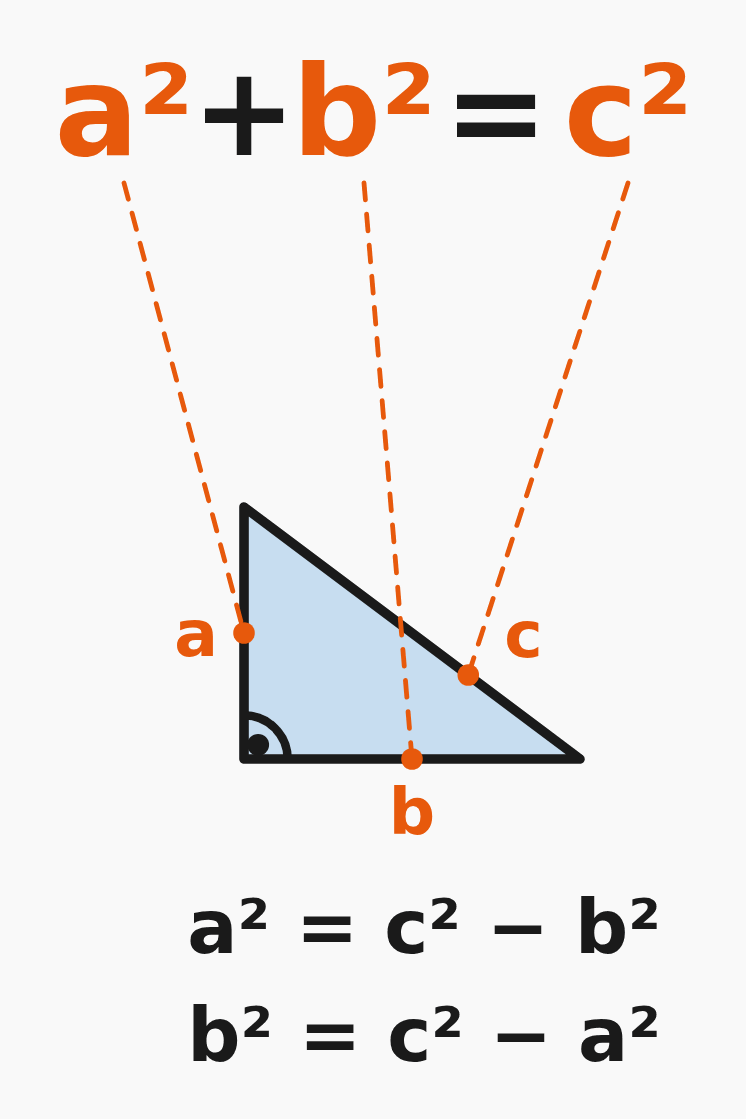
The Pythagorean theorem can be written as a single equation, but from it several practical forms follow, each handy in different situations. In this article we'll go through all of them.
Table of contents
The basic formula
In a right triangle, let us label:
- , – the legs (the sides adjacent to the right angle)
- – the hypotenuse (the side opposite the right angle)
Then the following holds:
In words: the sum of the squares of the legs equals the square of the hypotenuse.
Formula for the hypotenuse
If you know both legs and are looking for the hypotenuse, you solve for by taking the square root of both sides:
Example: ,📌 Remember: When computing the hypotenuse, and are always added.
Formula for a leg
If you know the hypotenuse and one of the legs, you compute the other by subtracting:
Example: ,📌 Remember: When computing a leg, you always subtract the square of the known leg from .
⚠️ The expression under the square root must be positive. If you get a negative number, you've mixed something up – most likely the hypotenuse and a leg.
Why squared
The square in the formula is no accident – it comes from the area of a square. Originally, the Pythagorean theorem was proved geometrically: on each side of a right triangle you build a square, and the area of the square on the hypotenuse is exactly equal to the sum of the areas of the two squares on the legs.
👉 The classic geometric proof: Proof of the Pythagorean theorem and history
Summary of formulas
| We want | Formula |
| Hypotenuse | |
| Leg | |
| Leg | |
| Checking for a right triangle |
Related articles
- The Pythagorean theorem – complete guide
- Pythagorean theorem examples
- The converse of the Pythagorean theorem
- Pythagorean triples