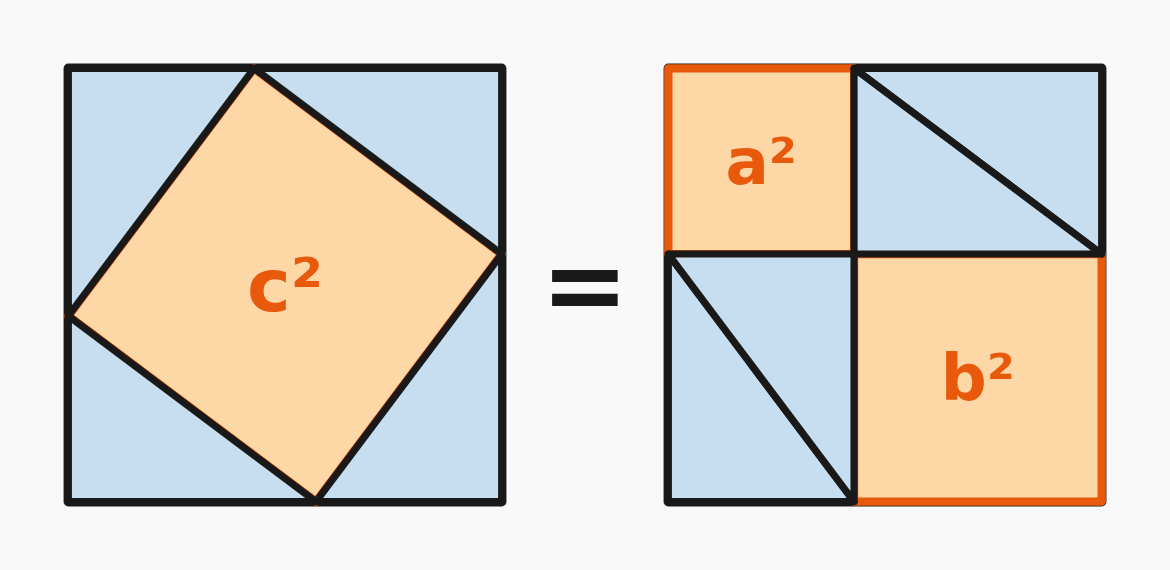
The Pythagorean theorem is not just a formula to memorize – behind it lies a beautiful geometric proof that you can show yourself with a simple drawing.
Table of contents
A short history
The theorem was known more than years ago – Babylonian clay tablets contain lists of Pythagorean triples. The ancient Egyptians also used the triple to lay out right angles when building the pyramids.
The theorem gets its name from Pythagoras of Samos (about BC), a Greek mathematician and philosopher. Pythagoras was probably not the first to know the theorem, but his school was the first to prove it in general for every right triangle.
The most famous geometric proof comes from the book Elements by Euclid (around BC). Today more than different proofs of this theorem exist – one of them is said to have been put together by the American president James Garfield.
Geometric proof
The simplest proof uses two large squares with the same side length , which we divide in different ways.
First division
We divide the large square into:
- a square with side → area
- a square with side → area
- two identical rectangles → total area
- (each rectangle can be divided by a diagonal into two right triangles with legs , )
The total area is:
Second division
We can divide the same square differently: we place inside it four identical right triangles (with legs and ) so that a new square forms inside with sides equal to the hypotenuses .
- four triangles → total area
- inner square with side → area
The total area is:
Conclusion
Both divisions describe the same large square, so their areas must be equal:
After subtracting from both sides we get:
And that is exactly the Pythagorean theorem.
Algebraic proof
Algebraically, the theorem can also be derived using similar triangles. In a right triangle, we drop an altitude from the vertex of the right angle to the hypotenuse. This creates two smaller triangles, each similar to the original. From the ratios of the sides it then follows that:
(where and are the segments of the hypotenuse at the foot of the altitude). Their sum:
Fun facts
- 🏛️ The oldest record of the theorem is on the Babylonian tablet Plimpton 322, around BC. It contains fifteen Pythagorean triples.
- 🔢 There are more than 400 different proofs – from purely geometric to algebraic, and even proofs using flowing water or origami.
- 📐 The Pythagorean theorem is a special case of the more general law of cosines, which holds for every triangle: . In a right triangle , so , and the formula simplifies to our Pythagorean theorem.
- 🌌 In non-Euclidean geometries (for example on a sphere), the Pythagorean theorem does not hold – it is therefore a property of plane (Euclidean) geometry.
Related articles
- The Pythagorean theorem – complete guide
- The Pythagorean theorem formula
- Pythagorean triples
- The converse of the Pythagorean theorem