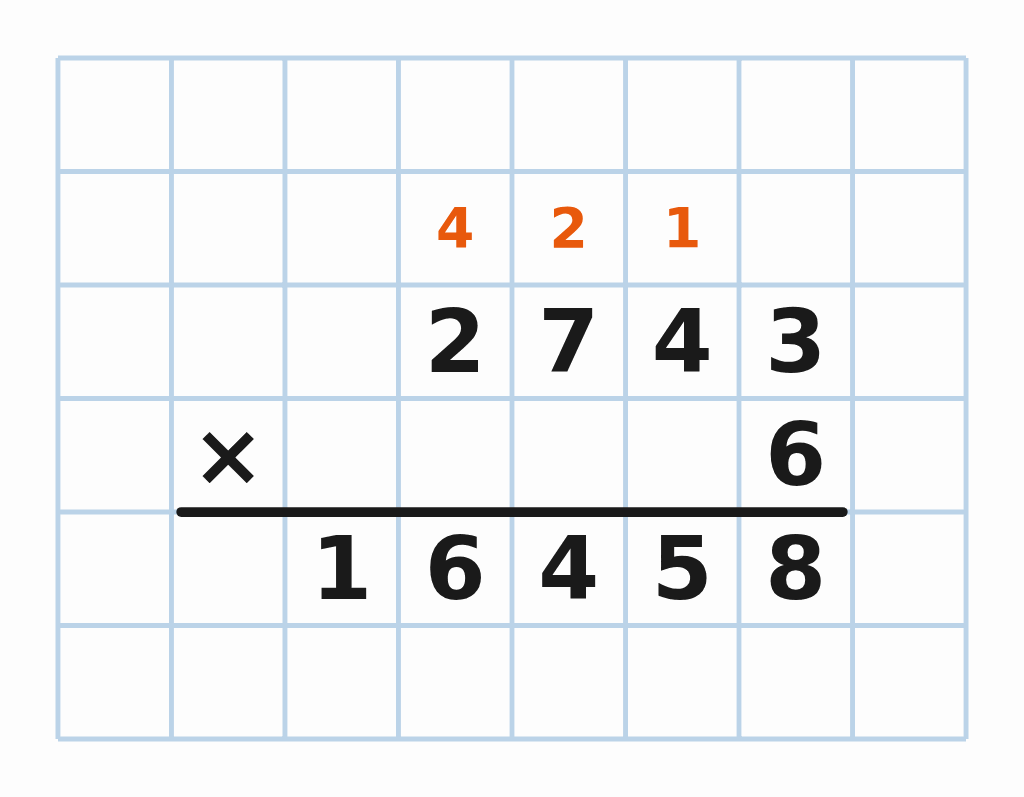
Multiplication by a one-digit number – comprehensive guide
In 5th grade you will learn how to multiply larger numbers by a one-digit number. Once you master this, you can quickly compute problems like 300⋅7 and write out 1,248⋅6 in columns.
Why this matters
Once you know the basic times-tables (for example 3⋅4=12), only two skills separate you from full multiplication: understanding what happens to the zeros and learning how to stack numbers in columns.
Three steps to mastery
We split the topic into three articles. Each one builds on the previous and has its own exercise.
1. Multiplying a round number by the same digit
The simplest case: a digit times the same digit followed by zeros. For example 3⋅300 or 5⋅50. If you know the times-tables, you know the answer instantly — just append the right number of zeros.
2. Multiplying a round number by a one-digit number
A small extension of the previous step: the round number does not have to begin with the same digit as the multiplier. For example 300⋅7 or 40⋅9. The rule is the same — multiply the leading digits, then append the zeros.
The final step: we multiply a multi-digit number by a one-digit number. We stack them in columns, the same way you did for written addition, and work from right to left — carrying tens when needed.
Make sure you're comfortable with the basic times-tables (1 – 9).
Read the article on round numbers with the same digit — you'll get confident with the zeros.
Move on to round numbers with any digit.
Only then try column multiplication.
After each article, try the exercise — you'll get instant feedback and see which parts you've mastered and which still need practice.
Summary test
When you can handle all three types, try the topic exam. It contains one problem from each exercise, so you can verify you've mastered the whole topic.