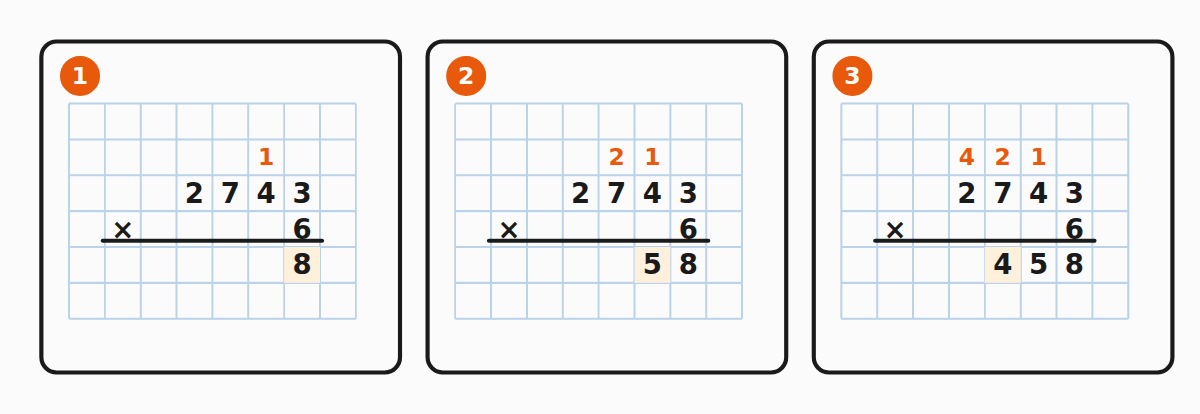
This is the capstone of the whole topic. We bring together the basic times-tables, work with round numbers, and the column layout you already know from addition and subtraction up to 10,000.
What the layout looks like
Write the multi-digit number on top, place the one-digit multiplier right-aligned below it, and draw a line. Put the result below the line.
Step-by-step approach
Work from right to left, exactly the same way as written addition.
Example: 1,248⋅6
carry
1 4 4
1 2 4 8
× 6
7 4 8 8
- Ones: 8⋅6=48. Write down 8, carry 4.
- Tens: 4⋅6=24, plus the carry 4 = 28. Write 8, carry 2.
- Hundreds: 2⋅6=12, plus the carry 2 = 14. Write 4, carry 1.
- Thousands: 1⋅6=6, plus the carry 1 = 7. Write 7.
Result: 7,488.
The carry rule
When the product in a column is greater than 9, you need to carry:
- Write down the last digit of the product.
- Carry the remaining digits (the tens) to the next column and add them in after the next multiplication.
For example 9⋅7=63 → write 3, carry 6.
Connection to round numbers
Column multiplication is really just a shorthand for what you learned with round numbers:
1,248⋅6=1,000⋅6+200⋅6+40⋅6+8⋅6
=6,000+1,200+240+48=7,488
The column algorithm computes this automatically, column by column.
Self-check questions
- Where does the one-digit multiplier go? All the way to the right, under the ones of the top number.
- How do I know I carried correctly? Check that an estimated answer roughly matches. 1,248⋅6 is about 1,200⋅6=7,200, so 7,488 looks right.
- What if the answer is larger than 9,999? It won't happen in our exercises — the generator always picks problems with results under 10,000. In school you may run into bigger answers; the method is the same, you just add one more digit on the left.
Watch out for
- Alignment. Put the one-digit multiplier under the ones, not under the thousands.
- Don't skip the carry. It's easy to forget when you multiply quickly.
- Read from right to left. Left-to-right only works for mental addition; not here.
Practice
👉 Exercise: Column multiplication up to 10,000
Related articles