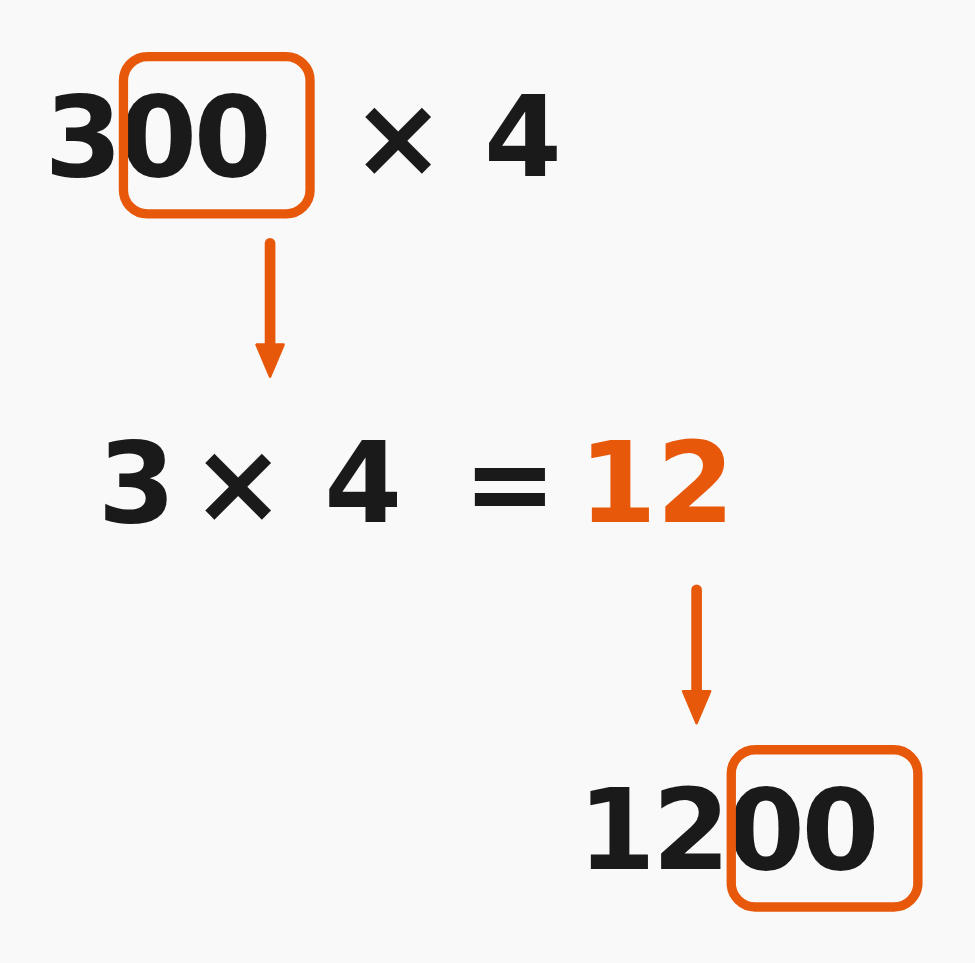
In the previous article we multiplied a round number by the same digit it began with. Now we go one step further: the second factor can be any digit from 1 to 9.
The rule stays the same
Again: multiply the leading digits and then append the right number of zeros.
Example 1: 300⋅7
- Times-tables: 3⋅7=21.
- The number 300 has 2 zeros.
- Add 2 zeros to 21 → 2,100.
300⋅7=2,100
Example 2: 40⋅9
- Times-tables: 4⋅9=36.
- The number 40 has 1 zero.
- Add 1 zero to 36 → 360.
40⋅9=360
Pattern in a table
This pattern shows why it works:
basic
× 10
× 100
× 1,000
3 · 7 = 21
30 · 7 = 210
300 · 7 = 2,100
—
4 · 9 = 36
40 · 9 = 360
400 · 9 = 3,600
—
Each extra zero in the round number pushes one extra zero into the result.
Why some problems don't appear
The times-tables never give a result larger than 81. But once you append zeros, the product grows quickly — in our exercises the result always stays under 10,000, so it still fits in four digits.
For example:
- 3⋅3,000=9,000 ✅ (fits)
- 4⋅3,000=12,000 ❌ (larger than 9,999, never generated here)
Quick sanity check
The result should have as many zeros as the round number — when the product of the leading digits is two digits. When the product of the leading digits is a single digit (for example 2⋅3=6), the number of zeros matches exactly: 2⋅300=600.
Practice
👉 Exercise: Multiplying a round number
What comes next