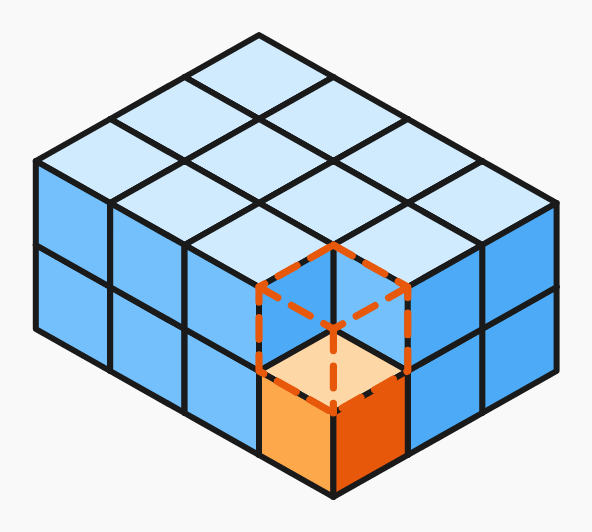
We have gone through both volume and surface area of a cuboid and a cube. Below is a quick summary and links to exercises.
Formulas in short
| Quantity | Formula | Unit |
| Volume of cuboid | V = a · b · c | cm³, dm³, m³ |
| Volume of cube | V = a · a · a | cm³, dm³, m³ |
| Surface area of cuboid | S = 2 · (a · b + a · c + b · c) | cm², dm², m² |
| Surface area of cube | S = 6 · a · a | cm², dm², m² |
Procedure for every exercise
- Read the prompt – do they want volume or surface?
- Write down the dimensions a, b, c (or just a for a cube).
- Use the right formula.
- Multiply / add in the correct order.
- Add the unit – volume in m³, cm³, dm³; surface area in m², cm², dm².
Common mistakes
- Mixing up volume and surface. For volume you multiply everything (a · b · c). For surface you add areas and double them. Don't confuse them!
- Wrong unit. Volume has cubic units (with a 3), surface area has square units (with a 2).
- Cube formula V = 6 · a. That is nonsense – a cube has 6 faces, but the volume is the edge cubed (a · a · a).
Practice generators
Start with volume
- Volume by counting unit cubes – understand the principle of volume by counting individual cubes.
- Volume of a cuboid (formula) – compute the volume from V = a · b · c.
Add nets and surface
- Cube net – pick the layout that folds into a cube.
- Cuboid surface from net – add the areas of 6 rectangles to get the surface area.
Bridge to grade 9
In grade 9 you'll extend these formulas to the pyramid, cylinder, cone, and sphere. There the formulas will involve π (pi), but the principle stays the same: volume tells you how much space is inside, surface area is how much area the faces take up.
See the grade 9 topic: Surface area and volume