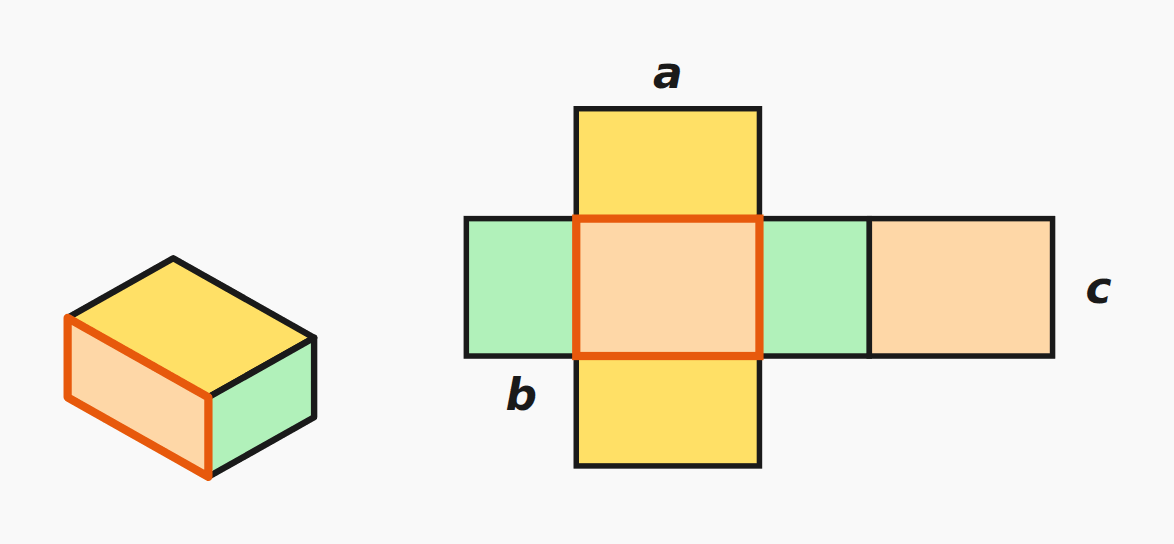
For volume we counted the space inside a solid. For surface area we count how much area its faces take up together. In other words: how much wrapping paper would you need to cover the cuboid completely?
A net helps you compute surface area
A cuboid net is 6 rectangles laid flat. When you compute the area of all 6 rectangles and add them up, you get the surface area.
In a cuboid the faces always come in equal pairs:
- front = back (rectangle a × c)
- left = right (b × c)
- top = bottom (a × b)
So you don't need to compute six different areas – just three different pairs and double each.
Formula
S = 2 · (a · b + a · c + b · c)
Where:
- a, b, c are the lengths of the three edges of the cuboid
- a · b is the area of one pair of faces (top = bottom)
- a · c is the area of another pair (front = back)
- b · c is the area of the third pair (left = right)
Add the three areas in the parentheses and double the result (because every pair is the same size).
Worked example
A cuboid measures 5 cm by 4 cm by 3 cm. What is its surface area?
Solution:
- a · b = 5 · 4 = 20 cm²
- a · c = 5 · 3 = 15 cm²
- b · c = 4 · 3 = 12 cm²
Add: 20 + 15 + 12 = 47
Double: 2 · 47 = 94 cm²
The surface area of the cuboid is 94 cm².
Surface area of a cube
For a cube all faces are equal (because a = b = c). The formula simplifies:
S = 6 · a · a
Six faces, each with area a · a.
Example: a cube with edge 5 cm has S = 6 · 5 · 5 = 6 · 25 = 150 cm².
Watch the units
- Surface area is in square units (cm², m², dm²) – because it is an area (2D), not a space.
- Volume is in cubic units (cm³, m³, dm³).
- They are not the same! If someone tells you that a cuboid has a surface area of 1 m³ – that is nonsense. m³ is a volume.
A check
When you have a net in front of you (on paper or in an exercise), you can verify your answer like this:
- Compute the area of each of the 6 rectangles separately.
- Add them up.
- The total should match the result from S = 2 · (a · b + a · c + b · c).
If they don't match, somewhere you made a mistake – either in addition or you swapped dimensions.