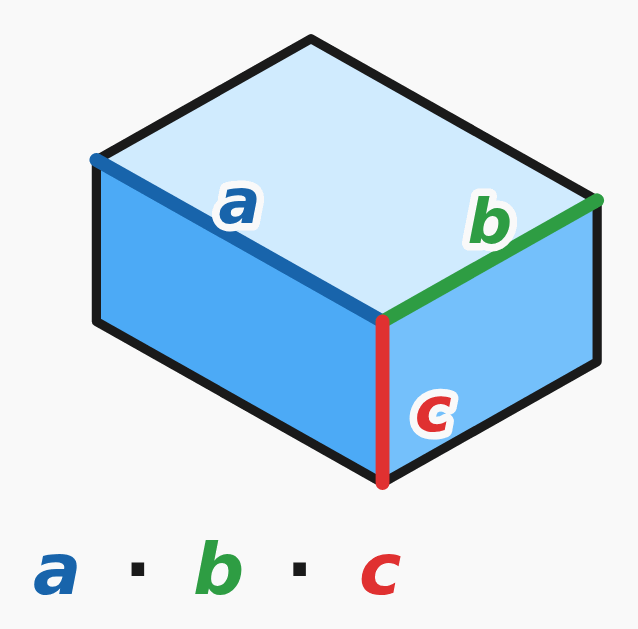
In the previous article we computed the volume of a cuboid by counting unit cubes layer by layer. That worked, but it is rather slow. There is a faster way – the formula.
Where the formula comes from
Let's go back to the cuboid from the previous article: length 4, width 2, height 3.
In one layer (the bottom one) there are 4 · 2 = 8 cubes. That is actually the area of the rectangle that forms the base of the cuboid.
There are 3 layers because the height is 3. So the total cube count is 8 · 3 = 24, which is base area · height.
This is the formula for the volume of a cuboid:
V = a · b · c
Where:
- a is the length of the cuboid
- b is the width of the cuboid
- c is the height of the cuboid
When you multiply these three numbers you get the number of unit cubes that fit inside the cuboid. That is the volume.
Worked example – cuboid
A cuboid measures 5 cm by 4 cm by 3 cm. What is its volume?
Solution: V = 5 · 4 · 3 = 60 cm³.
Worked example – cube
A cube has an edge of 6 cm. What is its volume?
Solution: a cube is a special cuboid where length, width, and height are all equal – all 6.
V = 6 · 6 · 6 = 216 cm³.
The formula for the volume of a cube can also be written:
V = a · a · a
For a cube you only need to know one edge a. Multiply it by itself three times and you get the volume.
Order of multiplication doesn't matter
Multiplication doesn't depend on order – you get the same result whether you compute a · b · c or b · a · c or c · a · b.
A trick for faster mental maths: multiply the easy numbers first. For example: 4 · 5 · 7 = (4 · 5) · 7 = 20 · 7 = 140. Start with 4 · 5 because it gives a nice 20, then finish.
Watch the units
When all dimensions are in the same unit (e.g. all in cm), the result will be in cubic of the same unit (cm³).
If some dimensions are in different units (length in metres, width in centimetres), you must first convert to a common unit, then multiply. Otherwise the result is wrong.
Common mistakes
- Adding instead of multiplying. A frequent error: V = a + b + c. That would (sort of) be a perimeter, not a volume. Volume means multiplication.
- Wrong power. For a cube, some students remember V = a · 6 (because a cube has 6 faces). That is also wrong – V = a · a · a (the edge cubed).
- No unit. A result without a unit is meaningless. Always write cm³, m³, or dm³.