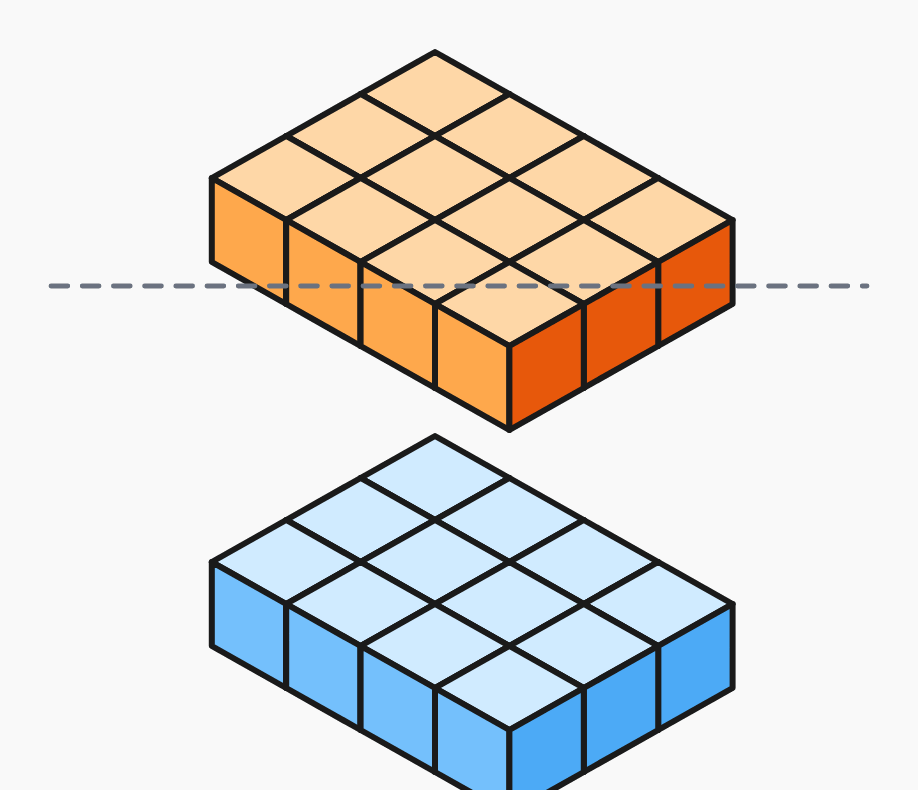
Imagine you have an empty box and you want to know how many things fit inside. Volume answers exactly that question – it tells you how much space a solid takes up inside.
With perimeter we measured the length around a figure. With area we measured the surface inside. With volume we measure the space inside a solid.
Unit cube
To measure volume conveniently, we invented the unit cube. It is a cube whose every edge has length 1. Most often 1 cm – such a cube has volume 1 cm³ (read "one cubic centimetre" or "one centimetre cubed").
Unit cubes can have different sizes depending on the unit you choose:
- 1 cm × 1 cm × 1 cm = one cube has volume 1 cm³
- 1 dm × 1 dm × 1 dm = one cube has volume 1 dm³ (= 1 litre)
- 1 m × 1 m × 1 m = one cube has volume 1 m³
Volume as the number of cubes
If a solid can be built from unit cubes, its volume equals the number of those cubes.
Example: you have a cuboid that is 4 cm long, 2 cm wide, and 3 cm high. You can build it from unit cubes with edge 1 cm. How many do you need?
Count the cubes layer by layer. In each layer there are 4 × 2 = 8 cubes. There are 3 layers, so the total is 8 + 8 + 8 = 24 cubes.
The volume of this cuboid is 24 cm³.
Cubic units – not a small two but a small three
For perimeter you write units plainly (cm, m). For area they have a small two at the top right (cm², m²). For volume they have a small three (cm³, m³).
That three means we are counting cubes – an object in 3D space. It corresponds to three dimensions (length, width, height), hence the three.
| For | Unit |
| Perimeter (length around) | cm, m |
| Area (surface inside a 2D figure) | cm², m² |
| Volume (space inside a 3D solid) | cm³, m³ |