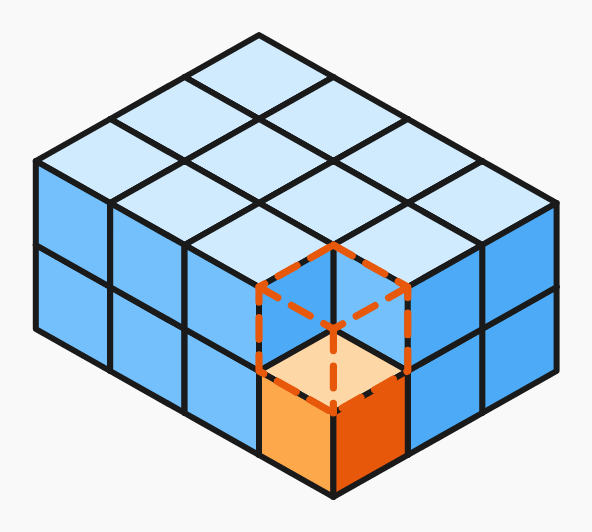
In this chapter you meet volume for the first time. Volume tells you how much space a solid takes up inside – how much water fits into it, or how many unit cubes you would need to build it.
We start gently: count unit cubes first, then arrive at the formula V = a · b · c. You also learn to recognise a valid cube net and to compute the surface area of a cuboid from its net.
What you will learn
After the articles and exercises you should be able to:
- understand what volume is and the units in which it is measured
- compute the volume of a cuboid by counting unit cubes
- use the formula V = a · b · c
- recognise a valid cube net
- compute the surface area of a cuboid from its net
Volume by counting unit cubes
A unit cube has all edges of length 1. If we use 1 cm edges, each unit cube has volume 1 cm³.
If a cuboid is built from unit cubes, its volume equals the number of unit cubes.
Example: a cuboid 4 cm long, 2 cm wide, 3 cm high contains 4 · 2 · 3 = 24 unit cubes. Its volume is 24 cm³.
Formula V = a · b · c
Multiply length, width, and height. The result is the volume in cubic units.
For a cube, all three are the same: V = a · a · a.
Cube net
A net is the unfolded version of a solid. The most familiar cube net is the cross: four squares in a row with one above and one below.
There are 11 distinct cube nets in total. Not every layout of 6 squares folds into a cube – a 2 × 3 rectangle, for example, does not.
Surface area from a net
The surface area of a cuboid is the sum of the areas of all 6 faces. Faces come in pairs:
- top = bottom (a · b)
- front = back (a · c)
- left = right (b · c)
S = 2 · (a · b + a · c + b · c)
For a cube: S = 6 · a · a.
Quick reference
| Quantity | Formula | Unit |
| Volume of cuboid | V = a · b · c | cm³, dm³, m³ |
| Volume of cube | V = a · a · a | cm³, dm³, m³ |
| Surface area of cuboid | S = 2 · (a · b + a · c + b · c) | cm², dm², m² |
| Surface area of cube | S = 6 · a · a | cm², dm², m² |