Imagine making a paper cube from match boxes. To do so you need a net – the cube unfolded onto a flat plane. A net is a set of 6 connected squares that, when folded along the edges, becomes a cube.
What is a net
A net of a solid is a flat figure on paper that, when folded along edges, gives the solid. For every solid with flat faces there is at least one net – usually several.
For the cube there are exactly 11 distinct nets (counting rotations and reflections as the same). For the cuboid there are also several.
The most familiar cube net – the cross
The most common cube net looks like a cross or plus sign.
Four squares in a row. One square sits above the middle position, one below it. When you fold the middle pair, you make a "floor" and a "ceiling". The other squares fold up into the remaining four faces.
Other valid cube nets
Other arrangements work too. Some examples:
T-net:■ ■ ■ ■
. ■ . .
. ■ . .(four horizontal + two below the second square)
Staircase:. . ■ ■
. ■ ■ .
■ ■ . .A nice example showing that a net doesn't have to be "pretty" or symmetric – it just has to fold into a cube.
Not every layout of 6 squares is a net
Watch out: 6 connected squares don't automatically make a cube. Some arrangements leave a gap or two squares overlap when folded.
For example, a 2 × 3 rectangle (6 squares in two rows):■ ■ ■
■ ■ ■This is not a valid cube net. When you try to fold it, one square is "extra" or won't overlap correctly.
A trick to verify
The best way to check whether a net works is to print or draw it on paper, cut it out, and try folding. Fold along the edges step by step and see whether the cube closes without gaps or overlaps.
You can do it in your head too – over time you learn to visualise. But at the start it's better to try physically.
Cuboid net
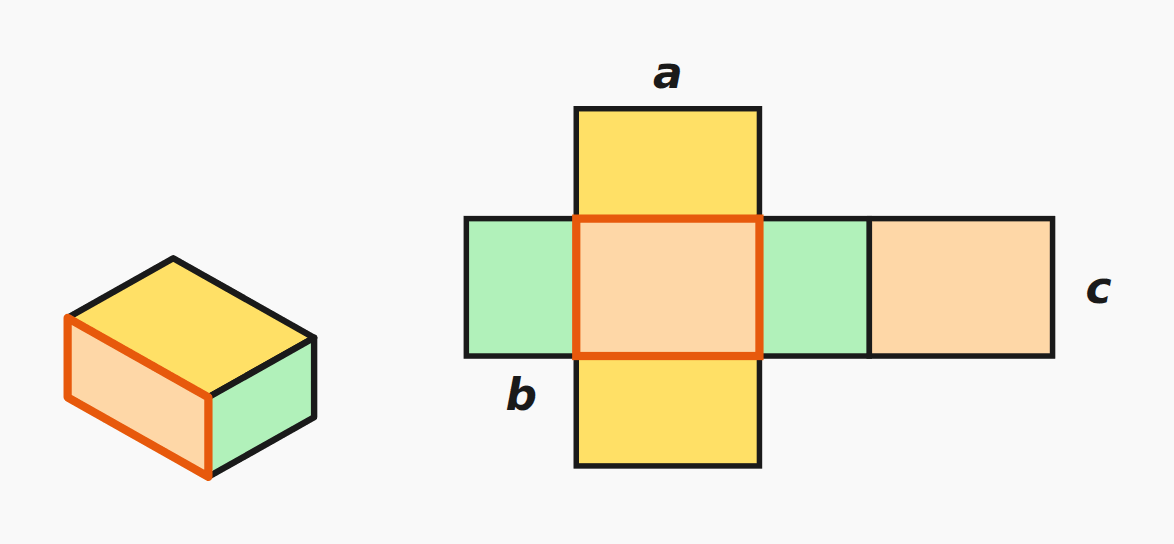
A cuboid net is similar, but the rectangles have different sizes. The most common form:
- one large rectangle in the middle (the front face)
- side rectangles for the side faces
- above and below the middle: top and bottom faces
- one more rectangle, the back face, attached anywhere
In a cuboid net it's important that:
- there are 6 rectangles in total
- the net contains exactly pairs of equal rectangles (front = back, top = bottom, left = right)
- when folded, all faces touch without gaps