Perimeter and area of plane figures – comprehensive guide
When you want to know how much fabric you need for a tablecloth, how much fence to put around a garden, or how much paint to cover a wall, you are computing perimeter or area. These two ideas get mixed up easily, so let's sort them out right at the start.
What perimeter and area mean
Picture a square playground.
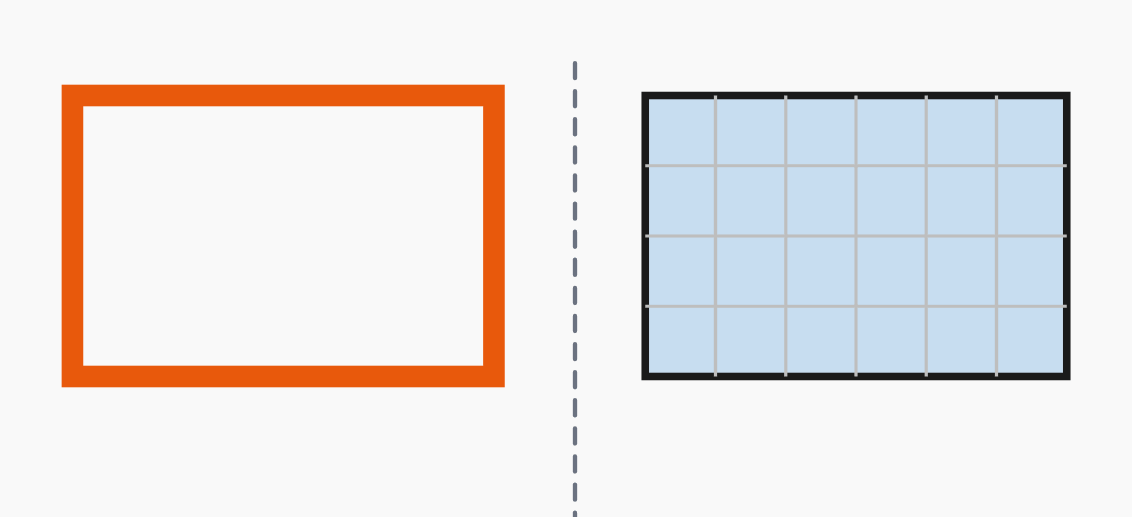
The perimeter is the length of the path around the playground. If you walk all the way around it and add up your steps, that is the perimeter. It is measured in units of length – centimeters, meters, or millimeters.
The area tells you how much room is inside the playground. If you laid 1 m × 1 m square tiles all over it, how many would fit? That is the area. It is measured in square units – cm², m², or mm².
In one line: perimeter = around, area = inside.
perimeter (around)
area (inside)
What shapes you will work with
In this topic you will compute perimeter and area for three basic plane figures and combinations of them:
square
rectangle
triangle
composite figures (built by joining or subtracting basic shapes)
Formulas at a glance
So you don't have to jump from article to article, here are all the formulas in short form. Each formula gets its own article with a careful explanation.
Shape
Perimeter
Area
Square with side a
P = 4 · a
A = a · a
Rectangle with sides a, b
P = 2 · (a + b)
A = a · b
Triangle with sides a, b, c and altitude hₐ
P = a + b + c
A = (a · hₐ) / 2
Watch the units
This is something that surprises a lot of students the first time: area is always in square units. If a square has a side of 5 cm, its area is not 25 cm but 25 cm². The little 2 up top means "square" – we are counting little square patches, not lengths.
For perimeter you keep the unit as it is. For area you add the small 2.
Where to start
Best to go step by step, from easier formulas to harder ones: