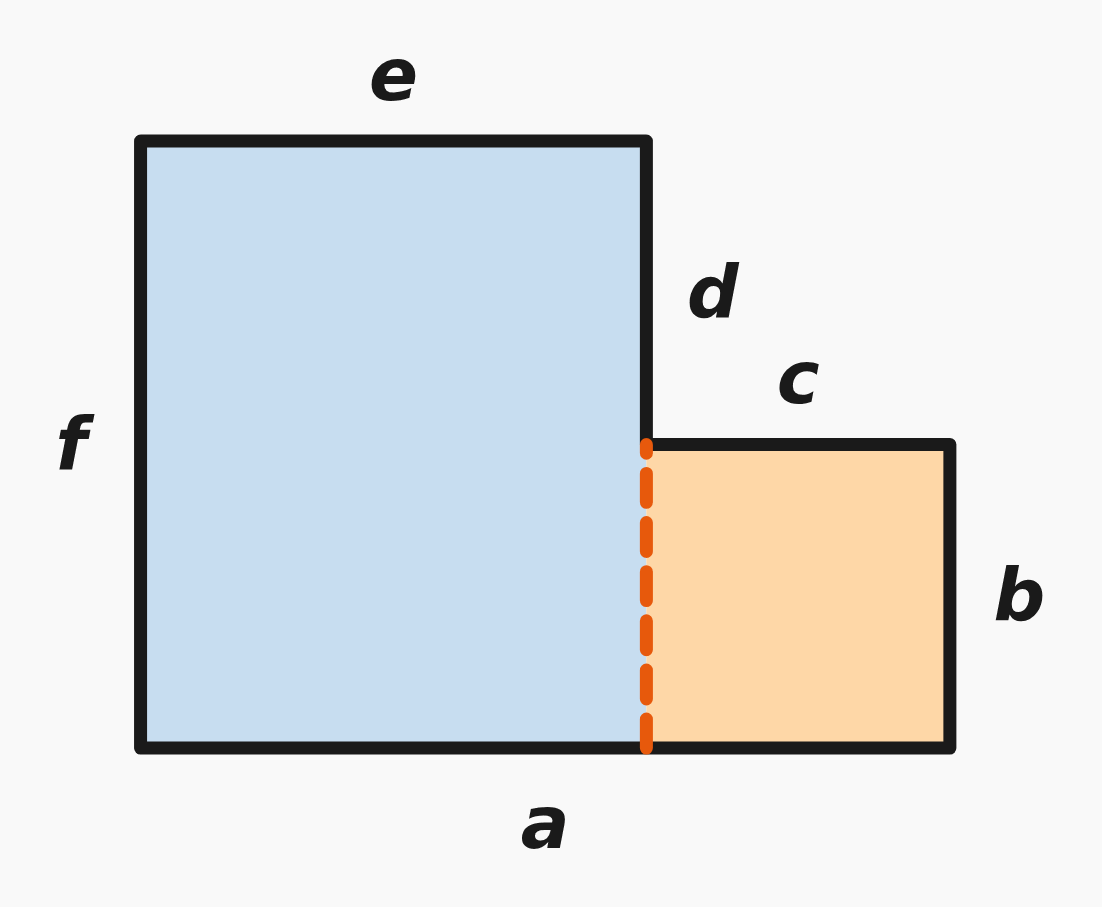
Sometimes a figure isn't a plain square, rectangle, or triangle. Sometimes it was built by joining several pieces, or a piece was cut out of one. Such figures are called composite figures.
The main idea
For composite figures you don't need any new formula. Just break the figure mentally into the simplest pieces you already know how to handle – rectangles, squares, triangles – and then add or subtract their areas.
Area of a composite figure
For area, always ask: what does this figure consist of? If it's two rectangles joined, compute each area separately and add them. If it's a big square with something missing, compute the big square's area and subtract the missing piece.
L-shape
Picture an L-shape as a big rectangle with a smaller rectangle cut out of one corner. Plus or minus – both work:
- Minus: compute the area of the big rectangle and subtract the cut-out rectangle.
- Plus: split the L into two smaller rectangles and add their areas.
Example: big rectangle 10 m × 8 m, cutout in the corner 3 m × 4 m.
Area: 10 · 8 − 3 · 4 = 80 − 12 = 68 m².
House
Picture a house as a rectangle (the walls) with a triangle on top (the roof). The area of the house is the rectangle's area plus the triangle's area.
Example: rectangle 6 m wide and 5 m tall, triangle on top with base 6 m and altitude 4 m.
Area: 6 · 5 + (6 · 4) / 2 = 30 + 12 = 42 m².
Square with cutout
A big square with a smaller square cut out of one corner. The procedure is the same as for the L-shape – subtract the cut-out area from the big area.
Perimeter of a composite figure
For perimeter, watch out – not every side of every piece counts. Only the sides that form the outer boundary count. Sides on the inside (where two pieces meet) are not part of the perimeter.
Easiest way: trace the outer boundary with your finger and add up all the segments you cross. That's the perimeter.
A nice property of the L-shape and square with cutout
For the L-shape and the square with a corner cutout, the perimeter equals the perimeter of the original big shape. The sides lost when cutting are replaced by the cutout sides of equal total length – so the sum stays the same.
L-shape 10 × 8 with a 3 × 4 cutout has perimeter 2 · (10 + 8) = 36 m, exactly as if it were a full 10 × 8 rectangle.
House
The house doesn't behave like that. The roof adds two slanted segments and removes the top horizontal side of the rectangle.
Perimeter of the house = bottom of rectangle + two sides + two slanted roof segments.
In the practice the slanted lengths are chosen so they always come out as nice whole numbers (for example 5, 10, 13, 17 meters).
A procedure that always works
- Look at the figure and describe in your head what pieces it's made of.
- Decide whether to add or subtract areas (joined pieces vs. big-minus-small).
- Compute the area of each piece separately.
- Add or subtract.
- For perimeter, always trace only the outer boundary.
Common mistakes
- For perimeter, students forget that interior sides don't count, and the answer comes out too big.
- For area, students multiply instead of summing. Areas are never multiplied – only added or subtracted.
- For the house, students forget the slanted roof segments in the perimeter, or use the slanted side instead of the altitude when computing the triangle's area.
Practice
Generator: Composite figuresRelated articles: