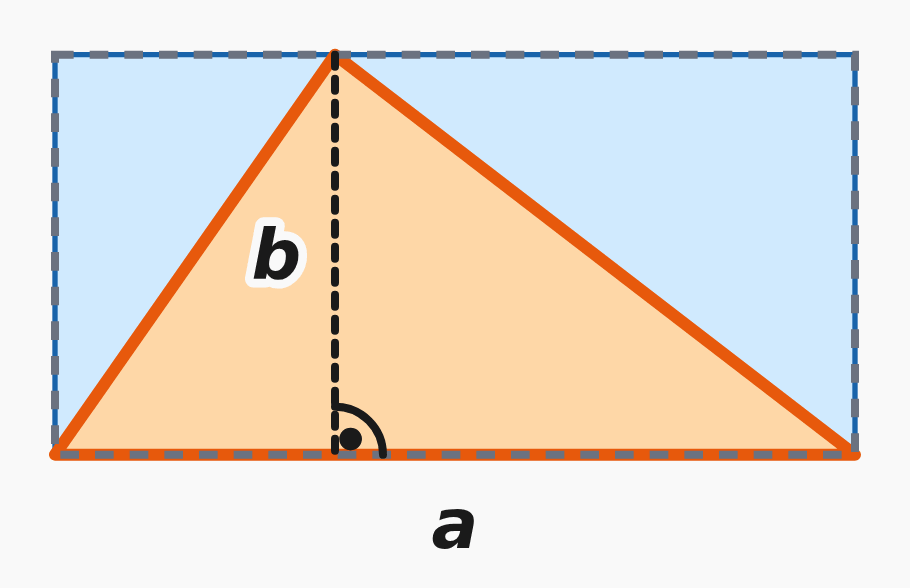
For the area of a triangle you meet two new things: besides the side, you also need the altitude (height); and at the end you divide by two. It looks unusual at first, but in a moment you will see why.
The formula
First pick one side of the triangle – say, the side we call side a. To that side belongs one altitude, which we call altitude hₐ (read "h-a"). Then:
A = (a · hₐ) / 2
In words: the area of a triangle equals half the product of the side and the altitude that goes with it.
What the altitude of a triangle is
The altitude is the perpendicular distance from the opposite vertex of the triangle down to the side. Imagine side a is the bottom edge of the triangle. The top vertex is somewhere above it. Drop a perpendicular line down – its length is altitude hₐ.
In the picture you see the altitude as a dashed line perpendicular to the side. A small square shows where the right angle is – that means the lines are really perpendicular.
Why we divide by two
Picture a rectangle with sides a and hₐ. Its area is a · hₐ. Now cut that rectangle along a diagonal – you get two equal triangles. Each triangle has exactly half the area of the rectangle.
So: triangle area = half of rectangle area = (a · hₐ) / 2.
Worked example
A triangular sail has a side of 8 m and an altitude of 6 m to that side. What is its area?
Solution: A = (8 · 6) / 2 = 48 / 2 = 24 m². The area is 24 square meters.