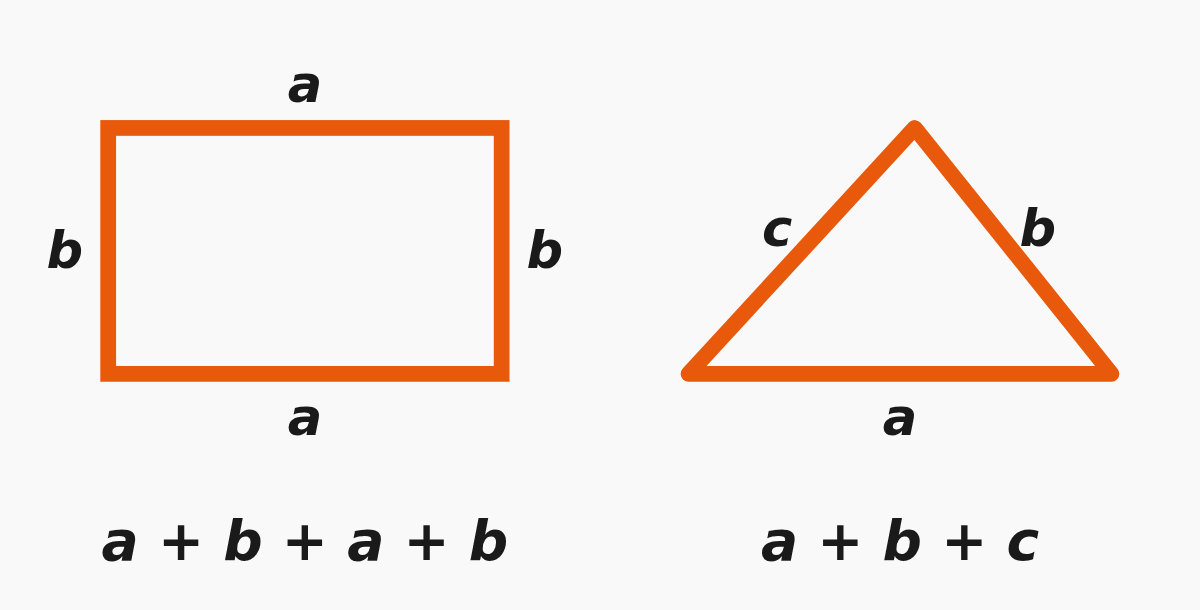
A triangle has three sides. Its perimeter is simply the sum of the lengths of all three sides. The formula is the same for every triangle – no matter how wide, tall, or slanted.
The formula
We call the sides side a, side b, and side c.
P = a + b + c
You add three numbers – done.
Three types of triangles
In the practice you will meet three types of triangles. The formula is the same; the side lengths behave differently.
Equilateral triangle
All three sides are equal. Knowing one side means you know all three.
If the side is 7 cm, the perimeter is:
P = 7 + 7 + 7 = 21 cm
Or as a shortcut: P = 3 · 7 = 21 cm.
Isosceles triangle
Two sides are equal (the legs), and one is different (the base). The legs may be longer or shorter than the base.
If the legs are 8 cm and the base is 6 cm, the perimeter is:
P = 8 + 8 + 6 = 22 cm
Scalene triangle
All three sides are different. There is no shortcut – you just add.
If a triangle has sides 5 cm, 7 cm, and 9 cm, the perimeter is:
P = 5 + 7 + 9 = 21 cm
A rule every triangle must satisfy
For three lengths to form a real triangle, the sum of any two sides must be greater than the third side. You cannot make a triangle with sides 2 cm, 3 cm, and 10 cm – the two shorter sides together don't reach across the longest one. The practice generator always respects this rule, so every triangle it produces can really be drawn.
Worked example
A gardener has a triangular flower bed. Its sides are 4 m, 6 m, and 7 m. How many meters of fence does she need to surround it?
The fence runs along the perimeter:
P = 4 + 6 + 7 = 17 m
She needs 17 meters of fence.