Article Contents
- The Coordinate System
- Points in the Plane
- Plotting Points from a Table
- Drawing a Graph
- Reading Values from a Graph
- Increasing and Decreasing
- Intercepts
- Examples of Common Graphs
- Common Mistakes
- Interactive Exercises
1. The Coordinate System {#coordinate-system}
A Cartesian coordinate system consists of two perpendicular number lines:
- x-axis (horizontal): shows the independent variable
- y-axis (vertical): shows the dependent variable
- Origin : where the axes cross
- Quadrants I, II, III, IV: the four regions created by the axes
2. Points in the Plane {#points-in-plane}
Every point is described by an ordered pair :
- = horizontal position (left/right from origin)
- = vertical position (up/down from origin)
Examples
| Point | Quadrant | ||
| I | |||
| II | |||
| III | |||
| IV |
3. Plotting Points from a Table {#plotting-points}
Given a function table, plot each pair as a point.
Example:
4. Drawing a Graph {#drawing-graph}
Step-by-step process
- Create a table of values (see Functions and Tables)
- Set up the coordinate system with appropriate scale
- Plot each point
- Connect the points:
- With a straight line for linear functions
- With a smooth curve for other functions
- Label the graph with the function formula
Tips for choosing -values
- For linear functions (): 2 points are enough, but use 3 for safety
- For quadratic functions (): use at least 5--7 points
- Always include if it is in the domain
- Choose values symmetrically around the interesting part
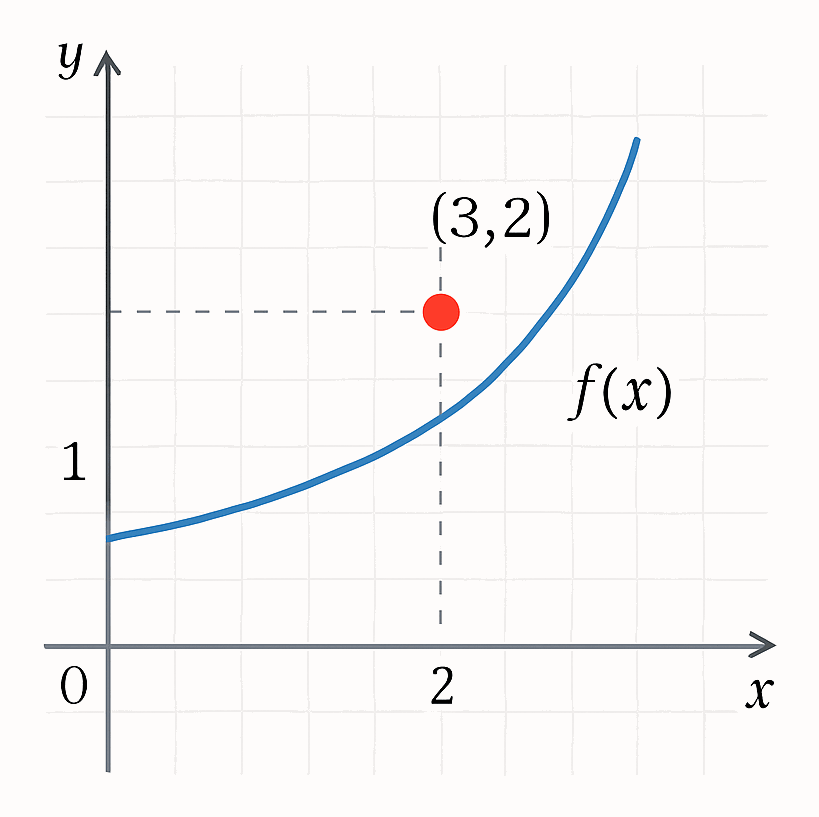
5. Reading Values from a Graph {#reading-from-graph}
To find -- reading the output:
- Find on the horizontal axis
- Go vertically to the graph
- Read the -value at that point
To find when -- reading the input:
- Find on the vertical axis
- Go horizontally to the graph
- Read the -value at that point
6. Increasing and Decreasing {#increasing-decreasing}
A graph shows us where a function is increasing or decreasing:
- Increasing: the graph goes up as you move right (when grows, grows)
- Decreasing: the graph goes down as you move right (when grows, shrinks)
7. Intercepts {#intercepts}
x-intercept (zero of the function)
The point where the graph crosses the x-axis, i.e., where .
y-intercept
The point where the graph crosses the y-axis, i.e., the value .
Example:
- y-intercept: , so the graph crosses the y-axis at
- x-intercept: , so the graph crosses the x-axis at
8. Examples of Common Graphs {#common-graphs}
| Function type | Equation | Graph shape |
| Constant | Horizontal line | |
| Linear | Straight line | |
| Direct proportion | Line through origin | |
| Inverse proportion | Hyperbola | |
| Quadratic | Parabola |
9. Common Mistakes {#common-mistakes}
| Mistake | How to avoid it |
| Swapping and coordinates | Always write -- horizontal first, vertical second |
| Connecting points with straight lines when the function is curved | Use a smooth curve for non-linear functions |
| Not enough points for a curved graph | Plot at least 5--7 points for quadratics and other curves |
| Forgetting to label axes and scale | Always mark the scale and axis names |
| Plotting instead of | The first number is always the horizontal position |
10. Interactive Exercises {#interactive-exercises}
Practice graphing skills:
Summary
| Concept | Description |
| Coordinate system | Two perpendicular axes (x horizontal, y vertical) with origin O |
| Point | = horizontal position, = vertical position |
| Plotting | Create a table, plot points, connect them |
| Reading | Go from vertically to the graph, read |
| x-intercept | Where (graph crosses x-axis) |
| y-intercept | The value (graph crosses y-axis) |
Related Articles
- Introduction to Functions -- what is a function
- Functions and Tables -- creating tables of values
- Domain of a Function -- which inputs are allowed
- Direct Proportion -- graphs of
- Linear Function -- graphs of