Article Contents
- Independent Variable (Input)
- Dependent Variable (Output)
- Why "Dependent" and "Independent"?
- Variables in Function Notation
- Variables on a Graph
- Real-Life Examples
- Common Mistakes
- Interactive Exercises
1. Independent Variable (Input) {#independent-variable}
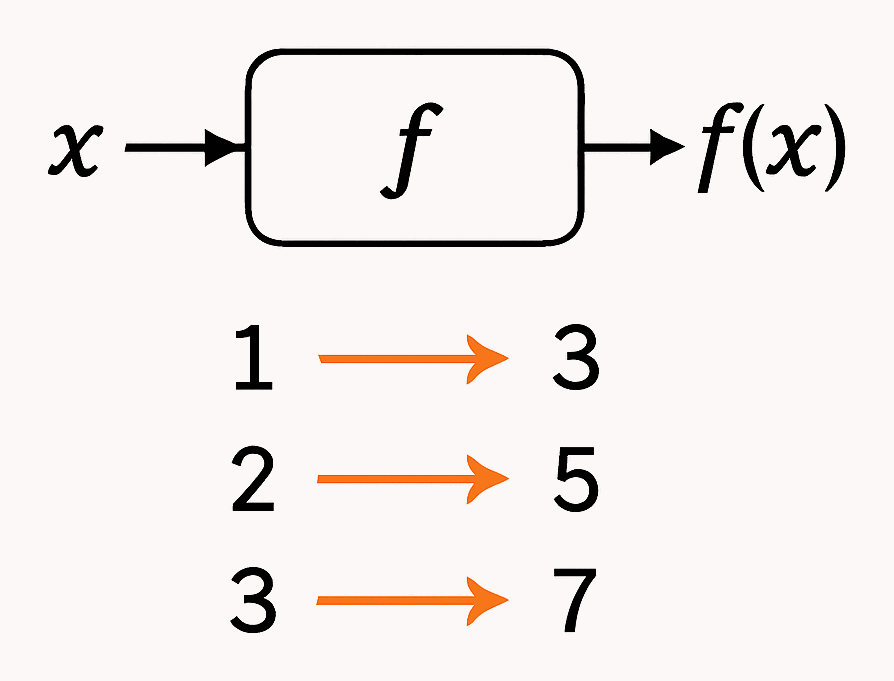
The independent variable is the value we choose freely. It is the input of the function.
- Usually denoted by
- Plotted on the horizontal axis (x-axis) of a graph
- We decide its value first
Example
In the function , the variable is independent. We can set to any value we like:
2. Dependent Variable (Output) {#dependent-variable}
The dependent variable is the result -- it depends on the input. It is the output of the function.
- Usually denoted by or
- Plotted on the vertical axis (y-axis) of a graph
- Its value is determined by the function rule
Example
For :
| Independent | Calculation | Dependent |
We chose . The function determined .
3. Why "Dependent" and "Independent"? {#why-dependent}
The names tell us which variable controls the other:
- Independent (): "I am free -- nobody tells me what to be."
- Dependent (): "I depend on -- when changes, I change too."
Analogy
Think of a light dimmer:
- The position of the dial = independent variable (you control it)
- The brightness of the light = dependent variable (it depends on the dial)
4. Variables in Function Notation {#variables-in-notation}
The notation tells us clearly which variable is which:
Different Letters, Same Idea
Functions can use any letters. The argument (inside parentheses) is always independent:
| Function | Independent | Dependent |
| or | ||
The variable inside the parentheses is always the input (independent).
5. Variables on a Graph {#variables-on-graph}
On a coordinate graph:
- The horizontal axis shows the independent variable
- The vertical axis shows the dependent variable
Each point on the graph represents one input-output pair: .
To read a function value from the graph:
- Choose an -value on the horizontal axis
- Go vertically up (or down) to the curve
- Read the -value on the vertical axis
6. Real-Life Examples {#real-life-examples}
Example 1: Distance and Time
A car drives at 80 km/h. The distance depends on time :
- Independent: time (hours) -- it passes on its own
- Dependent: distance (km) -- changes as time goes on
Example 2: Age and Height
A child's height changes with age :
- Independent: age (years)
- Dependent: height (cm)
Example 3: Workers and Time
If a job takes 120 person-hours, the time depends on the number of workers :
- Independent: number of workers
- Dependent: time to finish (hours)
7. Common Mistakes {#common-mistakes}
| Mistake | Correction |
| Thinking is always independent | The context determines which variable is independent |
| Confusing with | means "the value of function at ", not multiplication |
| Assuming can have any value | is determined by the function rule -- it is not free |
8. Interactive Exercises {#interactive-exercises}
Practice identifying variables:
Summary
| Concept | Description |
| Independent variable | The input, chosen freely; usually ; horizontal axis |
| Dependent variable | The output, determined by the function; usually or ; vertical axis |
| is independent, is dependent | |
| On a graph | -axis = independent, -axis = dependent |
Related Articles
- Introduction to Functions -- what is a function
- Functions and Tables -- representing functions with tables
- Functions and Graphs -- plotting and reading graphs
- Domain of a Function -- which inputs are allowed
- Range of a Function -- which outputs are possible