Article Contents
- What is the Range?
- Range vs Domain
- Finding the Range from a Graph
- Range of Common Functions
- Finding the Range from a Formula
- Worked Examples
- Common Mistakes
- Interactive Exercises
1. What is the Range? {#what-is-range}
The range of a function (written or ) is the set of all possible outputs -- all values that can take.
Think of it this way
The domain answers "what can I put in?" The range answers "what can come out?"
2. Range vs Domain {#range-vs-domain}
| Domain | Range | |
| What? | Set of allowed inputs | Set of possible outputs |
| Variable | (independent) | (dependent) |
| On graph | Horizontal extent | Vertical extent |
| Question | Which -values? | Which -values? |
3. Finding the Range from a Graph {#range-from-graph}
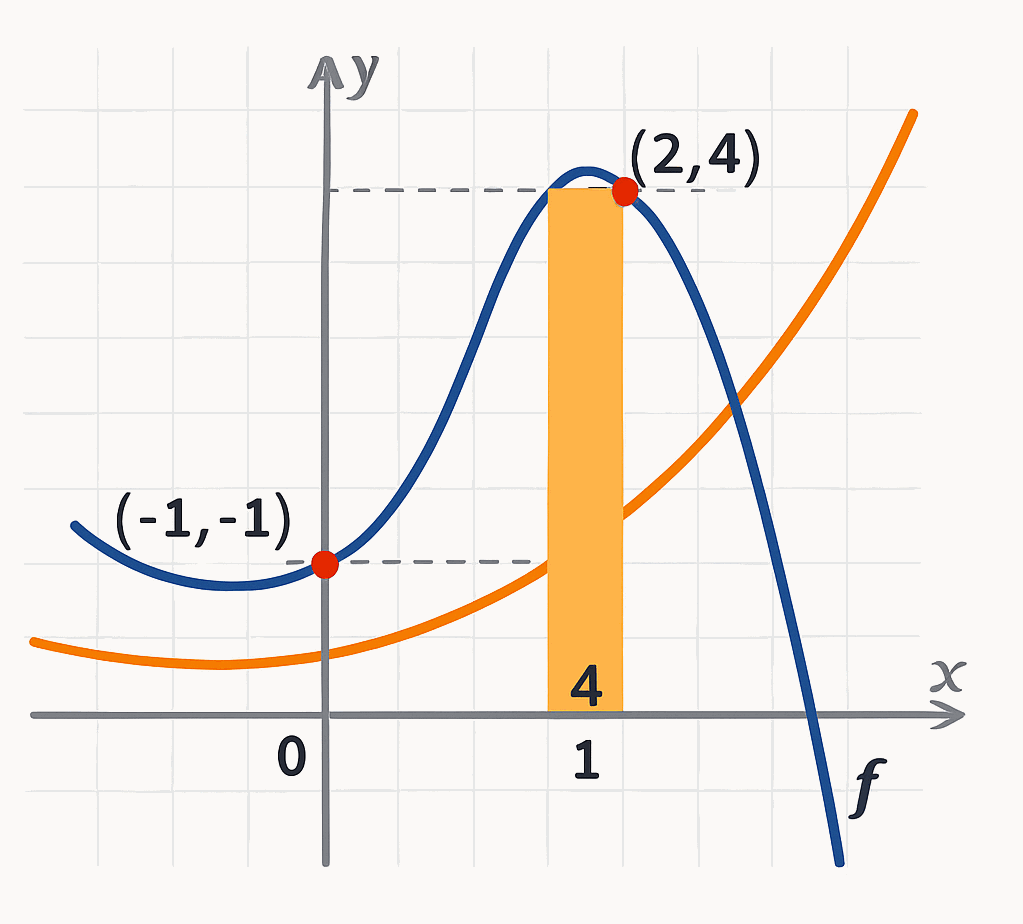
On a graph, the range is the set of all -values that the graph reaches.
Method: Project the graph onto the y-axis. The range is the vertical "shadow" of the graph.4. Range of Common Functions {#range-common}
| Function | Formula | Range | ||
| Linear | () | |||
| Constant | ||||
| Direct proportion | () | |||
| Inverse proportion | () | |||
| Quadratic (basic) | ||||
| Quadratic (negative) | ||||
| Square root | ||||
| Absolute value | $f(x) = | x | $ |
5. Finding the Range from a Formula {#range-from-formula}
Method for simple functions
Ask: "What values can produce?"
Example 1:
Since for all , we have:
The minimum value is 1 (when ), and can grow without bound.
Example 2:
Since , we have , so:
The maximum value is 4 (when ), and can decrease without bound.
Example 3:
Since , the fraction can be any number except 0.
6. Worked Examples {#worked-examples}
Example A
Find the range of on the domain .This is a linear function with slope . A non-constant linear function takes all real values.
Example B
Find the range of .The absolute value is always . When , .
Example C
Find the range of .Since , we have .
When : (minimum).
7. Common Mistakes {#common-mistakes}
| Mistake | Correction |
| Confusing domain and range | Domain = inputs (-values), Range = outputs (-values) |
| Saying for | is always , so |
| Forgetting that never equals 0 | has no solution, so |
| Not checking the minimum/maximum | For quadratics, find the vertex value first |
8. Interactive Exercises {#interactive-exercises}
Practice finding ranges:
Summary
| Concept | Description |
| Range | Set of all possible output values |
| From a graph | Project onto the y-axis -- the vertical extent |
| Linear () | |
Related Articles
- Domain of a Function -- which inputs are allowed
- Functions and Graphs -- visualising functions
- Introduction to Functions -- function basics
- Linear Function -- range of linear functions