Article Contents
- What is a Linear Function?
- Slope k
- Y-intercept q
- Drawing the Graph (Two-Point Method)
- SVG: Comparing Linear Functions
- Special Cases
- Parallel Lines
- Finding the Equation from Two Points
- Intersection with Axes
- Properties
- Common Mistakes
- Interactive Exercises
1. What is a Linear Function? {#what-is-linear}
A linear function is a function of the form:
where:
- is the slope (gradient) -- how steep the line is
- is the y-intercept -- where the line crosses the y-axis
The graph is always a straight line.
Relationship to Direct Proportion
When , the linear function becomes , which is a direct proportion. So direct proportion is a special case of the linear function.
2. Slope k {#slope-k}
The slope tells us how much changes when increases by 1:
| Value of | Meaning | Graph | ||
| Function is increasing | Line goes up to the right | |||
| Function is decreasing | Line goes down to the right | |||
| Function is constant | Horizontal line () | |||
| $ | k | $ large | Steep line | |
| $ | k | $ small | Gentle line |
Example
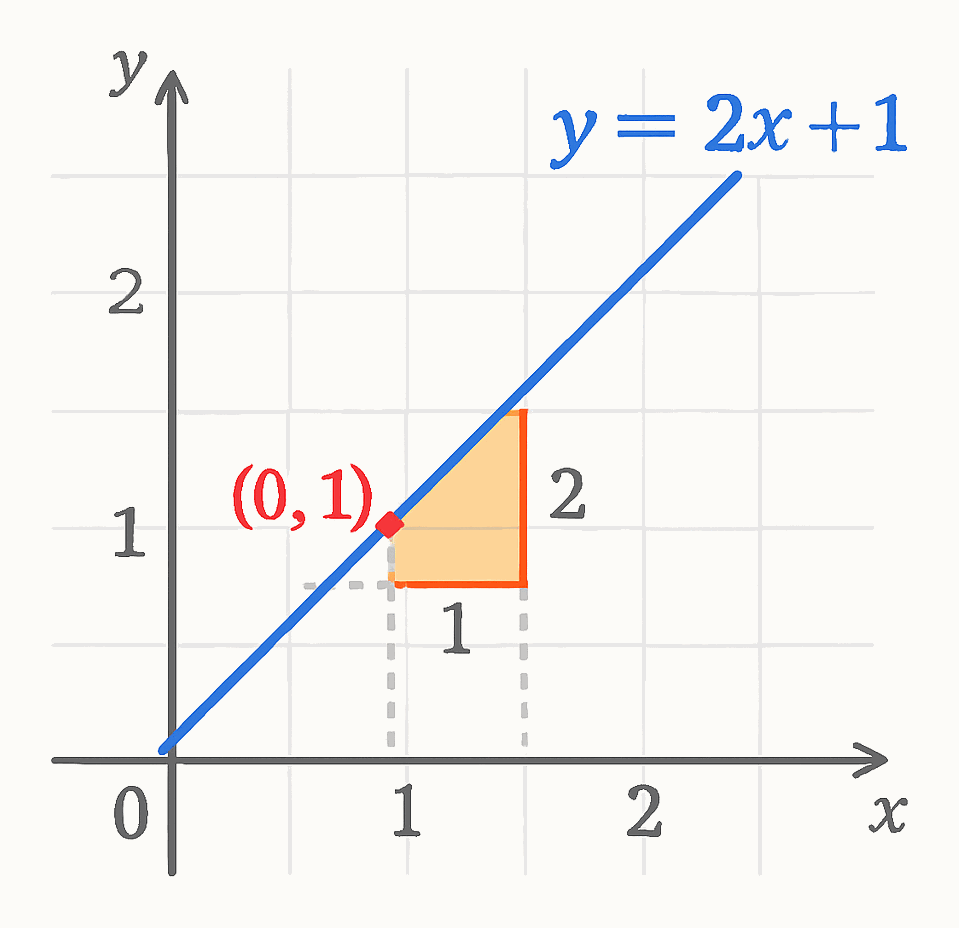
For : the slope is .
This means: when increases by 1, increases by 3.
3. Y-intercept q {#y-intercept-q}
The y-intercept is the value of :
So the graph crosses the y-axis at the point .
| Value of | Where the line crosses the y-axis |
| Above the origin | |
| At the origin (direct proportion) | |
| Below the origin |
4. Drawing the Graph (Two-Point Method) {#drawing-graph}
To draw a straight line, you only need two points. Here is the method:
Step 1: Find two points
Choose two easy values of (often and , or where ).
Step 2: Calculate
Step 3: Plot and connect
Example:
- Point 1: gives
- Point 2: gives
- Point 3 (check): gives
Plot these points and draw a straight line through them.
5. SVG: Comparing Linear Functions {#comparing-functions}
| Function | Slope | Y-intercept | Behaviour |
| Increasing, steep | |||
| Decreasing | |||
| Increasing, gentle |
Notice how:
- The blue and green lines both go upward (positive ), but blue is steeper
- The red line goes downward (negative )
- Each line crosses the y-axis at its value
6. Special Cases {#special-cases}
| Case | Equation | Graph |
| Horizontal line | ||
| Direct proportion (through origin) | ||
| The identity line (45 degree angle) |
7. Parallel Lines {#parallel-lines}
Two linear functions are parallel if and only if they have the same slope .
Example
and are parallel (both have ).They never intersect -- the distance between them is constant.
Rule: Same slope = parallel. Different slope = the lines will intersect at exactly one point.8. Finding the Equation from Two Points {#equation-from-points}
Given two points and :
Step 1: Calculate the slope:Example
Find the equation of the line through and .
9. Intersection with Axes {#intersection-axes}
Y-axis intersection
Set :
The line crosses the y-axis at .
X-axis intersection (zero of the function)
Set :
The line crosses the x-axis at .
Example:
- Y-intercept:
- X-intercept: , so
10. Properties {#properties}
| Property | Value |
| Formula | |
| Graph | Straight line |
| Domain | |
| Range | (if ) or (if ) |
| Slope | |
| Y-intercept | |
| X-intercept | for |
| Increasing | When |
| Decreasing | When |
| Parallel lines | Same slope |
11. Common Mistakes {#common-mistakes}
| Mistake | Correction |
| Confusing slope and y-intercept | In , is the slope (multiplies ), is the y-intercept (constant) |
| Using only one point to draw | Use at least two points; three for verification |
| Thinking parallel lines have the same | Parallel means same , not same |
| Writing | The slope is , not |
| Confusing with direct proportion | Direct proportion: (no ). Linear: |
12. Interactive Exercises {#interactive-exercises}
Practice linear functions:
Summary
| Concept | Description |
| Linear function | |
| Slope | Rate of change; steepness and direction of the line |
| Y-intercept | Where the line crosses the y-axis: |
| Drawing | Find 2 points, plot them, draw a straight line |
| Parallel | Same slope , different |
| Special case | gives direct proportion |
Related Articles
- Introduction to Functions -- what is a function
- Direct Proportion -- the special case
- Functions and Graphs -- plotting and reading graphs
- Domain of a Function -- allowed inputs
- Range of a Function -- possible outputs
- Summary of Functions -- quick reference card