Article Contents
- What is Direct Proportion?
- The Constant of Proportionality k
- Table of Values
- Graph of Direct Proportion
- Positive vs Negative k
- Comparing Different Values of k
- Properties of Direct Proportion
- Real-Life Examples
- Common Mistakes
- Interactive Exercises
1. What is Direct Proportion? {#what-is-direct-proportion}
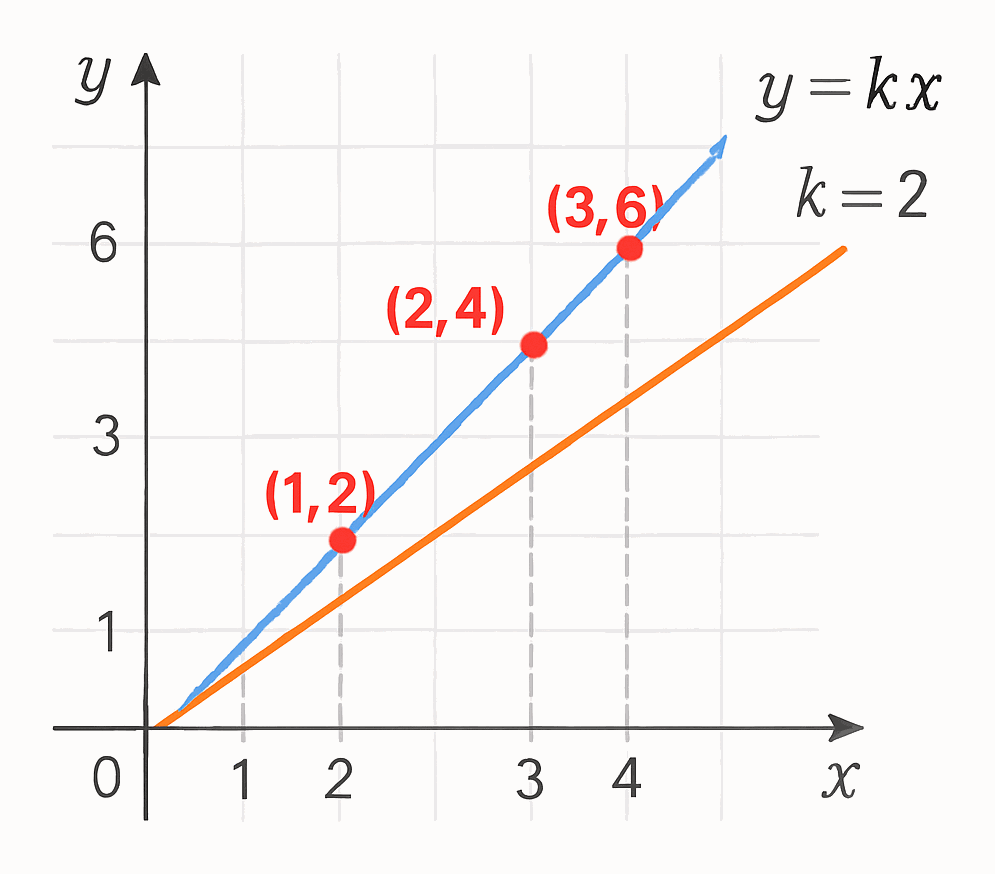
Direct proportion is a function of the form:It describes the relationship "when doubles, doubles too." The variable is directly proportional to .
Key feature
The graph of a direct proportion is a straight line through the origin .
This makes sense: when , .
2. The Constant of Proportionality k {#constant-k}
The number is called the constant of proportionality (or slope).
| Value of | Effect | ||
| increases as increases (graph goes up-right) | |||
| decreases as increases (graph goes down-right) | |||
| $ | k | $ large | Steep line |
| $ | k | $ small | Gentle line |
Finding k from a point
If you know that , then:
3. Table of Values {#table-of-values}
Example:
Notice: the ratio is constant for every non-zero .
Example:
Here : the output is always the negative of the input.
4. Graph of Direct Proportion {#graph}
Every direct proportion is a straight line through the origin.
All three lines pass through the origin .
5. Positive vs Negative k {#positive-vs-negative}
When (e.g. )
- The function is increasing -- as grows, grows
- The graph goes from bottom-left to top-right
- Both variables change in the same direction
When (e.g. )
- The function is decreasing -- as grows, shrinks
- The graph goes from top-left to bottom-right
- The variables change in opposite directions
6. Comparing Different Values of k {#comparing-k}
| Function | Steepness | Direction | |
| Very steep | Increasing | ||
| Steep | Increasing | ||
| Gentle | Increasing | ||
| Gentle | Decreasing | ||
| Steep | Decreasing |
7. Properties of Direct Proportion {#properties}
| Property | Value |
| Formula | , |
| Graph | Straight line through origin |
| Domain | |
| Range | |
| y-intercept | Always |
| Increasing/decreasing | Increasing if , decreasing if |
| Key ratio | is constant |
8. Real-Life Examples {#real-life-examples}
Price and quantity
Pencils cost \$1.50 each. The total price:
| Pencils | ||||
| Price | \$1.50 | \$3.00 | \$7.50 | \$15.00 |
Speed and distance
A runner moves at 8 km/h. Distance after hours:
Currency conversion
If 1 EUR = 1.10 USD:
where is the amount in EUR.
Weight on the Moon
An object's weight on the Moon is about of its weight on Earth:
9. Common Mistakes {#common-mistakes}
| Mistake | Correction |
| Confusing direct proportion with linear function | Direct proportion is (no constant term). Linear is |
| Thinking must be positive | can be negative (e.g. ) |
| Forgetting the graph must pass through the origin | If the line does not pass through , it is not a direct proportion |
| Confusing with inverse proportion | Direct: (multiply). Inverse: (divide) |
10. Interactive Exercises {#interactive-exercises}
Practice direct proportion:
Summary
| Concept | Description | ||
| Direct proportion | , | ||
| Graph | Straight line through the origin | ||
| Increasing function | |||
| Decreasing function | |||
| **$ | k | $ large** | Steep line |
| Key property | is always the same |
Related Articles
- Introduction to Functions -- what is a function
- Functions and Graphs -- plotting and reading graphs
- Linear Function -- generalisation
- Inverse Proportion -- the other type of proportion
- Summary of Functions -- quick reference card