Article Contents
- What is the Domain?
- When the Domain is All Real Numbers
- Restriction: Division by Zero
- Restriction: Square Roots
- Combining Restrictions
- Interval Notation
- Reading the Domain from a Graph
- Common Mistakes
- Interactive Exercises
1. What is the Domain? {#what-is-domain}
The domain of a function (written ) is the set of all allowed inputs -- all values of for which is defined and produces a real number.
Think of it this way
The domain answers: "Which values of can I plug in?"
2. When the Domain is All Real Numbers {#domain-all-reals}
For many common functions, every real number is a valid input:
| Function | Domain | Why |
| Linear -- no restrictions | ||
| Polynomial -- no restrictions | ||
| Polynomial -- no restrictions | ||
| Constant -- no restrictions |
3. Restriction: Division by Zero {#division-by-zero}
Division by zero is undefined. If the function has in a denominator, we must exclude values that make the denominator zero.
Example 1:
The denominator is . Set it equal to zero:
So is not allowed.
Example 2:
Example 3:
Factor the denominator:
4. Restriction: Square Roots {#square-roots}
The expression under a square root must be non-negative (greater than or equal to zero).
Example 1:
Example 2:
Example 3:
5. Combining Restrictions {#combining-restrictions}
Some functions have both a fraction and a square root.
Example:
Two conditions:
- Square root requires:
2. Denominator requires:
Combining: .
Example:
- Square root requires:
- Denominator requires:
6. Interval Notation {#interval-notation}
We use intervals to describe the domain concisely:
| Notation | Meaning |
| All with (endpoints excluded) | |
| All with (endpoints included) | |
| All with | |
| All with | |
| All with | |
| All real numbers = | |
| All real numbers except |
Union of intervals
When the domain has a "gap", we use (union):
This means all real numbers except .
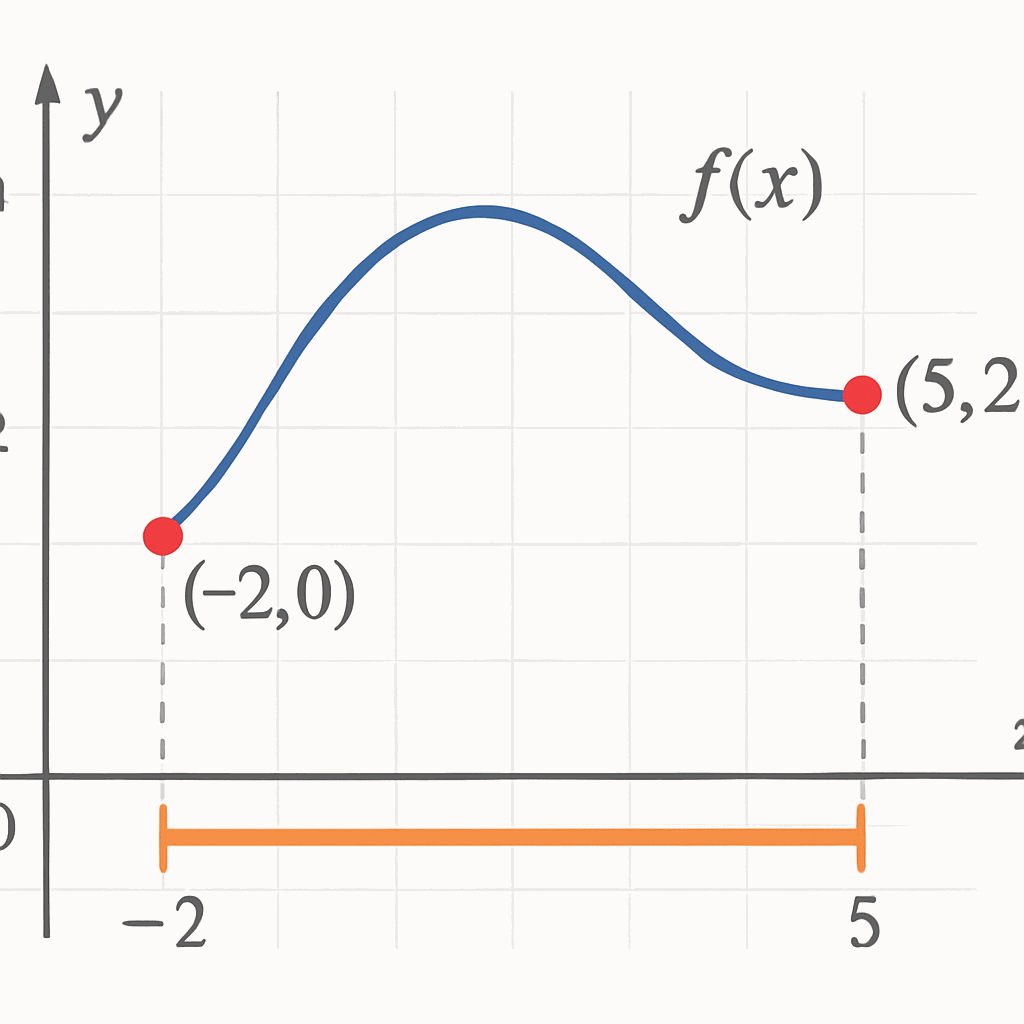
7. Reading the Domain from a Graph {#domain-from-graph}
On a graph, the domain is the set of all -values where the graph exists.
Look at the horizontal extent of the graph -- from the leftmost to the rightmost point.
8. Common Mistakes {#common-mistakes}
| Mistake | Correction |
| Forgetting to check the denominator | Always set denominator |
| Writing instead of | The condition goes on the expression under the root |
| Using instead of for square roots | is defined, so include the boundary |
| Ignoring the case | Here the expression under the root must be strictly positive () |
9. Interactive Exercises {#interactive-exercises}
Practice finding domains:
Summary
| Function type | Domain rule |
| Polynomial () | |
| Fraction () | |
| Square root () | |
| Root in denominator () |
Related Articles
- Introduction to Functions -- what is a function
- Range of a Function -- which outputs are possible
- Functions and Graphs -- visualising functions
- Inverse Proportion -- a function with