Article Contents
- What is a Function Table?
- Building a Table from a Formula
- Step-by-Step Example
- Reading Values from a Table
- Finding a Formula from a Table
- Tables with Real-Life Data
- From Table to Graph
- Common Mistakes
- Interactive Exercises
1. What is a Function Table? {#what-is-a-table}
A function table (or table of values) lists selected inputs and their corresponding outputs:
Each row contains an input-output pair .
Tables are especially useful for:
- Computing specific values before drawing a graph
- Organising measured or experimental data
- Spotting patterns in a function's behaviour
2. Building a Table from a Formula {#building-a-table}
Given a formula, follow these steps:
- Choose several -values (include negative, zero, and positive values)
- Substitute each into the formula
- Calculate
- Write the results in the table
Example:
| Calculation | ||
3. Step-by-Step Example {#step-by-step}
Task: Complete the table for . Step 1: Choose values: Step 2: Substitute and calculate:Notice the pattern: each time increases by 1, increases by 2. This is because the coefficient of is 2.
4. Reading Values from a Table {#reading-from-table}
Given a table, you can answer questions like:
Look at the column where . The answer is .
Q: For which is ?Find the column where . The answer is .
Q: For which is ?The value does not appear in the table. It falls between and . We would need the formula or graph to find the exact value.
5. Finding a Formula from a Table {#formula-from-table}
Sometimes you need to discover the rule behind a table.
Example
The difference is constant (), so this is a linear function: .
Step 2: The constant difference gives us the slope: . Step 3: Use a known point, e.g. :Verification
-- matches the table.6. Tables with Real-Life Data {#real-life-tables}
Temperature throughout the day
| Time | 6:00 | 9:00 | 12:00 | 15:00 | 18:00 | 21:00 |
| Temp (C) |
Here the independent variable is time and the dependent variable is temperature.
Taxi fare
| Distance (km) | ||||||
| Fare (\$) |
The fare increases by \2 per km, with a \3 base fee: .
7. From Table to Graph {#table-to-graph}
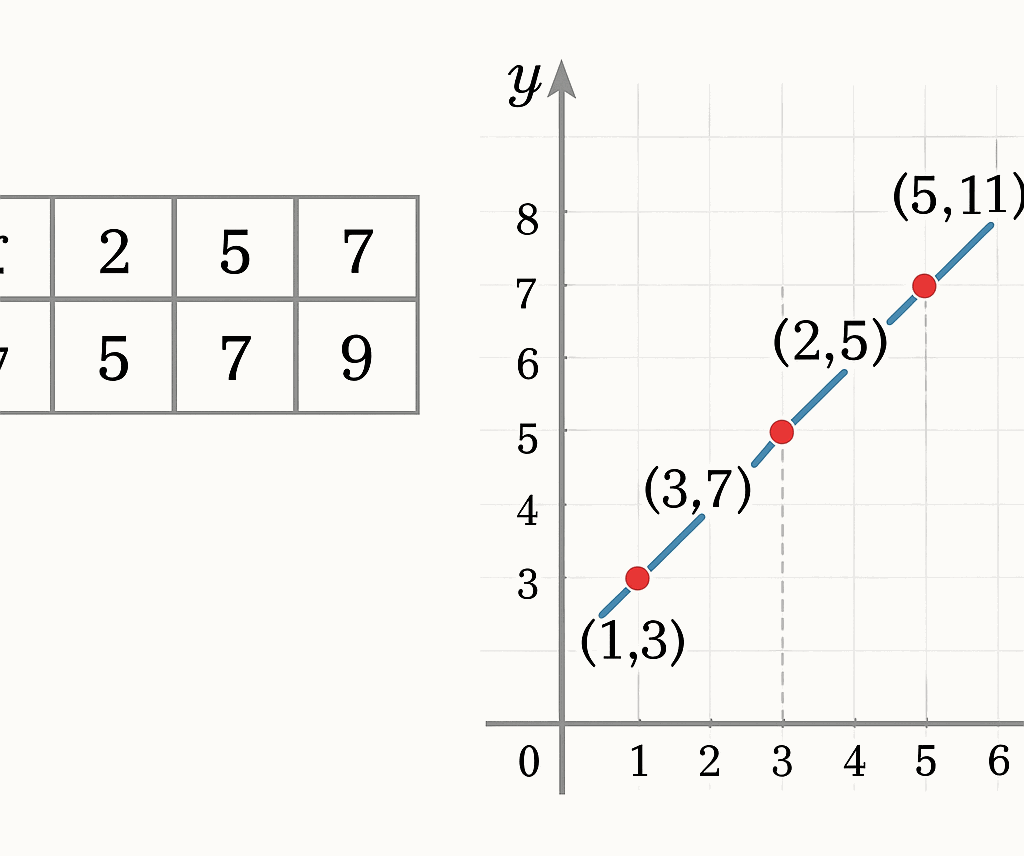
A table provides the points you need to draw a graph:
- Each pair becomes a point in the coordinate plane
- Plot all points
- Connect them with a smooth curve (or a straight line if linear)
See the detailed process in Functions and Graphs.
8. Common Mistakes {#common-mistakes}
| Mistake | How to avoid it |
| Forgetting negative signs when substituting | Use parentheses: , not |
| Choosing only positive -values | Always include negative values and zero |
| Assuming a linear pattern without checking | Verify the difference is truly constant |
| Skipping the calculation column | Write out intermediate steps to reduce errors |
9. Interactive Exercises {#interactive-exercises}
Practice working with function tables:
Summary
| Concept | Description |
| Function table | Lists input-output pairs |
| Building a table | Choose -values, substitute into the formula, compute |
| Reading a table | Find the column with the given or |
| Finding a formula | Look for constant differences (linear) or other patterns |
Related Articles
- Introduction to Functions -- what is a function
- Variables in Functions -- independent and dependent variables
- Functions and Graphs -- plotting tables as graphs
- Linear Function -- the most common table pattern