Article Contents
- What is Inverse Proportion?
- The Constant k
- Table of Values
- Graph: The Hyperbola
- Comparing k > 0 and k < 0
- Domain and Range
- Asymptotes
- Properties of Inverse Proportion
- Real-Life Examples
- Common Mistakes
- Interactive Exercises
1. What is Inverse Proportion? {#what-is-inverse-proportion}
Inverse proportion is a function of the form:
f(x)=xk,k=0
It describes the relationship "when x doubles, y halves." The product x⋅y=k is constant.
Key feature
As one variable gets larger, the other gets smaller -- they change in opposite ways.
2. The Constant k {#constant-k}
The number k determines the shape and position of the graph.
k=x⋅y=x⋅f(x)
Finding k
If you know that when x=4, y=3:
k=4⋅3=12⟹f(x)=x12
3. Table of Values {#table-of-values}
Example: f(x)=x6
| x | −6 | −3 | −2 | −1 | 1 | 2 | 3 | 6 |
| f(x) | −1 | −2 | −3 | −6 | 6 | 3 | 2 | 1 |
Notice:
- We skip x=0 (division by zero is undefined)
- The product x⋅f(x)=6 is always constant
- Positive x gives positive f(x); negative x gives negative f(x)
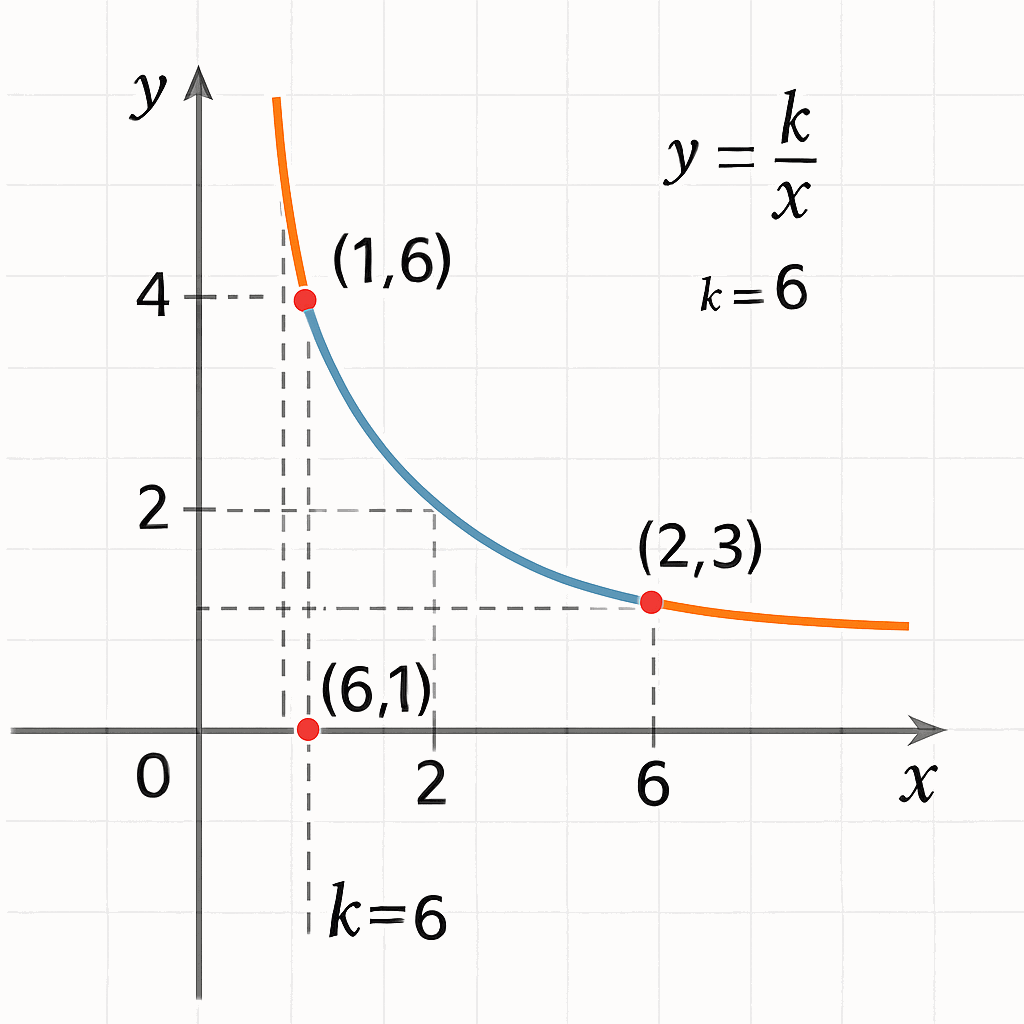
4. Graph: The Hyperbola {#graph-hyperbola}
The graph of f(x)=xk is called a hyperbola. It has two separate branches.
The graph has two branches:
- When k>0: one branch in quadrant I, one in quadrant III
- The branches never touch the axes
5. Comparing k > 0 and k < 0 {#comparing-k}
| k>0 (e.g. y=x2) | k<0 (e.g. y=x−2) |
| Branches in | Quadrants I and III | Quadrants II and IV |
| In quadrant I | Decreasing, positive | Does not exist |
| Behaviour | Both x and y have the same sign | x and y have opposite signs |
6. Domain and Range {#domain-range}
Since we cannot divide by zero:
D(f)=R∖{0}=(−∞,0)∪(0,+∞)
The output xk can be any number except 0:
R(f)=R∖{0}=(−∞,0)∪(0,+∞)
See Domain of a Function and Range of a Function for more details.
7. Asymptotes {#asymptotes}
An asymptote is a line that the graph approaches but never touches.
The hyperbola y=xk has two asymptotes:
| Asymptote | Equation | Meaning |
| Vertical | x=0 (y-axis) | As x→0, $ | y | \to \infty$ |
| Horizontal | y=0 (x-axis) | As $ | x | \to \infty,y \to 0$ |
In words: the graph gets infinitely close to the axes but never reaches them.
8. Properties of Inverse Proportion {#properties}
| Property | Value |
| Formula | f(x)=xk, k=0 |
| Graph | Hyperbola (two branches) |
| Domain | D(f)=R∖{0} |
| Range | R(f)=R∖{0} |
| Asymptotes | x=0 and y=0 |
| Key product | x⋅y=k is constant |
| Symmetry | The graph is symmetric about the origin |
9. Real-Life Examples {#real-life-examples}
Workers and time
A job takes 120 person-hours. The time t to finish depends on the number of workers w:
t(w)=w120
| Workers w | 1 | 2 | 3 | 4 | 6 | 10 | 12 |
| Hours t | 120 | 60 | 40 | 30 | 20 | 12 | 10 |
More workers means less time -- classic inverse proportion!
Speed and travel time
A journey is 240 km. The travel time t depends on speed v:
t(v)=v240
| Speed (km/h) | 40 | 60 | 80 | 120 |
| Time (h) | 6 | 4 | 3 | 2 |
Sharing equally
A pizza is cut into n equal slices. Each person's share:
s(n)=n1
As more people share, each gets less.
Pressure and volume (Boyle's Law)
At constant temperature, gas pressure P and volume V satisfy:
P⋅V=k⟹P=Vk
10. Common Mistakes {#common-mistakes}
| Mistake | Correction |
| Plotting at x=0 | f(0) is undefined -- skip x=0 |
| Connecting the two branches | The branches are separate -- do not draw a line through the origin |
| Confusing with direct proportion | Direct: y=kx (line). Inverse: y=k/x (hyperbola) |
| Thinking the graph touches the axes | It approaches but never touches (asymptotes) |
11. Interactive Exercises {#interactive-exercises}
Practice inverse proportion:
Summary
| Concept | Description |
| Inverse proportion | f(x)=xk, k=0 |
| Graph | Hyperbola with two branches |
| Key property | x⋅y=k is constant |
| Domain | R∖{0} |
| Range | R∖{0} |
| Asymptotes | x=0 (vertical) and y=0 (horizontal) |
Related Articles