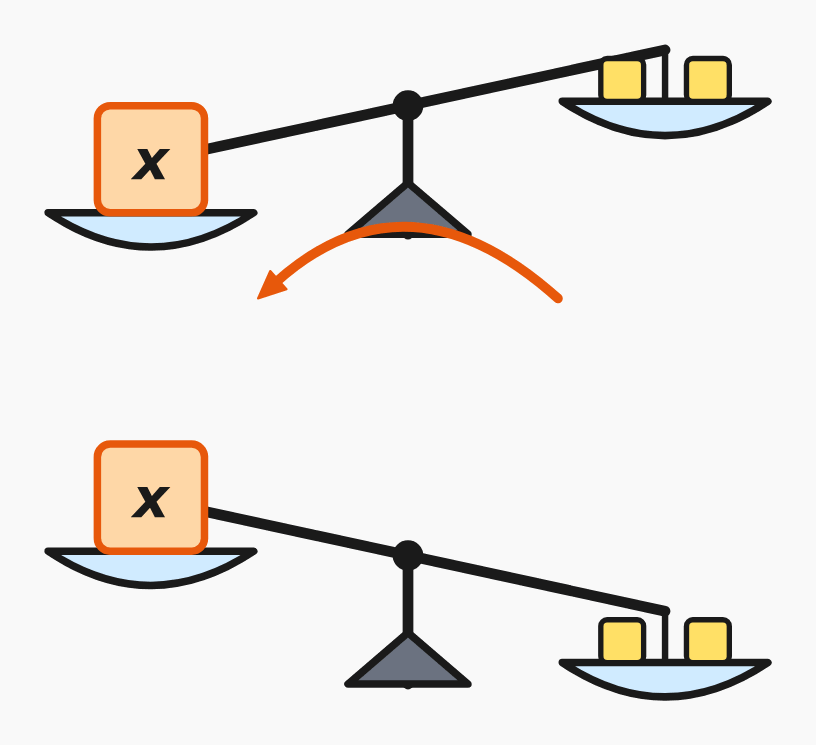
A linear inequality with one variable is a mathematical statement that can be written in one of the following forms:
ax+b>cax+b<cax+b≥cax+b≤c
where:
a, b, and c are known numbers (coefficients)
x is the unknown variable we want to find
The highest power of x is 1 (that is what makes it "linear")
Difference from an Equation
With an equation like 2x+3=11, we look for one specific number (x=4).
With an inequality like 2x+3>11, we look for an entire set of numbers that satisfy the inequality (x>4, meaning 5, 6, 4.1, 100, and so on).
Key difference: The solution to an equation is usually a single number. The solution to an inequality is an interval or set of numbers.
Examples of Linear Inequalities
Inequality
Type
2x+3>11
strict inequality (greater than)
x−5<8
strict inequality (less than)
3x≥15
non-strict inequality (greater than or equal to)
4x≤6
non-strict inequality (less than or equal to)
What is NOT a Linear Inequality?
x2+3>12 --- x has power 2 (quadratic inequality)
2x<16 --- x is in the exponent (exponential inequality)
x1≥4 --- x is in the denominator (rational inequality)
2. Inequality Symbols
Symbol
Name
Meaning
Example
<
less than
left side is smaller than right side
3<5
>
greater than
left side is larger than right side
7>2
≤
less than or equal to
left side is smaller or equals the right
3≤5, also 3≤3
≥
greater than or equal to
left side is larger or equals the right
7≥2, also 7≥7
Strict vs. Non-Strict Inequalities
Strict inequalities (<, >) --- the boundary value is not included in the solution
Non-strict inequalities (≤, ≥) --- the boundary value is included in the solution
Example: For x>3 the number 3 is not a solution. For x≥3 the number 3 is a solution.
3. Transformation Rules
Rule 1: Addition and Subtraction
You can add or subtract any number on both sides of an inequality. The direction of the inequality does not change.
x+5>12⇒x+5−5>12−5⇒x>7
x−3≤10⇒x−3+3≤10+3⇒x≤13
Rule 2: Multiplication and Division by a Positive Number
You can multiply or divide both sides of an inequality by a positive number. The direction of the inequality does not change.
3x>15⇒33x>315⇒x>5
4x≤6⇒x≤24
Rule 3: Multiplication and Division by a Negative Number
WARNING! This is the most important rule! When you multiply or divide both sides of an inequality by a negative number, you must reverse the direction of the inequality!
−2x>6⇒−2−2x<−26⇒x<−3
−x≤5⇒x≥−5
Why does the direction reverse? Consider concrete numbers:
We know that 3<7
Multiply both sides by −1: we get −3 and −7
On the number line −3>−7, so the inequality flipped!
Rules Summary
Operation
Inequality Direction
+a or −a
stays the same
×a or ÷a where a>0
stays the same
×a or ÷a where a<0
reverses!
4. Step-by-Step Solving
Example 1: Simple Inequality
Solve: 2x+3>11
Step 1: Subtract 3 from both sides
2x+3−3>11−3
2x>8
Step 2: Divide both sides by 2 (positive, direction stays the same)
22x>28
x>4
Step 3: Check by substitution (e.g. x=5)
2⋅5+3=13>11✓
Solution:x∈(4,∞)
Example 2: Inequality with a Negative Coefficient
Solve: −3x+6≤15
Step 1: Subtract 6 from both sides
−3x+6−6≤15−6
−3x≤9
Step 2: Divide both sides by −3 (negative, reverse the direction!)
−3−3x≥−39
x≥−3
Step 3: Check by substitution (e.g. x=0)
−3⋅0+6=6≤15✓
Also check the boundary point (x=−3):
−3⋅(−3)+6=9+6=15≤15✓
Solution:x∈[−3,∞)
Example 3: Variable on Both Sides
Solve: 5x−4>2x+8
Step 1: Move terms with x to the left side (subtract 2x)
5x−2x−4>8
3x−4>8
Step 2: Move numbers to the right side (add 4)
3x>12
Step 3: Divide by 3 (positive, direction stays the same)
x>4
Step 4: Check by substitution (e.g. x=5)
5⋅5−4=21>2⋅5+8=18✓
Solution:x∈(4,∞)
5. Writing Solutions
Solutions of an inequality can be written in three ways:
Way 1: Inequality Notation
Write the solution as an inequality:
x>3x≤−2x≥0
Way 2: Interval Notation
Write the solution as an interval:
Inequality
Interval
x>3
(3,∞)
x≥3
[3,∞)
x<3
(−∞,3)
x≤3
(−∞,3]
Note: With ∞ and −∞ always use a round bracket (open end), because infinity is not a specific number.
Way 3: Number Line Representation
Strict inequality (<, >) --- open circle on the boundary point
Non-strict inequality (≤, ≥) --- filled circle on the boundary point
An arrow shows the direction where the solutions lie
Solving inequalities is very similar to solving equations. You use the same techniques:
Equations
Inequalities
Add/subtract on both sides
Add/subtract on both sides
Multiply/divide on both sides
Multiply/divide on both sides
The = sign never changes
The direction changes when multiplying/dividing by a negative!
Solution: a single number (x=4)
Solution: an interval (x>4)
Check: substitute and verify equality
Check: substitute and verify inequality
Tip: If you can solve linear equations, you can solve inequalities too. Just remember one extra rule --- when multiplying or dividing by a negative number, flip the inequality sign.
8. Common Mistakes to Avoid
Mistake 1: Forgetting to Reverse the Inequality
−2x>6
Wrong: x>−3
Correct: x<−3 (dividing by a negative number reverses the sign!)
Mistake 2: Incorrect Interval Notation
For x>3:
Wrong: [3,∞) --- the square bracket means 3 is included in the solution
Correct: (3,∞) --- round bracket, because 3 is not a solution