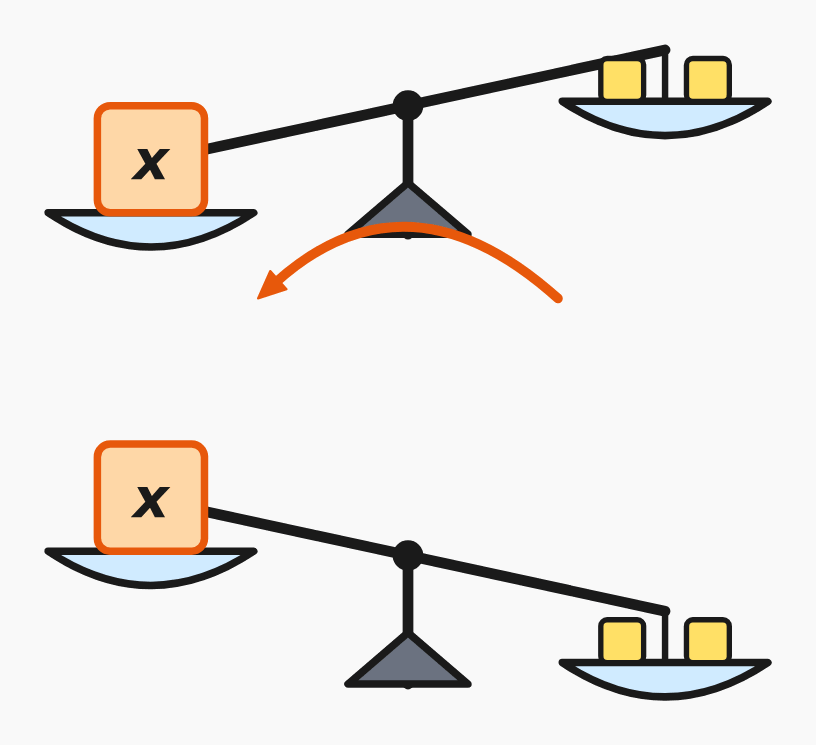
Table of Contents
- Type 1: Addition and Subtraction
- Type 2: Multiplication by a Positive Number
- Type 3: Division by a Positive Number
- Type 4: Multiplication by a Negative Number
- Type 5: Two Operations Combined
- Summary
- Practice Exercises
- Related Articles
Type 1: Addition and Subtraction
These are the simplest inequalities. You solve them by adding or subtracting the same number from both sides. The inequality direction does not change.
Example 1a
Solve: x+7>12
x+7>12
x+7−7>12−7
x>5
Check: Let
x=6:
6+7=13>12 ✓
Solution: x∈(5,∞)
Example 1b
Solve: x−3≤10
x−3≤10
x−3+3≤10+3
x≤13
Check: Let
x=10:
10−3=7≤10 ✓
Solution: x∈(−∞,13]
Type 2: Multiplication by a Positive Number
When x is multiplied by a positive number, divide both sides by that number. The inequality direction does not change.
Example 2a
Solve: 3x>18
3x>18
33x>318
x>6
Check: Let
x=7:
3⋅7=21>18 ✓
Solution: x∈(6,∞)
Example 2b
Solve: 5x≤40
5x≤40
55x≤540
x≤8
Check: Let
x=8:
5⋅8=40≤40 ✓
Solution: x∈(−∞,8]
Type 3: Division by a Positive Number
When x is divided by a positive number, multiply both sides by that number. The inequality direction does not change.
Example 3a
Solve: 4x<3
4x<3
4x⋅4<3⋅4
x<12
Check: Let
x=8:
48=2<3 ✓
Solution: x∈(−∞,12)
Example 3b
Solve: 2x≥−5
2x≥−5
x≥−10
Check: Let
x=0:
20=0≥−5 ✓
Solution: x∈[−10,∞)
Type 4: Multiplication by a Negative Number
This is where students make the most mistakes! When you divide by a negative number, you must reverse the inequality sign.
Example 4a
Solve: −2x>8
−2x>8
Divide both sides by −2. Since −2 is negative, flip the sign:
x<−28
x<−4
Check: Let
x=−5:
−2⋅(−5)=10>8 ✓
Also check that x=−4 does NOT work: −2⋅(−4)=8, and
8>8 is false
✓
Solution: x∈(−∞,−4)
Example 4b
Solve: −x≤6
−x≤6
Multiply both sides by −1. Since −1 is negative, flip the sign:
x≥−6
Check: Let
x=0:
−0=0≤6 ✓
Solution: x∈[−6,∞)
Type 5: Two Operations Combined
These require two steps: first add/subtract, then multiply/divide.
Example 5a
Solve: 2x+5>13
Step 1: Subtract 5 from both sides
2x>13−5
2x>8
Step 2: Divide by 2 (positive, direction unchanged)
x>4
Check: Let
x=5:
2⋅5+5=15>13 ✓
Solution: x∈(4,∞)
Example 5b
Solve: −4x+3≥19
Step 1: Subtract 3 from both sides
−4x≥19−3
−4x≥16
Step 2: Divide by
−4 (negative,
reverse the sign!)
x≤−416
x≤−4
Check: Let
x=−5:
−4⋅(−5)+3=20+3=23≥19 ✓
Check boundary x=−4:
−4⋅(−4)+3=16+3=19≥19 ✓
Solution: x∈(−∞,−4]
Summary
| Type | Example | Key Point |
| Addition/Subtraction | x+a>b | Direction unchanged |
| Positive coefficient | ax>b, a>0 | Direction unchanged |
| Positive divisor | ax>b, a>0 | Direction unchanged |
| Negative coefficient | ax>b, a<0 | Direction reverses! |
| Two operations | ax+b>c | Solve step by step |
Golden rule: The inequality sign flips only when you multiply or divide by a negative number. Addition and subtraction never change the direction.
Practice Exercises
Related Articles