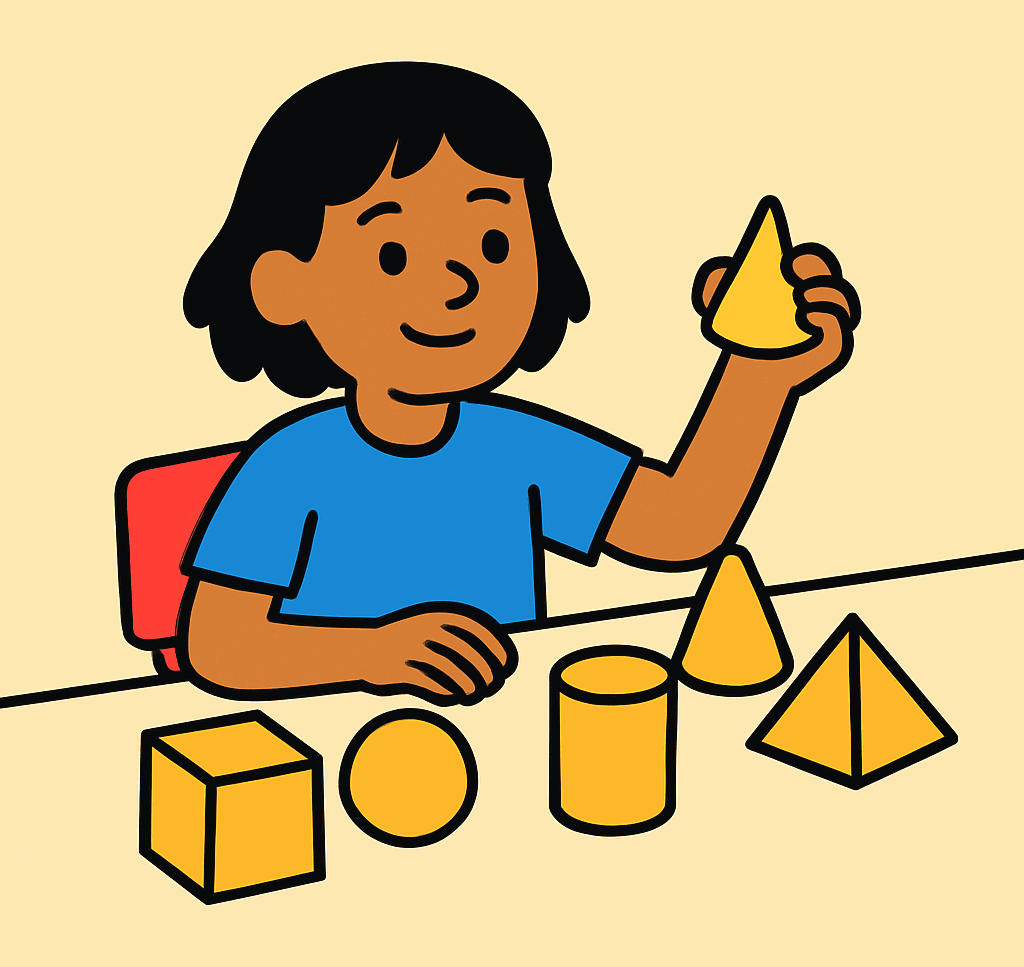
We've gone through all seven basic solids and learned three things: what they are called, how many faces, edges, and vertices they have, and where to find them in the real world. Below is a quick summary and links to exercises.
The seven basic solids
Solid
Main properties
Cube
six equal square faces
Cuboid
six rectangular faces of different sizes
Sphere
completely round, no edges
Cylinder
two circles + side surface
Cone
circle at the bottom + pointy top
Pyramid
square at the bottom + 4 triangles
Prism
two triangles + three rectangles
Faces, edges, vertices – reference
Solid
Faces
Edges
Vertices
Cube
6
12
8
Cuboid
6
12
8
Pyramid
5
8
5
Prism
5
9
6
Tips
Naming a solid: ask – does it have flat faces? Are they curved? How many? What shape?
Counting faces, edges, vertices: a picture usually helps – count step by step, don't forget the back and bottom which you may not see.
Finding a solid in the real world: ask – what shape does this object basically have? Ignore small details (rounded edges, missing pieces) – you're looking for similarity.
Practice generators
Start here
Name the solid – picture of a solid, pick the name from 4 options.
Objects around us – real-world object (ball, can...), pick the solid it resembles.