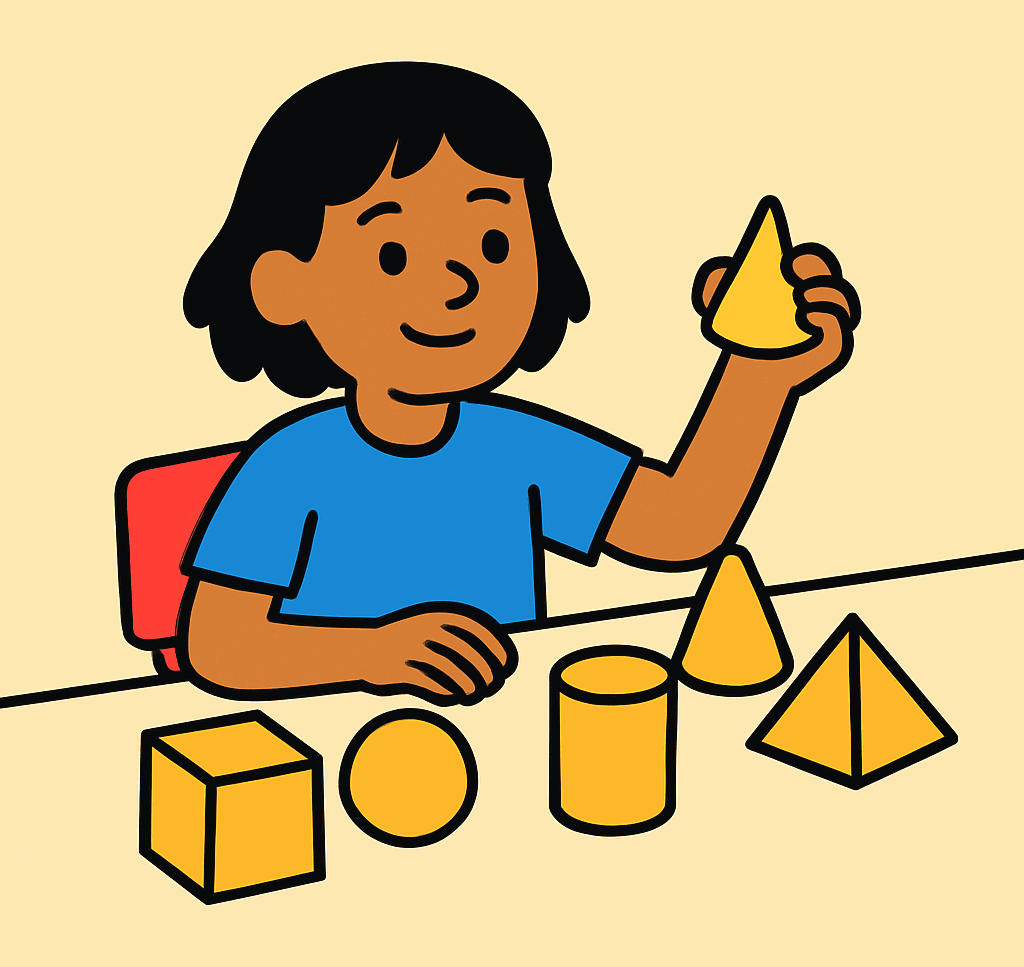
Things around us have all sorts of shapes. Some are flat – like a sheet of paper or a tile. Others have height as well – you can pick them up and turn them around. Flat shapes are called plane figures, three-dimensional shapes are called solids.
In this chapter you will learn to:
- recognise the seven basic solids
- name each solid
- count its faces, edges, and vertices
- find a solid in everyday objects
Plane figure vs solid
A square, a circle, or a triangle can be drawn on a sheet of paper. They are plane figures. They have only length and width, no thickness.
A cube, a ball, or a can also have height or thickness. You can hold them in your hand. They are solids.
The seven basic solids
In this chapter you meet seven solids:
- Cube – like a die, six equal square faces
- Cuboid – like a shoebox, flat faces of different sizes
- Sphere – like a ball, perfectly round on every side
- Cylinder – like a can or a pencil, circles on top and bottom
- Cone – like an ice-cream cone, pointy on top
- Pyramid – like an Egyptian pyramid, pointy on top with a square base
- Prism – like a tent or roof, two triangles and three rectangles
Faces, edges, and vertices
Solids with flat faces (cube, cuboid, pyramid, prism) have three important parts you can count:
- Face – a flat surface (like a page in a book)
- Edge – a line where two faces meet
- Vertex – a pointy corner where at least three edges meet
| Solid | Faces | Edges | Vertices |
| Cube | 6 | 12 | 8 |
| Cuboid | 6 | 12 | 8 |
| Square pyramid | 5 | 8 | 5 |
| Triangular prism | 5 | 9 | 6 |
For the sphere, cylinder, and cone we usually do not count faces, edges, and vertices the same way – they have curved surfaces.
Solids in the real world
- ⚽ ball → sphere
- 🥫 can → cylinder
- 🎲 die → cube
- 📦 box → cuboid
- 🍦 ice-cream cone → cone
- 🛕 Egyptian pyramid → pyramid
- ⛺ tent → prism