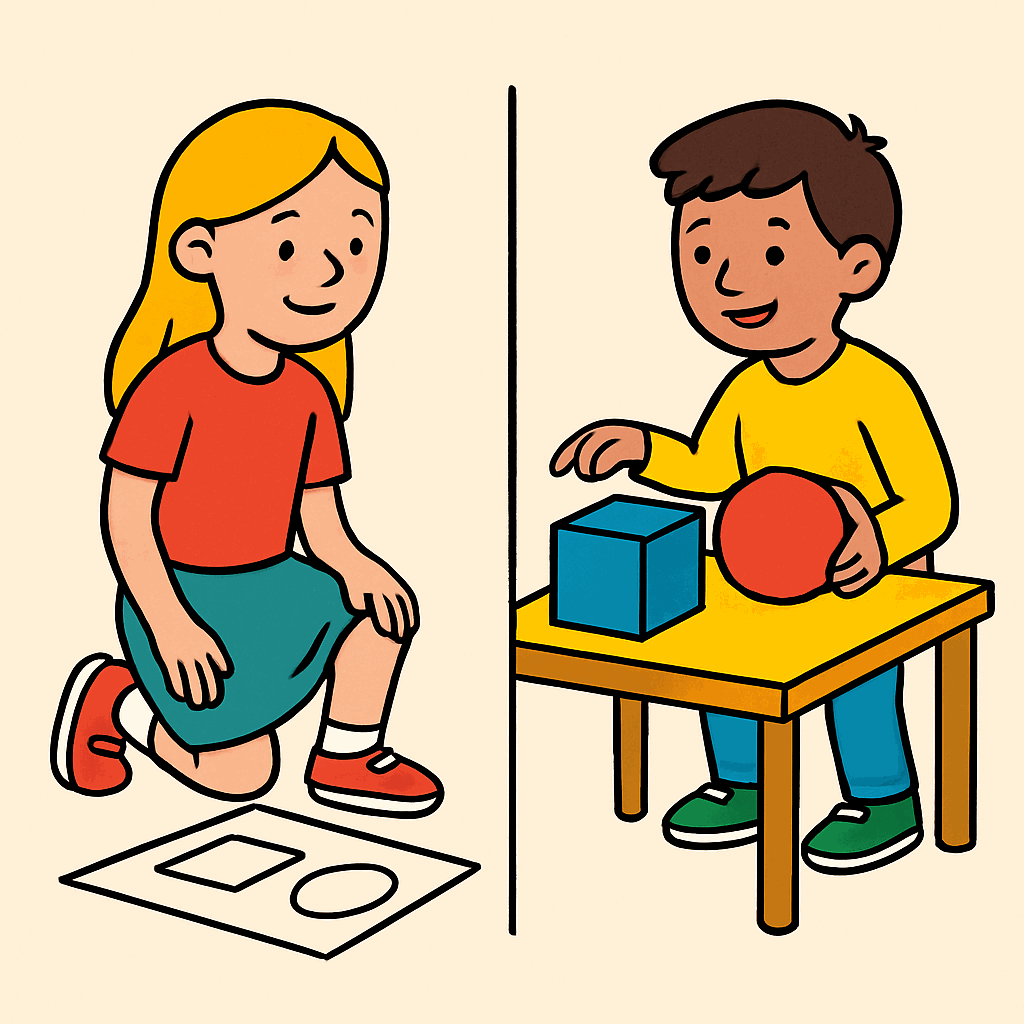
Imagine drawing with a pencil on paper. You can draw a square, a circle, or a triangle. These figures fit on paper because they have only two dimensions: length and width. We call them plane figures.
Now look at a die from a board game. It is "full" – it has length, width, and height. It does not fit on paper because it sticks out of it. You can hold a die in your hand and turn it. We call it a solid.
A flat figure has no height
A flat figure, also called a plane figure, is like a shadow – flat. How much room does it have? Only two dimensions:
- length (how long it is)
- width (how wide it is)
Examples:
- square
- rectangle
- triangle
- circle
A solid also has height
A solid is "full". Besides length and width it also has height or thickness. It does not fit on paper because it is not flat.
Examples:
- cube (like a die)
- cuboid (like a box)
- sphere (like a ball)
- cylinder (like a can)
This is a picture of a cube. Even though we draw it on paper, we picture a "full" die you could hold. You see it from a corner, so you can recognise three of its faces: the top (lightest), the left, and the right side (different shades).
Pairs that are easy to confuse
Some figures and solids have similar names – but one is flat and one is full:
- Square is flat. Cube is a solid with 6 square faces.
- Circle is flat. Sphere is a solid that looks like a circle but is "full" (a ball).
- Rectangle is flat. Cuboid is a solid with 6 rectangular faces (a box).
A trick: if you can draw the figure with a pencil as one flat thing – it is a plane figure. If you'd need to make a 3D model from paper or modelling clay – it is a solid.