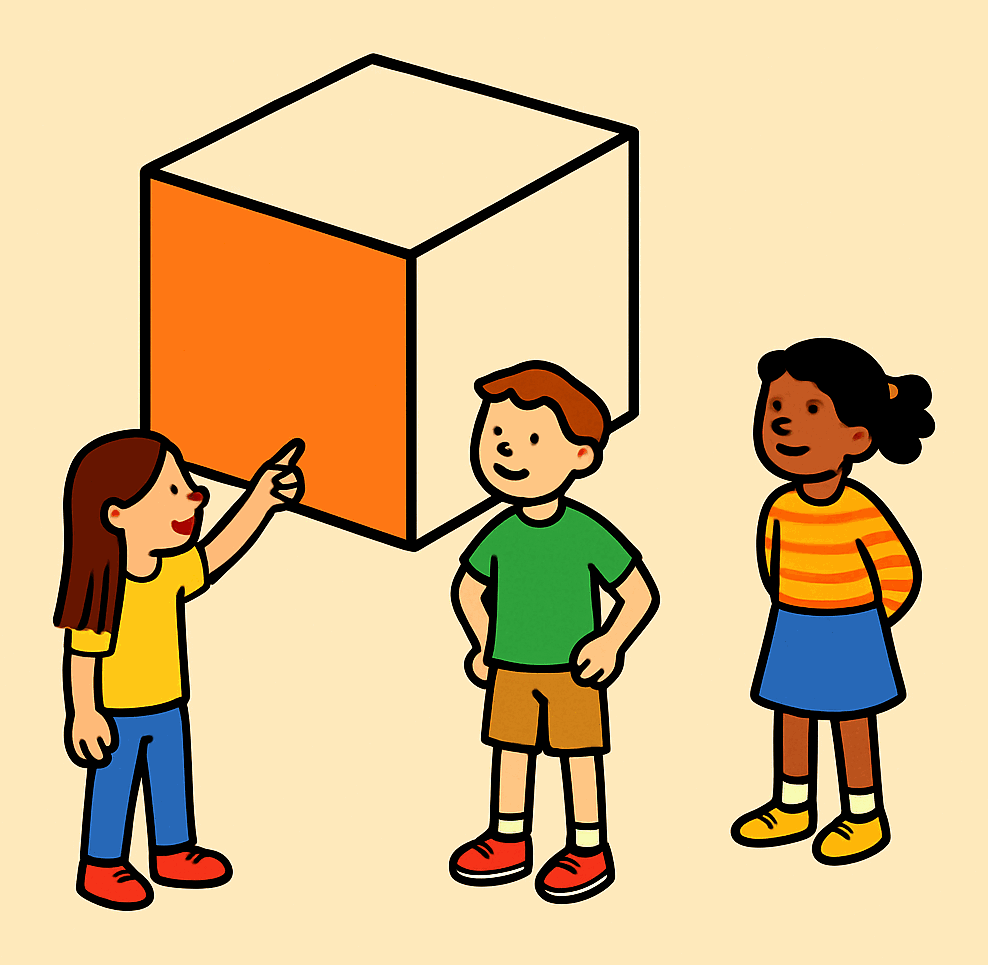
Solids with flat faces (cube, cuboid, pyramid, prism) have three important parts you can count: faces, edges, and vertices.
Face
A face is a flat surface that bounds the solid. Imagine a page in a book – it is flat. That's what a face of a solid looks like.
- A cube has 6 faces, all equal squares.
- A cuboid has 6 faces, but they are rectangles of different sizes.
- A pyramid has 5 faces – one base (a square) and four triangular faces.
- A triangular prism has 5 faces – two triangles and three rectangles.
Edge
An edge is a line where two faces meet. Imagine two pages of a book – where they're glued, that's an edge.
- A cube has 12 edges, all equal in length.
- A cuboid has 12 edges, but of different lengths (since the cuboid's sides are different lengths).
- A pyramid (square-based) has 8 edges – four at the bottom and four going up to the apex.
- A triangular prism has 9 edges.
Vertex
A vertex is a pointy corner where at least three edges meet. Imagine the corner of a cube where it stands on a table.
- A cube has 8 vertices – four on the bottom, four on top.
- A cuboid has 8 vertices, just like a cube.
- A pyramid has 5 vertices – four at the bottom and one on top (the apex).
- A triangular prism has 6 vertices – three in front, three in back.
Reference table
| Solid | Faces | Edges | Vertices |
| Cube | 6 | 12 | 8 |
| Cuboid | 6 | 12 | 8 |
| Pyramid (square base) | 5 | 8 | 5 |
| Prism (triangular) | 5 | 9 | 6 |
Notice that a cube and a cuboid have the same number of faces, edges, and vertices – they are very similar. They differ only in that a cube has all faces as equal squares, while a cuboid has rectangles.
What about the sphere, cylinder, and cone?
For the sphere, cylinder, and cone we do not count faces, edges, and vertices the same way as for a cube. These solids have curved surfaces, and in grade 3 we usually only name them and find them in the real world.
A trick to remember
For a cube, remember 6, 12, 8 – faces, edges, vertices. There is also a curious equality: 6 + 8 − 12 = 2. It works for the pyramid too: 5 + 5 − 8 = 2. And for the prism: 5 + 6 − 9 = 2. For all solids with flat faces this holds (it's called Euler's formula, but that's another story).