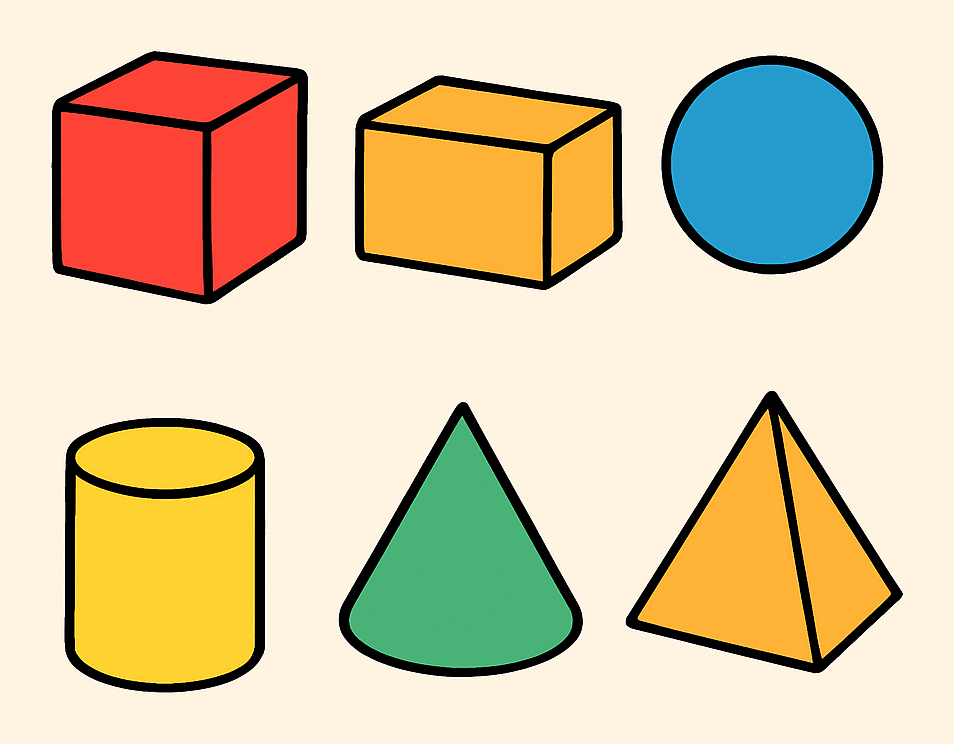
Seven solids you'll meet most often and that we'll learn to recognise: cube, cuboid, sphere, cylinder, cone, pyramid, and prism. Look at them one by one and notice how they differ.
Cube
A cube is a solid with six equal square faces. All sides of a cube have the same length.
Where to find it: a die, a sugar cube, a Lego brick.
Cuboid
A cuboid is similar to a cube, but its faces are rectangles, not squares. Some sides are longer, others shorter. Like a brick or a box.
Where to find it: a shoebox, a book, an aquarium, a brick, a freezer.
Sphere
A sphere is completely round on every side. It has no flat faces, edges, or vertices – it is smooth.
Where to find it: a football, an orange, a globe, a marble, a Christmas bauble.
Cylinder
A cylinder has two equal circles (one on top, one on the bottom) and a curved "wave" – the side surface – around them. It looks like a can.
Where to find it: a soda can, a pencil, a candle, a rolling pin, a wooden log.
Cone
A cone has a circle at the bottom and is pointy on top. It looks like an ice-cream cone.
Where to find it: an ice-cream cone, a witch's hat, a traffic cone, a pointy roof.
Pyramid
A pyramid has a square base and is pointy on top. Four triangular faces lead up to one vertex.
Where to find it: an Egyptian pyramid, a pyramid-shaped lamp, the top of a tower.
Prism
A triangular prism has two triangles (one in front, one in back) and three rectangular faces between them. It looks like a Toblerone or a tent.
Where to find it: a tent, a Toblerone bar, a roof of a house, a glass prism.