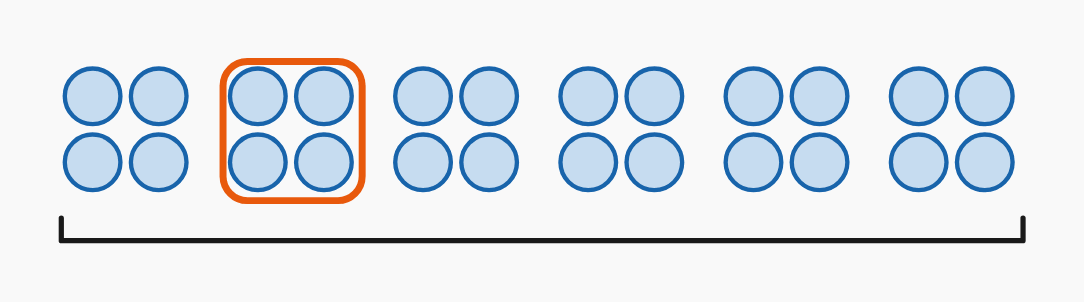
Long division is built on a simple idea: instead of dividing the whole big number at once, divide it one chunk at a time, going from left to right. Each chunk gives you one digit of the quotient and a small difference that you carry into the next chunk.
Place value, one step at a time
Take . The dividend has four digits with place values . We do not handle them all at once. Instead:
- Start with the leading digits that are large enough to contain . The first two digits, , are. So remainder (because ).
- Bring down the next digit (). Now we are looking at . And remainder .
- Bring down the next digit (). Now remainder .
- No more digits — the final remainder is . And the quotient, written digit by digit from left to right, is .
So . ✓
Why does it work?
A number as big as is too much to divide all at once — at least in your head. But you do know how to divide small numbers. So we split the work into smaller pieces:
- First we work with just the leading digits and divide them by the divisor.
- The leftover joins the next digit, and we divide again.
- And so on, until we have used every digit of the dividend.
Each small piece gives one digit of the quotient, and we stack them left-to-right into the final answer.
What the remainder is
The remainder is what is left after the very last division step. It is always less than the divisor — because at every step we pick the biggest possible quotient digit.
If the remainder ever turns out to be the same as or bigger than the divisor, the quotient digit could have been larger. Go back and re-check that step.
Two key sanity checks
Before declaring you are done, verify:
- Each quotient digit is correct. Ask yourself: what is the biggest digit from 1 to 9 such that, when I multiply it by the divisor, the answer still fits inside the chunk I am dividing?
- The final remainder is less than the divisor. If not, the last quotient digit was too small.