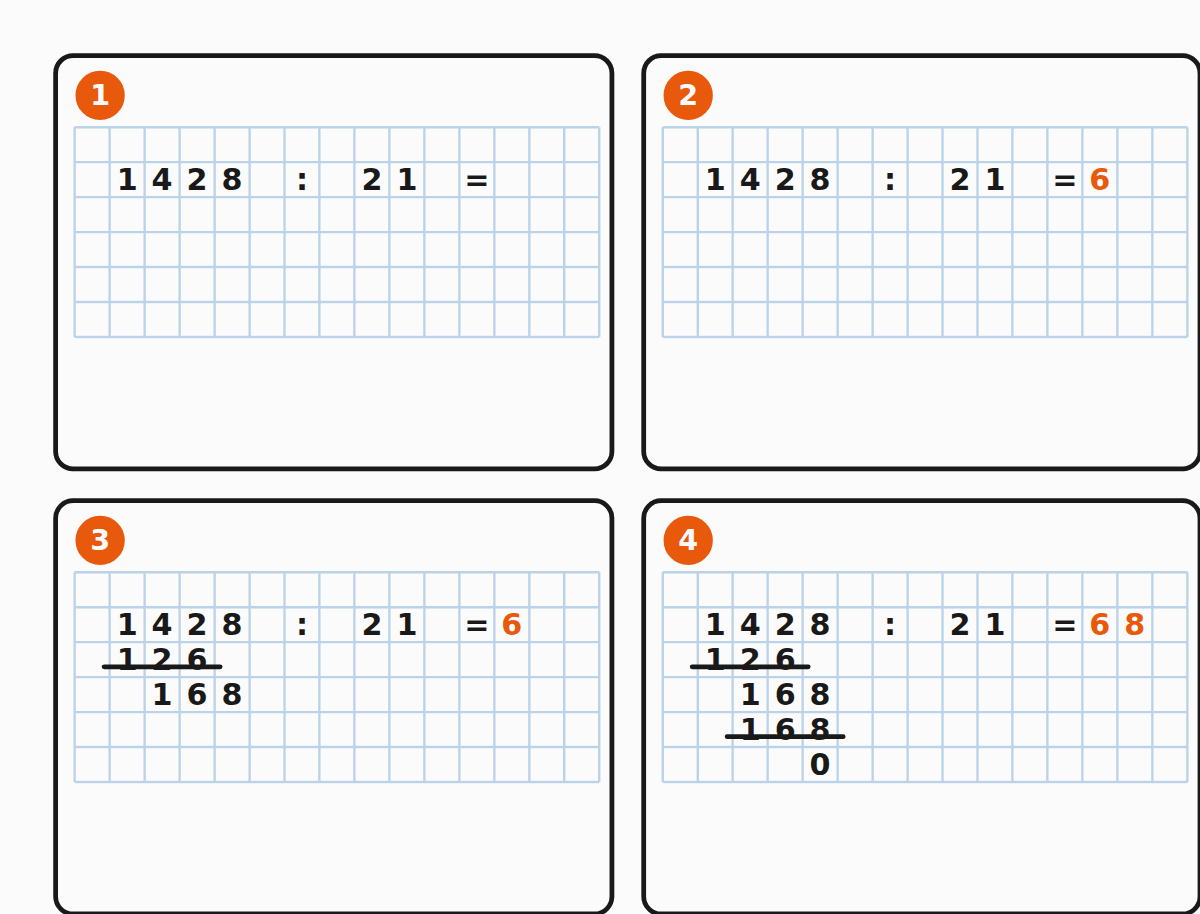
This is the recipe for dividing a 2-, 3- or 4-digit dividend by a two-digit divisor. The steps are the same; only the number of repetitions changes.
Set up the layout
Write the dividend on the left, then a colon, then the divisor, then `=`. After the equals sign you will write the quotient digits one by one. To the right, leave space for "remainder X". Below the dividend, draw a workspace for the partial products and differences.
For :
Step 1 – first chunk
Pick the smallest left-hand chunk of the dividend that is at least as large as the divisor. For and divisor :
- Just ? No — too small.
- ? Still too small ().
- ? Yes — .
So the first chunk is .
Step 2 – estimate the quotient digit
We are looking for the largest digit from 1 to 9 that we can multiply by the divisor such that the result still fits inside . We try:
- — that fits inside .
- — that is bigger than , so too much.
So the right digit is . Write it as the first digit of the quotient.
Step 3 – multiply and write below
Multiply the divisor by the quotient digit (). Write the product directly under the chunk ().
Step 4 – subtract
Draw a small bar and subtract: . Write the difference below the bar.
Step 5 – bring down the next digit
Bring down the next digit of the dividend (here ) and append it to the right of the difference. The new chunk is .
Now repeat steps 2–4 with the new chunk :
- We look for a digit that, multiplied by , gives a number close to but not bigger. — fits nicely; is too much. The digit is .
- Write as the next digit of the quotient: the quotient is now .
- Write below and subtract: .
Step 6 – stop and read the remainder
When there are no more digits in the dividend to bring down, the last difference is the remainder. Here it is . Check that it is smaller than the divisor — is indeed less than , so we are done.
Final answer: remainder .
How many digits will the quotient have?
A handy rule of thumb:
- 2-digit dividend ÷ 2-digit divisor → 1-digit quotient.
- 3-digit dividend ÷ 2-digit divisor → 2-digit quotient (when the leading 2 digits of the dividend are at least the divisor).
- 4-digit dividend ÷ 2-digit divisor → 3-digit quotient (when the leading 2 digits of the dividend are at least the divisor).
The exercise generator uses these patterns so the difficulty grows in clean steps.
Read more
- Division by a two-digit number – guide
- The principle of long division
- Worked examples and common mistakes