Worked examples and common mistakes
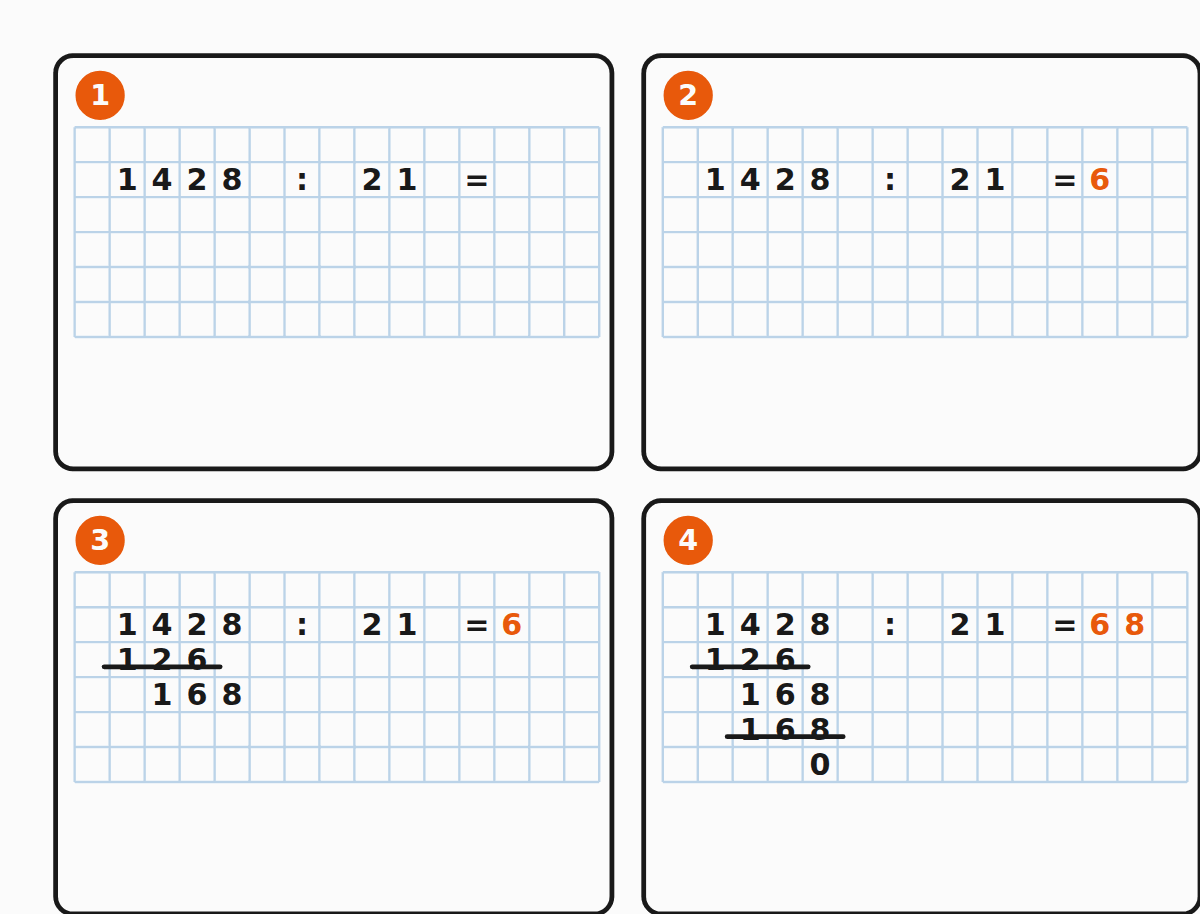
Here are three fully solved problems, one per difficulty level. Each one follows the recipe from Step-by-step procedure.
Example 1 – 2-digit dividend (easy)
95:14=?
The whole number 95 is our first chunk, because it is bigger than the divisor 14. We are looking for how many times 14 fits into 95. Try 6×14=84 — that fits, it is less than 95. Try 7×14=98 — that is already too much. So we write 6 in the quotient. Subtract 95−84=11. There are no more digits in 95, so the remainder is 11.
95 : 14 = 6 r. 11
84
──
11
So 95:14=6 remainder 11. Check: 6×14+11=84+11=95. ✓
Example 2 – 3-digit dividend (medium)
567:23=?
- First chunk is 56. It is bigger than the divisor 23, so we can divide. How many times does 23 fit into 56? Try 2×23=46 — fits; 3×23=69 is too much. We write 2 in the quotient. Subtract 56−46=10.
- Append the next digit of the dividend, 7, to the difference 10. The new chunk is 107. How many times does 23 fit into 107? 4×23=92 — fits; 5×23=115 is too much. We write 4. Subtract 107−92=15.
- There are no more digits in the dividend, so the remainder is 15.
567 : 23 = 24 r. 15
46
──
107
92
───
15
So 567:23=24 remainder 15. Check: 24×23+15=552+15=567. ✓
Example 3 – 4-digit dividend (hard)
6789:23=?
- First chunk is 67. It is bigger than 23, so we divide. 2×23=46 — fits; 3×23=69 is too much. We write 2. Subtract 67−46=21.
- Append the next digit, 8, to the difference 21. The new chunk is 218. How many times does 23 fit into 218? 9×23=207 — that's the closest, still less than 218. We write 9. Subtract 218−207=11.
- Append the last digit, 9, to the difference 11. The new chunk is 119. 5×23=115 — fits; 6×23=138 is too much. We write 5. Subtract 119−115=4.
- There are no more digits in the dividend, so the remainder is 4.
6789 : 23 = 295 r. 4
46
──
218
207
───
119
115
───
4
So 6789:23=295 remainder 4. Check: 295×23+4=6785+4=6789. ✓
Common mistakes
Watch out for these — almost every wrong answer comes from one of them.
- Quotient digit too small. If the difference after subtraction is larger than the divisor, you picked a quotient digit that was too small. The correct digit is one larger. (E.g. you wrote 5×14=70 for 95:14 and got 25 as the difference — but 25>14, so the correct digit is 6.)
- Quotient digit too large. If after multiplying you get a number bigger than the chunk you are dividing, the digit was too big. Try one smaller.
- Forgetting to bring down a digit. Each step (after the first) uses exactly one new digit from the dividend. Skipping one will make the quotient too short.
- Arithmetic slips during multiplication or subtraction. Double-check: the number you write below the chunk should equal the divisor times your quotient digit, and the difference after subtraction should be smaller than the divisor.
- Final remainder is the same as or bigger than the divisor. If you finish and the remainder is at least the divisor, you missed a quotient digit — it could have been larger. Re-check the last step.
Self-check
A quick way to verify your answer:
quotient×divisor+remainder=dividend
If this equation holds, your division is correct.
Read more
Practise