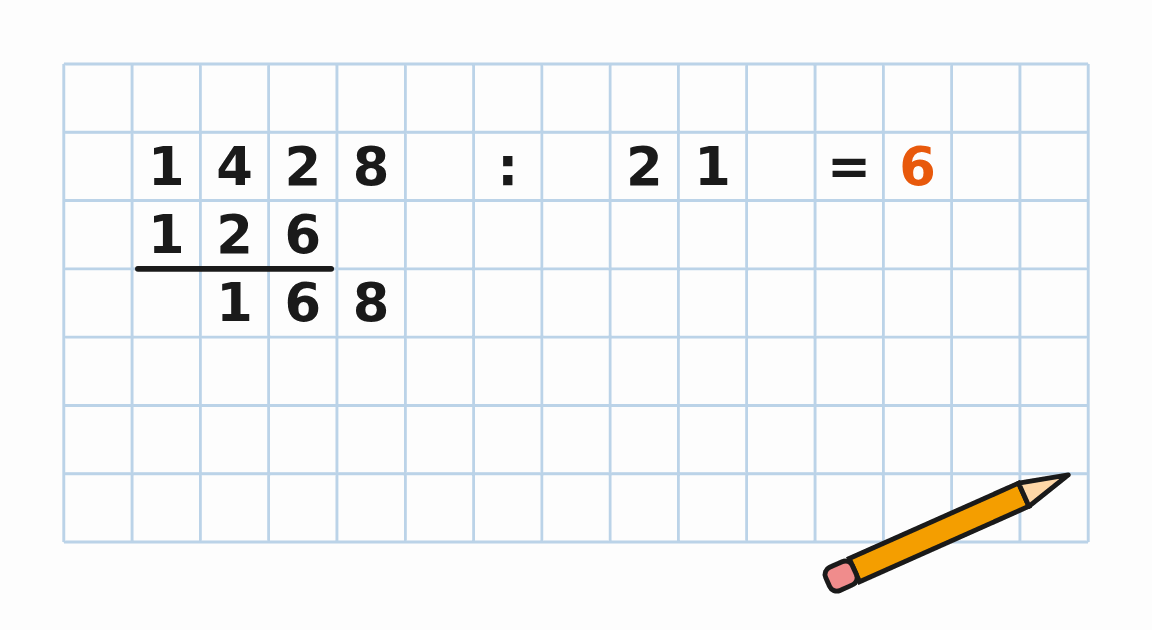
Long division is the way to divide larger numbers without a calculator. By fifth grade you know how to divide by a one-digit number; the next step is to divide by a two-digit divisor like 23, 56 or 99. The recipe is exactly the same — you just have to estimate each digit of the quotient a little more carefully.
What you will learn
In this topic you will work through:
- The principle of long division – why we divide one chunk at a time and where the remainder comes from.
- Step-by-step procedure – the exact moves for each digit of the quotient.
- Worked examples and common mistakes – fully solved problems and the slip-ups to watch for.
A first look
Take . We pull off the smallest left-hand chunk of that is at least — that is . Then (because and which is too big). Subtract: . Bring down the next digit, : now we have . And again, with left over. So remainder .
Why is this useful?
Long division shows up wherever you want to share something equally or to find how many times one number fits into another. It is also a foundation for working with fractions, decimals, and percentages later on.
Difficulty levels
The interactive exercise generates problems at three levels — they all use a two-digit divisor:
- easy — 2-digit dividend, 1-digit quotient (one division step).
- medium — 3-digit dividend, 2-digit quotient (two division steps).
- hard — 4-digit dividend, 3-digit quotient (three division steps).
Practise
When you are ready, open the interactive exercise:
- Long division by a two-digit number – generates a two-digit divisor and a 2- to 4-digit dividend, with empty fields for every multiple of the divisor and for the final remainder.