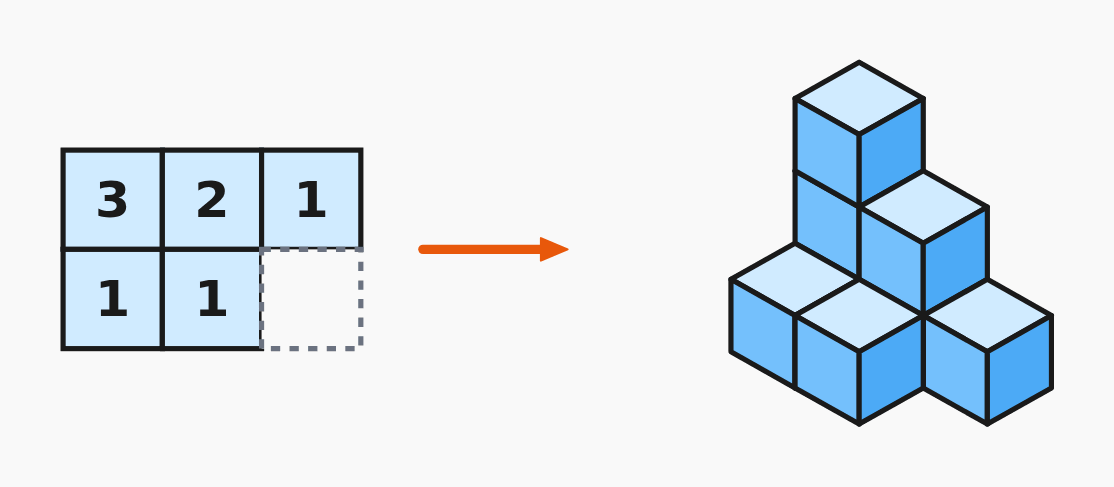
A plan is a clever way to describe exactly what a building looks like – without having to draw it in 3D. A plan is a top-down grid where every cell contains a number. The number tells you how many cubes are stacked at that spot.
How a plan works
Imagine looking at the building from above. You see the footprint – which cells are taken. A plan adds one more piece of information: the height.
- Number 1 = 1 cube here (no cube above it)
- Number 2 = 2 cubes stacked
- Number 3 = 3 cubes stacked
- Empty cell (or 0) = no cube here
How to find the number of cubes
The recipe is simple:
Add up all the numbers in the plan. The sum is the number of cubes in the building.
Example plan:
2 1 .
1 3 1
Sum: 2 + 1 + 0 + 1 + 3 + 1 = 8 cubes.
The building has eight cubes in total.
How to find the height
The tallest column of the building = the largest number in the plan.
In our example, the largest number is 3, so the tallest column has 3 cubes. (It's the middle-bottom cell.)
How a plan relates to views
The plan is essentially the top view enriched with height. If you erase the numbers and just keep "filled vs empty" cells, you get the plain top view.
From a plan you can also build the front and side views:
- Front view: for each column in the front row, find the largest number in that plan column (across all rows). That's the height of the front-view column.
- Side view: the same but reading rows of the plan instead.
Worked example
Plan:
2 1 1
0 2 1
Questions:
- How many cubes does the building have?
- What is its tallest column?
- How many footprint cells does it occupy?
Answers:
- Sum: 2 + 1 + 1 + 0 + 2 + 1 = 7 cubes.
- The largest number is 2, so the building is 2 cubes tall.
- Count the non-zero cells: 5 cells. The building covers 5 footprint cells.
Common mistakes
- Counting cells instead of summing the numbers. A plan tells you not only where cubes stand but how many are stacked. To get the total number of cubes you must add the numbers, not just count filled cells.
- Forgetting the empty cells. An empty cell contributes zero – it lowers the total count but doesn't change the width or depth of the footprint.
- Confusing height with total. The largest number is the height, not the count!
Practice
Related articles: