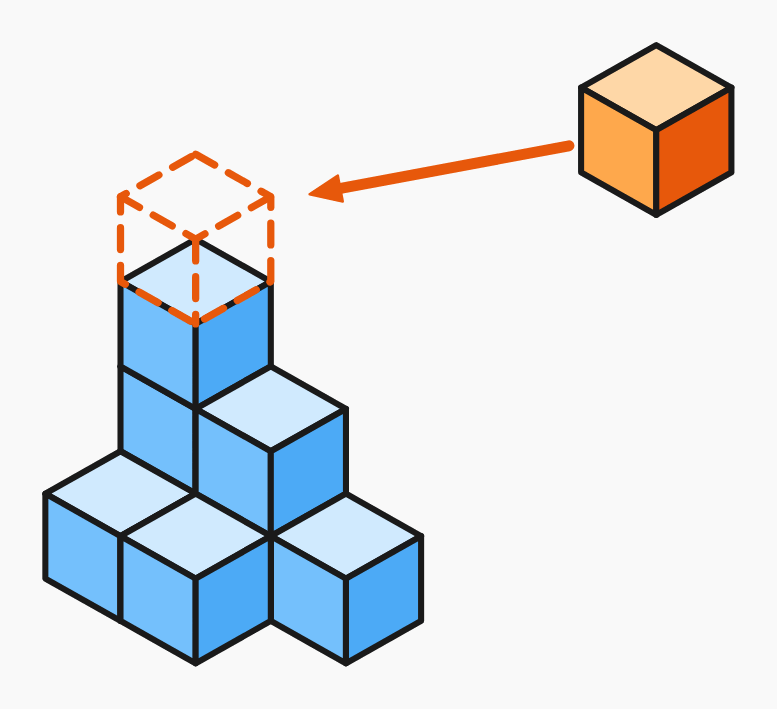
Imagine a small structure built from identical cubes – like a model made of dice or LEGO. Looked at from different sides, it seems different. From above you see the footprint; from the front you see the front wall; from the side you see only a narrow profile. To describe such a building precisely we use two tools in math: views and plans.
In this chapter you will learn how to:
- count the cubes you can see in a building
- count all the cubes, including the ones hidden behind others
- draw the top, front, and side views of a building
- read a building plan and figure out how many cubes the building has
What is a cube building
A cube building is an object built from equally sized cubes. Cubes stand on top of one another or next to each other. There is one important rule: every cube must have a solid base under it. That means it either rests on the floor (the bottom layer), or another cube sits below it.
This is a single unit cube. Every cube in our buildings will look like this – with a top (lighter face), a left and a right side (different shades of the same colour).
Four kinds of questions
There are four typical questions about cube buildings. Each is covered in its own exercise.
1. How many cubes do I see
The simplest task – you look at the picture and count the cubes that are visible. Work through the layers: top, middle, bottom.
2. How many cubes does the building have in total
A bit harder. Sometimes there is a cube hidden behind its neighbours. You can't see it, but you know it must be there – otherwise the cube above would have nothing to stand on.
3. Views of the building
When you look at the building from one direction, you see only its outline – a flat "photo" of the building. We talk about the top view, front view, and side view.
4. Building plan
The plan is a top-down grid where each cell holds a number telling you how many cubes are stacked in that spot. The plan lets you describe even complicated buildings precisely.
Why this matters
Working with cube buildings trains your spatial reasoning. You will need it when:
- drawing in geometry
- reading building blueprints
- studying surface area and volume in grade 5 and beyond
- in everyday life, picturing how furniture fits into a room
What you will learn in this chapter
After going through the exercises you should be able to:
- count cubes in a simple building (up to 12 cubes)
- recognise hidden cubes and include them in the total
- determine the top, front, and side views from a building
- read a plan and count cubes from it
- describe a building with a plan or with views