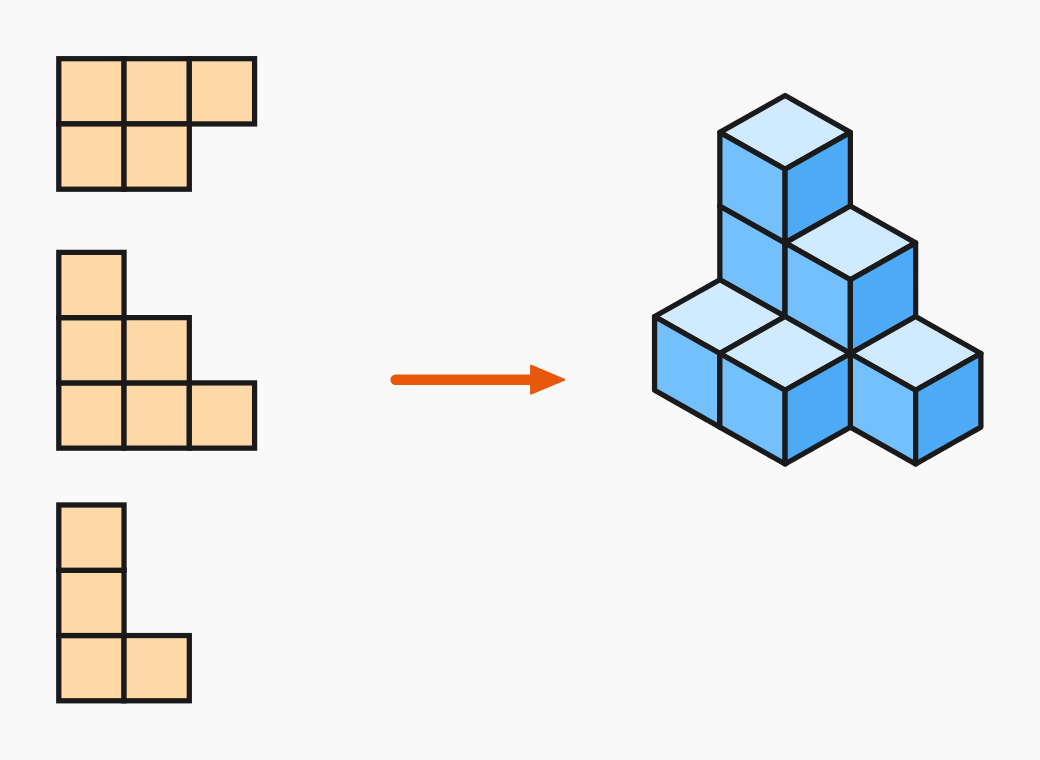
In the previous article we made views from a 3D building. Now we go the other way: given the views (top, front, side), we reconstruct the building.
This is the most challenging step for spatial reasoning – your brain has to glue three flat pictures into one 3D object.
A three-step method
Step 1: top view gives the footprint
The top view tells you which footprint cells are occupied. Now you know how many ground cells the building uses.
Example: a 2 × 2 full top view = the building has 4 columns, one in each corner of the 2 × 2 footprint.
Step 2: front view gives the height of front columns
The front view shows what you'd see if you stood in front of the building. You see the height of each column in the front row. Note: the front view doesn't separate front and back columns at the same screen position. It shows the maximum height of the building in each column.
That means: if the front view shows height 3 in some column, then somewhere in that column line (front or behind it) there's a column 3 cubes tall.
Step 3: side view gives the height of side columns
The side view does the same, but for the other direction. Combined with the front view you can find the height of every column.
Combining views
With all three views you proceed like this:
- From the top view find which footprint cells are occupied (where the columns stand).
- From the front view find the height limit for each column from front to back.
- From the side view find the height limit for each column from side to side.
- For each occupied column, the height equals the smaller of the two limits (front and side).
Worked example
Views:
- Top view: a full 2 × 2 square (4 occupied cells)
- Front view: left column height 1, right column height 2
- Side view: front column height 2, back column height 1
Solution:
- Footprint 2 × 2 = the building has 4 columns: front-left, front-right, back-left, back-right.
- Front view says: left column is at most height 1, right column at most height 2.
- Side view says: front column is at most height 2, back column at most height 1.
Combine:
- Front-left: front allows 1, side allows 2 → height 1
- Back-left: front allows 1, side allows 1 → height 1
- Front-right: front allows 2, side allows 2 → height 2
- Back-right: front allows 2, side allows 1 → height 1
The plan is:
1 1
1 2
Total: 1 + 1 + 1 + 2 = 5 cubes.
When is the answer unique?
Sometimes three views describe more than one possible building. In that case the problem doesn't have a single answer – usually we look for the simplest (smallest) building that fits all three views.
In grade-4 problems the views are usually chosen so the building is unique. But it's worth knowing that in trickier cases the answer may not be unique.
Trick: start with the top view
Always start with the top view – it gives you the occupied cells. The other two views just fill in the heights.
Without the top view you don't know whether a column at a given spot exists at all, or there's a gap there!
Practice
- Generator: Building views – here we go from the building to the view, but the logic is the same in reverse.
Related articles: