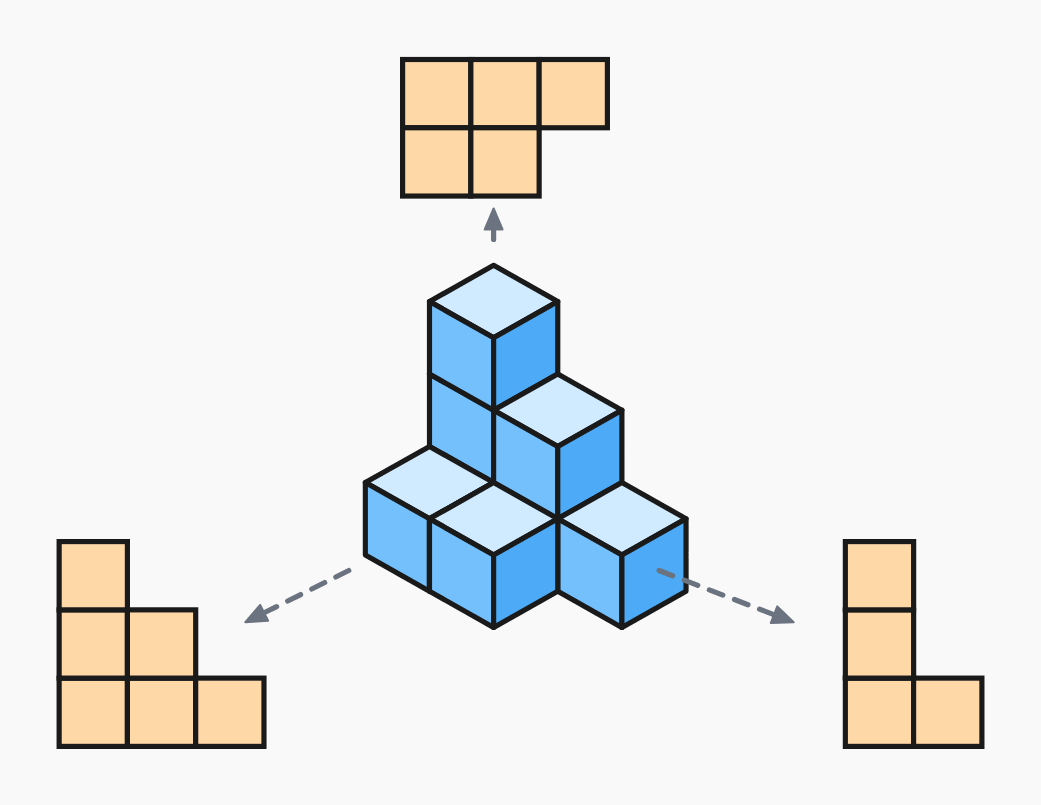
Imagine you stand in front of a building and take pictures from three different sides. Your camera doesn't see in 3D – the result is always a flat picture. We call that a view. In maths we use three basic views: top, front, and side.
Top view
The top view shows you where the building stands on the floor. You look at it from above and see only the footprint. The height of the columns doesn't matter – you're looking down.
For each grid cell:
- Filled cell = at least one cube stands there
- Empty cell = no cube there
In a building with a 2 × 2 base and one extra cube on top of the back-right column, the top view is a full 2 × 2 grid – the building has a square footprint, even though there's an extra cube up high. The top cube stands directly above one of the base cubes, so from above it overlaps with the base.
Front view
The front view is the outline of the building when you stand in front of it and look straight on. You see the height in each column.
For the front view:
- Width of the grid = width of the building (number of columns at the front)
- Height of the grid = the tallest column in the building
- Filled cell = at least one cube exists at that column-and-height
In our example the building has width 2 and maximum height 2. The front view shows the right column rising to height 2, while the left column reaches only height 1.
Side view
The side view works the same way as the front view, but from the side (e.g. from the right).
- Width of the grid = depth of the building (number of columns front-to-back)
- Height of the grid = tallest column
For the example building above, the side view happens to look the same as the front view – the building is symmetric. In general, front and side views differ.
How to find a view
A method that always works:
- Top view: for each column of the building (each footprint cell), check whether at least one cube is there. If yes, fill the cell.
- Front view: for each column in the front row, mark how high any cube reaches behind it. Fill the cell up to that height.
- Side view: same idea, but from the side.
In other words – front and side views show how tall the building reaches in each column. The top view shows where the building stands.
When two views look the same
If a building has special symmetry, the front and side views can match. In a tower (one column of stacked cubes), the front and side views are both a thin vertical strip – they look identical.
But the top view of a tower is different: it's a 1 × 1 filled cell, because the tower stands in a single spot.
Practice
Related articles: