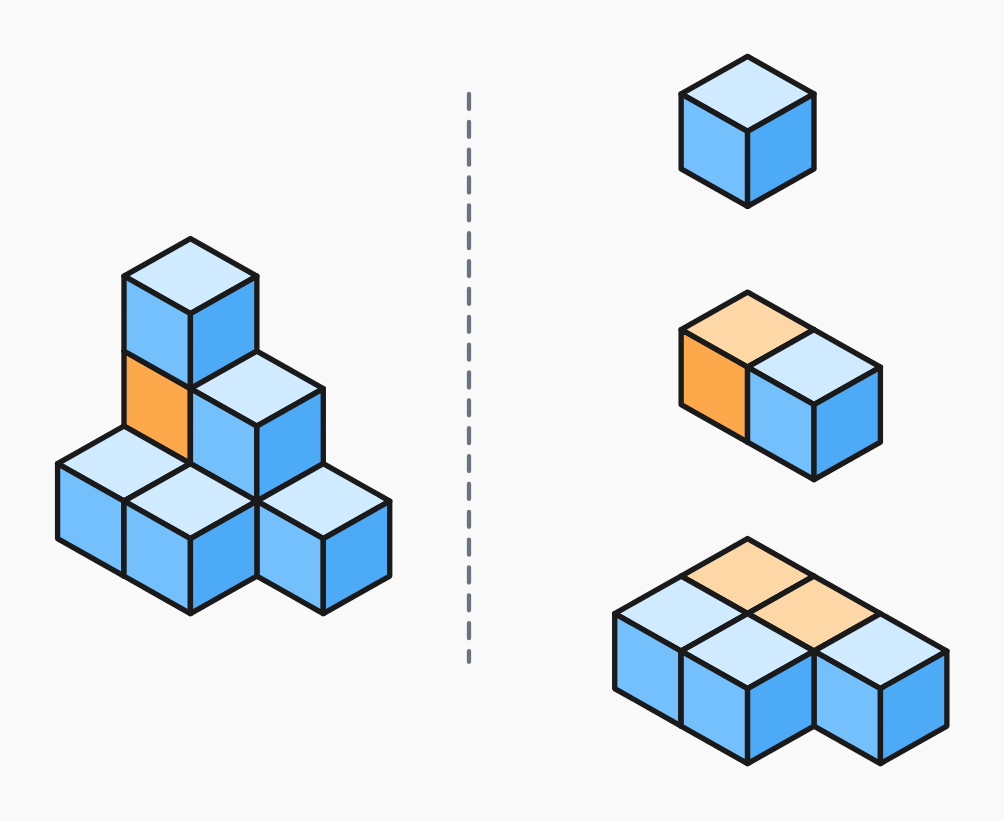
Counting cubes in a building is sometimes easy – when you can see all of them. But sometimes it is harder, because some cubes are hidden behind others and you have to remember they are there.
Work layer by layer
The best trick: count the cubes layer by layer. A building has layers like floors – the lowest one is on the ground, the next sits on top of it, and so on.
Start at the bottom (the lowest layer) and work upward. In each layer figure out how many cubes are there. Then add everything up.
This building has two layers:
- Bottom layer: 4 cubes (a 2 × 2 square base on the ground)
- Top layer: 1 cube (sits on the back-right cube of the bottom layer)
Total: 4 + 1 = 5 cubes.
Visible cubes vs hidden cubes
Sometimes the question only asks you to count what you can see. Other times you have to add cubes you cannot see — they must be there to support the cubes above them.
Example with all cubes visible
Look at the building above. The top cube sits on the back-right cube of the base, so you can see all 5 cubes (each one shows at least one face). In that case both questions ("how many do you see" and "how many in total") give the same answer: 5.
Example with a hidden cube
Now imagine a denser building: 2 × 2 × 2 cubes (8 cubes forming a small bigger cube). From the three visible sides you see 7 cubes – one is fully tucked away in the back corner, hidden by its neighbours.
- "How many do you see?" → 7
- "How many in total?" → 8
How to spot a hidden cube
A hidden cube has a cube above it, a cube to its right, and a cube behind it – all three of its potentially-visible faces are blocked. Even though you can't see it, it must be there because:
- the cube above it would have nothing to rest on
- or there's no other way the building could be drawn
In dense square or rectangular buildings, hidden cubes are common.
Common mistakes
- Forgetting the top cube. The top layer with just one cube is easy to miss.
- Double counting. A cube whose top, side, and back are all visible can accidentally be counted three times. Count cubes, not faces!
- Forgetting hidden cubes. In dense buildings it's easy to forget that the inside must also have cubes.
Worked example
A building has a full 2 × 3 base (6 cubes) and a top layer that fills only the right column: 1 × 3 (3 cubes). How many cubes in total?
Answer: 6 + 3 = 9 cubes. None are hidden, because the top layer doesn't fully cover the base.
Practice
Related articles: