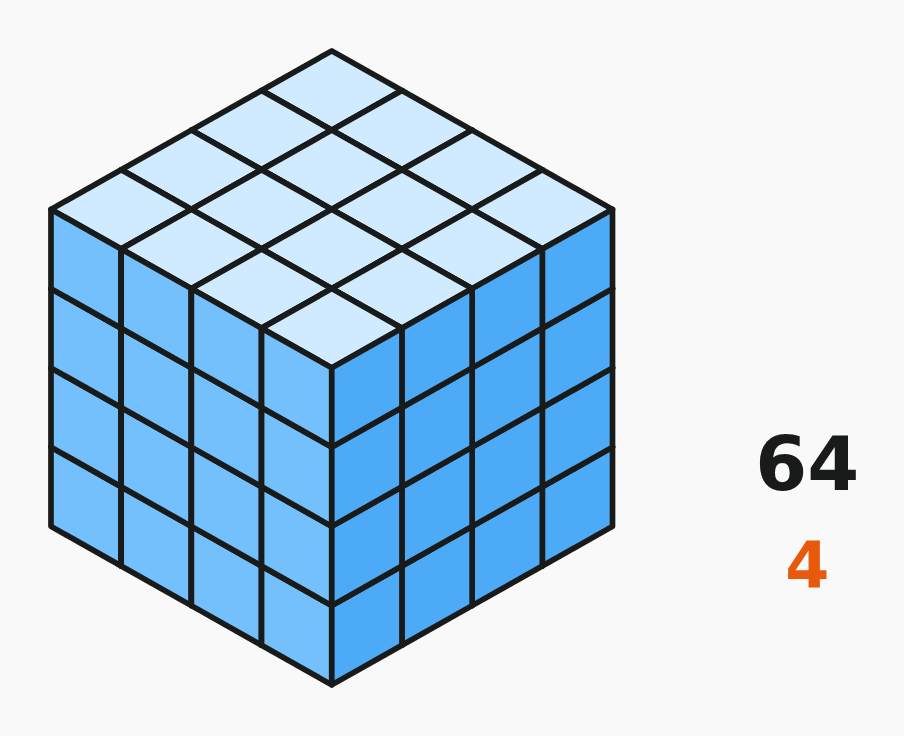
Cubing a number means using it as a factor three times: 4³ = 4·4·4 = 64. A number you get this way — like 1, 8, 27, 64, 125 — is called a perfect cube.
The cube root undoes cubing
The cube root, written ∛, asks "which number, used three times, gives this?" So ∛64 = 4, because 4·4·4 = 64. Cubing and taking the cube root undo each other, just like squaring and the square root.
Reading off a cube root
It helps to know the first cubes: 2³ = 8, 3³ = 27, 4³ = 64, 5³ = 125, 6³ = 216. Then ∛125 = 5 and ∛216 = 6 come straight away.
Unlike square roots, cube roots of negative numbers make sense: ∛(−27) = −3, because (−3)·(−3)·(−3) = −27.
Three rules that always help
- A perfect cube is a number used as a factor three times.
- The cube root undoes cubing, so ∛(n³) = n.
- Cube roots of negative numbers are negative.
Keep going
- Practice: Cube root of a perfect cube
- Back to the square roots overview